On this page
A common board-exam and JEE Main question shines two wavelengths on the same metal, gives the stopping potential for each, and asks for Planck's constant and the work function. It is really two simultaneous equations in two unknowns, the same algebra you use in school maths.
What equation do you start from?
Einstein's photoelectric equation says the fastest photoelectron leaves with kinetic energy K_max = hf − φ (OpenStax University Physics, Volume 3). The work function φ is the energy needed to detach a photoelectron from the surface, as the same OpenStax chapter defines it. That chapter also gives K_max = eVₛ, where Vₛ is the stopping potential that just halts those fastest electrons.
Put the two together and use f = c/λ:
eVₛ = hc/λ − φ
Our post on deriving Einstein's photoelectric equation and its graph shows where this comes from.
How do you find h and φ from two wavelengths?
Write the equation once for each wavelength. It is the same metal, so φ is the same in both.
eV₁ = hc/λ₁ − φ
eV₂ = hc/λ₂ − φ
Subtract (2) from (1). φ cancels: e(V₁ − V₂) = hc(1/λ₁ − 1/λ₂)
Solve for h: h = e(V₁ − V₂) / [c(1/λ₁ − 1/λ₂)]
Put h back into (1): φ = hc/λ₁ − eV₁
If asked, threshold frequency f₀ = φ/h and threshold wavelength λ₀ = hc/φ
The shorter wavelength always has the larger stopping potential. If your numbers say otherwise, you have paired them the wrong way round.
Worked example: sodium lit at 300 nm and 400 nm
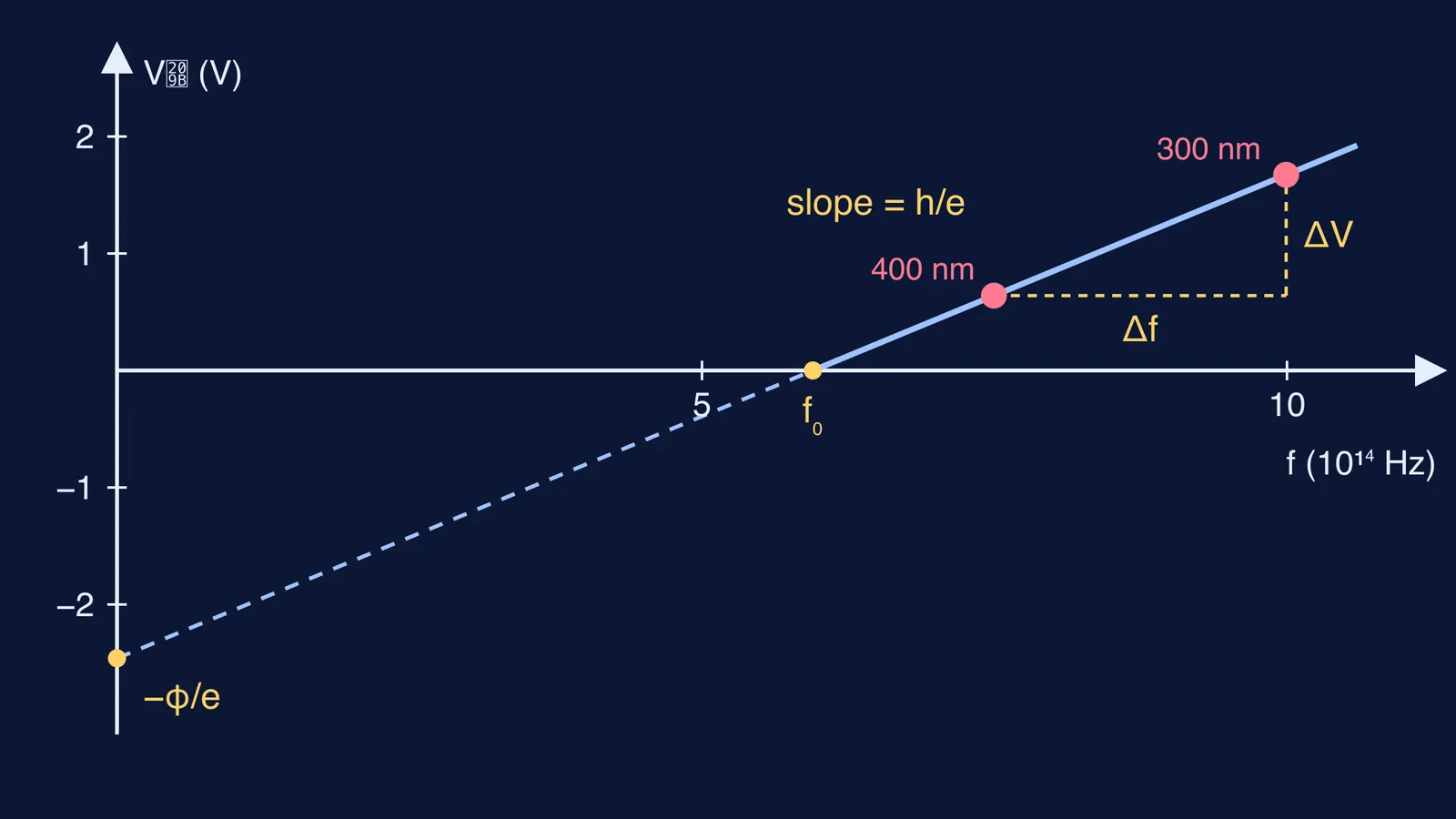
We built this question from real values. OpenStax lists the work function of sodium as 2.46 eV (OpenStax, Table 6.1). Using that and the exact constants from NIST for h, e and c, light of 300 nm gives a stopping potential of about 1.67 V and light of 400 nm about 0.64 V.
Now pretend you were given only those two voltages, and work backwards with the rounded values most papers supply: c = 3 × 10⁸ m/s and e = 1.6 × 10⁻¹⁹ C.
Step 1: frequencies. f₁ = (3 × 10⁸) / (300 × 10⁻⁹) = 1.0 × 10¹⁵ Hz. f₂ = (3 × 10⁸) / (400 × 10⁻⁹) = 7.5 × 10¹⁴ Hz.
Step 2: differences. f₁ − f₂ = 2.5 × 10¹⁴ Hz and V₁ − V₂ = 1.03 V.
Step 3: Planck's constant. h = (1.6 × 10⁻¹⁹ × 1.03) / (2.5 × 10¹⁴) = 6.59 × 10⁻³⁴ J s.
Step 4: work function. hf₁ = 6.59 × 10⁻¹⁹ J, which is 4.12 eV. So φ = 4.12 − 1.67 = 2.45 eV.
Step 5: threshold. λ₀ = hc/φ = (6.59 × 10⁻³⁴ × 3 × 10⁸) / (2.45 × 1.6 × 10⁻¹⁹) ≈ 504 nm. Any wavelength longer than that emits no electrons from this surface.
Now check. NIST gives Planck's constant as exactly 6.626 070 15 × 10⁻³⁴ J s (NIST CODATA). Our 6.59 × 10⁻³⁴ J s is about 0.5% low, and that gap comes from rounding c, e and the voltages. The work function came back within 0.01 eV of the 2.46 eV we started from.
Where do students lose marks?
Mixing units. Keep φ in joules until the last line, or work entirely in electron-volts. From NIST's values of h, c and e, hc/e works out to about 1240 V nm, so a photon of λ nm carries roughly 1240/λ eV.
Dropping e. A stopping potential in volts becomes an energy in joules only after you multiply by 1.6 × 10⁻¹⁹.
Nanometres. 300 nm is 300 × 10⁻⁹ m, not 300 × 10⁻⁶ m.
Subtracting in the wrong order. A negative h means you paired the larger voltage with the longer wavelength.
A related trap: doubling the frequency does not double the kinetic energy, because φ is taken away first. Our post on whether doubling frequency doubles kinetic energy works through it.
Why is this the same as reading a graph?
Two points fix a straight line. Plot Vₛ against f and the line has slope h/e; it crosses the frequency axis at f₀ and, extended back, meets the voltage axis at −φ/e. Solving two equations is simply finding that slope and intercept by algebra. Our explainer on why the slope of the stopping potential vs frequency graph is h/e covers the graph version. The idea is old: Robert Millikan's 1916 paper was titled "A Direct Photoelectric Determination of Planck's h" (Physical Review, 1916).
If a variant trips you up, such as frequencies instead of wavelengths or kinetic energy given in eV, the Fermi Problem Library has worked problems with a step-by-step solver that explains the reasoning rather than printing an answer. If the idea of a work function itself feels shaky, the Fermi Concept Library gives each physics concept its own lesson and its place in the map.