

On this page
When you double the frequency of light striking a metal surface, you might guess that the ejected electrons would fly off with twice the energy. In reality, as OpenStax University Physics explains, their maximum kinetic energy more than doubles.
This non-linear jump is built directly into Albert Einstein’s 1905 photoelectric equation. It is a common trap in physics exams, but the maths behind it is straightforward once you account for the energy required to free the electron.
If you are stuck on why this happens, the proof lies in the energy intercept. Let us walk through how the work function shifts the math, and look at a step-by-step worked example to prove the point.
Why does kinetic energy more than double when frequency doubles?
The relationship between the frequency of incident light (f or ν) and the maximum kinetic energy (K_max) of the photoelectrons is governed by Einstein’s photoelectric equation: K_max = hν − Φ.
Here, hν is the energy of the incoming photon (where h is Planck's constant and ν is the frequency), and Φ is the work function of the metal. The work function is the minimum amount of energy required to detach an electron from the surface of a specific metal.
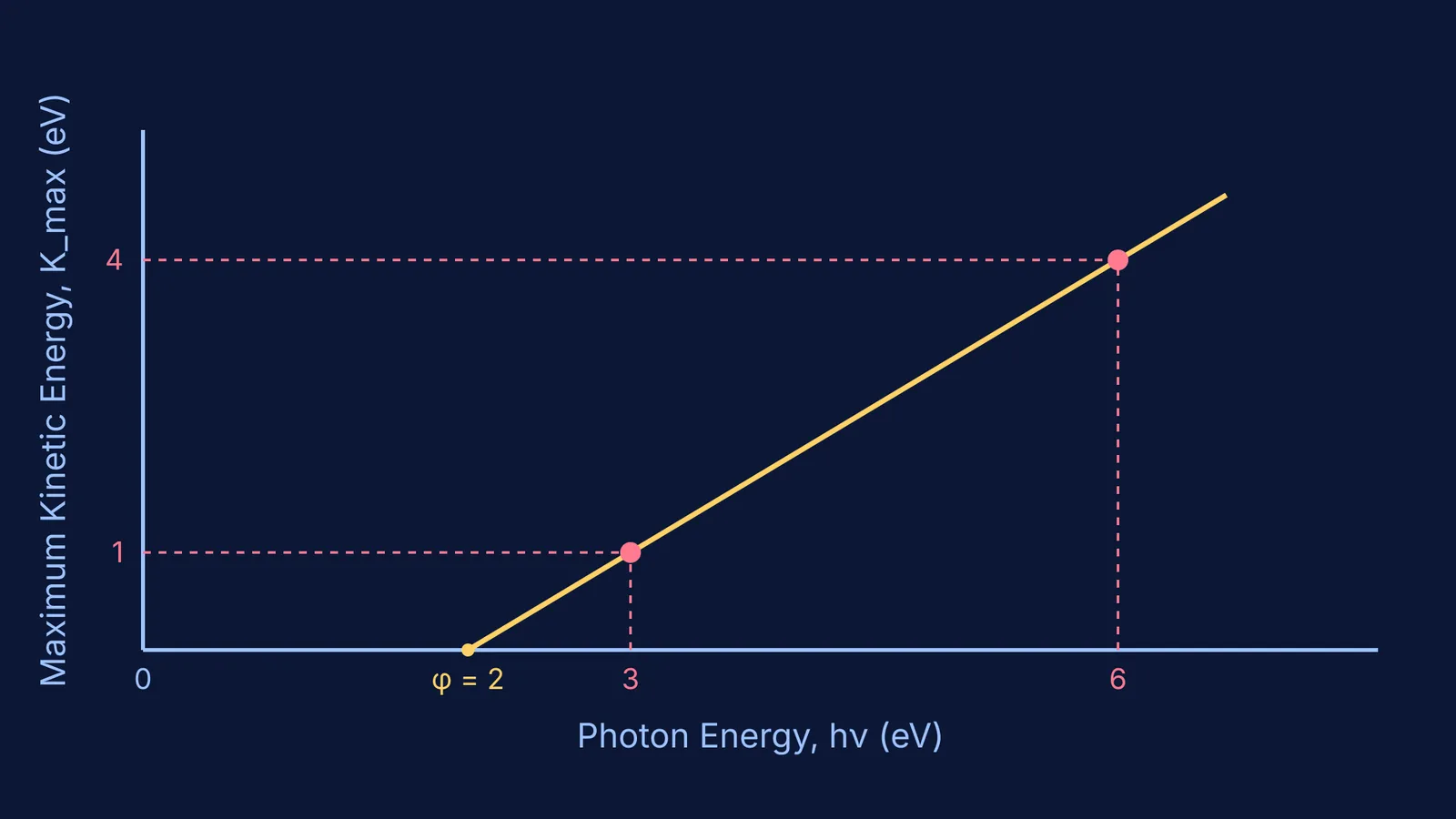
Because the work function Φ is always subtracted from the photon's energy, the maximum kinetic energy K_max is a linear function of frequency, but it is not directly proportional to it. In a direct proportion, doubling one variable doubles the other. Here, the constant subtraction of the work function ruins the perfect ratio.
Imagine you send in light with a frequency ν1. The kinetic energy of the ejected electrons is K1 = hν1 − Φ.
Now, you double the frequency of the light to 2ν1. The new photon energy is exactly double, 2hν1. The new kinetic energy is K2 = 2hν1 − Φ.
To see how K2 relates to K1, we can rewrite the 2hν1 term. Since hν1 = K1 + Φ, we can substitute this into our second equation to get K2 = 2(K1 + Φ) − Φ, which simplifies to K2 = 2K1 + Φ.
Because the work function Φ is a positive constant (it always takes some energy to break an electron free), K2 is equal to twice the original kinetic energy *plus* the work function. Therefore, doubling the frequency will always result in a maximum kinetic energy that is strictly greater than double the original.
A worked example with a 2 eV work function
Let us look at real numbers to see just how dramatic this increase can be in a laboratory or exam setting.
Suppose you are experimenting on a metal surface that has a work function of Φ = 2 eV. This means every electron needs a 2 eV "push" just to escape the metal, before it can retain any kinetic energy for flight.
Initial state: You shine light with a photon energy of hν = 3 eV. K1 = 3 eV − 2 eV = 1 eV. After paying the 2 eV "exit toll," the photoelectrons leave the metal with a maximum kinetic energy of 1 eV.
Doubled frequency: You double the frequency of the light source. Because photon energy is directly proportional to frequency, the new photon energy is exactly double: hν = 6 eV. K2 = 6 eV − 2 eV = 4 eV. After paying the same 2 eV exit toll, the photoelectrons now leave with a maximum kinetic energy of 4 eV.
By merely doubling the light's frequency, the kinetic energy of the electrons has quadrupled (jumping from 1 eV to 4 eV). The higher the initial frequency goes, the closer the final energy ratio gets to exactly double, but it will always remain slightly above due to the work function penalty.
Does doubling x always double y in physics?
The assumption that "doubling x always doubles y" catches many students in physics exams. When a formula takes the form of a straight line equation (y = mx + c), scaling the independent variable will never scale the dependent variable by the exact same factor, unless the intercept (c) is zero.
If you frequently lose marks on these proportional reasoning questions because you skip past the constants, the Fermi Problem Library has worked problems with a step-by-step solver that explains the reasoning rather than printing an answer, helping you spot the intercepts that break direct proportions.
Here is a quick checklist for evaluating changes in variables:
Look for addition or subtraction: If a formula has a constant being added or subtracted (like the work function in the photoelectric effect, or friction in a mechanics problem), it is not a direct proportion. Simple multiplication will lead you to the wrong answer.
Write out the before and after states: Always define the initial state (K1) and the final state (K2) algebraically before plugging in any scaling factors.
Substitute and expand: Use substitution, as shown in the proof above, to clearly see how the constant term survives the scaling process.
Related reading:


