On this page
In 1927, Clinton Davisson and Lester Germer at Bell Labs fired slow electrons at a nickel crystal and found something particles should not do: the scattered electrons bunched up at particular angles, the way light does after passing through a grating. Their full report, Diffraction of Electrons by a Crystal of Nickel, appeared in Physical Review in December 1927, after a shorter letter in Nature in April 1927.
It is also a calculation you can do yourself. Below we do it twice: from de Broglie's formula, and from the measured angle.
What did Davisson and Germer actually do?
An electron gun accelerated electrons through a voltage V onto a nickel surface, and a movable detector counted electrons coming back at each angle. According to the Wikipedia summary of the experiment, an accidental air leak in 1925 oxidised the nickel, and heating the sample to clean it turned it into large single-crystal regions, a regular array of atoms to scatter from.
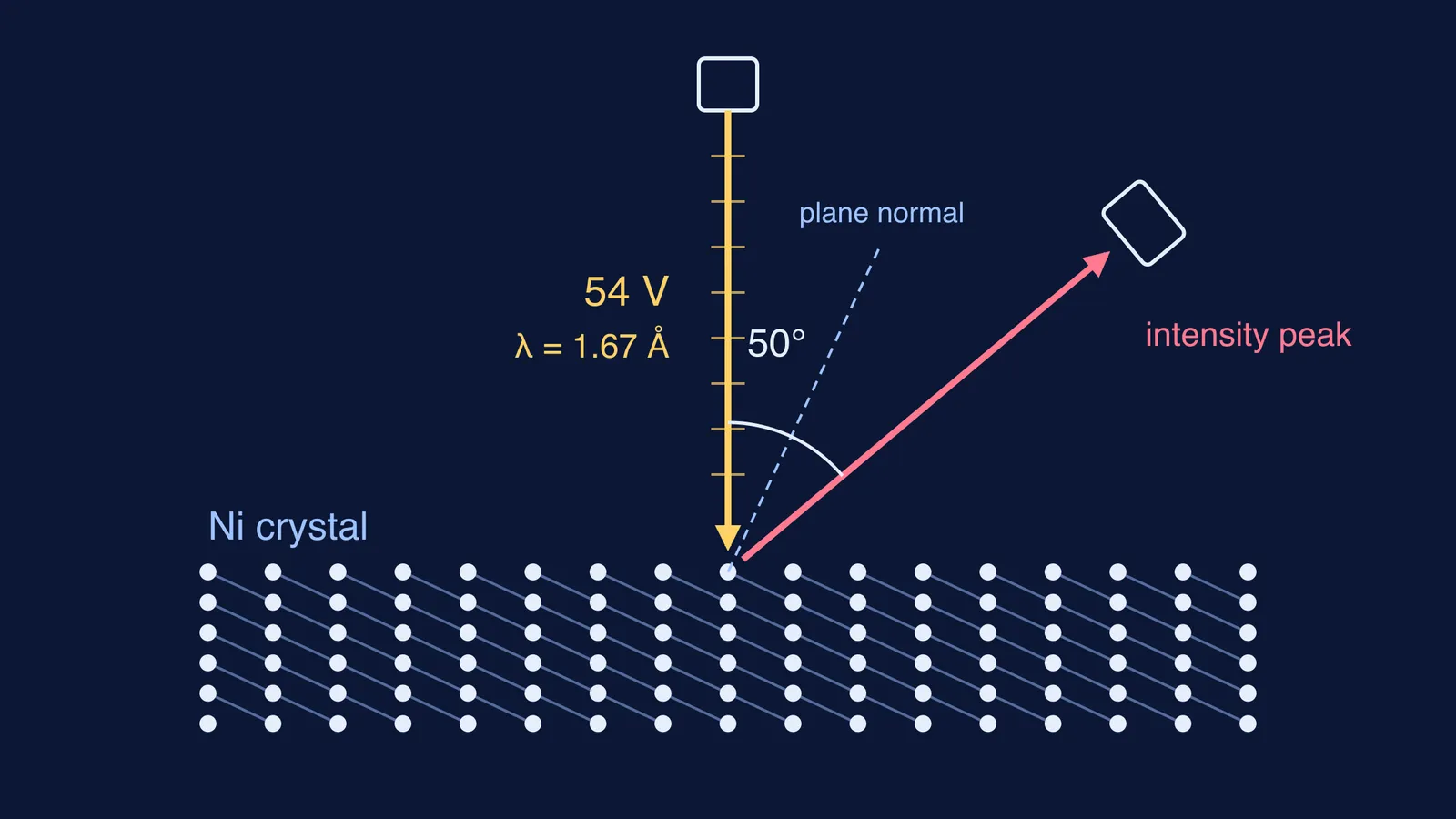
The strongest result: at 54 V, the scattered intensity peaked at 50° from the incoming beam (HyperPhysics, Georgia State University). For the people and the lab, read our profile of Clinton Davisson and the discovery of electron diffraction.
Why does a peak at 50° prove electrons are waves?
Tiny balls bouncing off atoms would spread out smoothly, with no favourite angle. A sharp peak means waves from different layers of atoms arrive in step and add up. That is interference, and in a crystal its rule is Bragg's law, nλ = 2d sinθ.
The atomic planes that matter here are tilted inside the crystal, and their spacing in nickel is d = 0.091 nm, known from earlier X-ray experiments (Wikipedia, citing Eisberg and Resnick). The diagram above shows the incoming beam, the 50° scattered beam, and the planes whose normal bisects the two.
How do you calculate the electron wavelength at 54 V?
Use the CODATA values from NIST: h = 6.626 × 10⁻³⁴ J s (NIST, Planck constant), m = 9.109 × 10⁻³¹ kg (NIST, electron mass) and e = 1.602 × 10⁻¹⁹ C (NIST, elementary charge).
Part A: what de Broglie predicts
Kinetic energy gained through 54 V: K = eV = 54 eV = 8.65 × 10⁻¹⁸ J.
Momentum: p = √(2mK) = √(2 × 9.109 × 10⁻³¹ × 8.65 × 10⁻¹⁸) = 3.97 × 10⁻²⁴ kg m/s.
Wavelength: λ = h/p = 6.626 × 10⁻³⁴ / 3.97 × 10⁻²⁴ = 1.67 × 10⁻¹⁰ m, or 1.67 Å.
Shortcut check: the constants combine to λ = 12.27/√V Å for electrons, and 12.27/√54 = 12.27/7.35 = 1.67 Å.
Part B: what the experiment measured
The 50° is the angle between the incoming and outgoing beams, not the Bragg angle.
The plane normal bisects that 50°, so it sits 25° from the beam, and the glancing angle on the planes is θ = 90° − 25° = 65°, the Bragg angle HyperPhysics also gives.
Bragg's law with n = 1 and d = 0.91 Å (Wikipedia): λ = 2d sinθ = 2 × 0.91 Å × sin 65° = 1.82 × 0.906 = 1.65 Å.
Measured 1.65 Å against predicted 1.67 Å: about 1% apart, a direct check of de Broglie's hypothesis.
One caveat: in a 1928 follow-up paper, Davisson and Germer wrote that their data did not fit the Bragg formula exactly, though their calculated wavelengths still agreed with h/mv (as quoted on Wikipedia).
What mistakes do students make with Davisson-Germer questions?
Check before you write the answer:
Did you convert the 50° scattering angle to the 65° glancing angle?
Did you keep energy in joules (multiply eV by e) before taking the square root?
Did you use 12.27/√V only for electrons? A proton or alpha particle needs its own mass and charge.
Did you square-root V, not V²? Doubling the voltage cuts λ by √2, not by 2.
Is your answer in ångströms or nanometres, as the question asks? 1.67 Å = 0.167 nm.
If you keep picking the wrong angle or formula, the Fermi Problem Library has worked problems with a step-by-step solver that explains the reasoning rather than printing an answer. For practice on the formula itself, try our set of de Broglie wavelength problems.
Who won the Nobel Prize for electron diffraction?
Louis de Broglie received the 1929 Nobel Prize in Physics "for his discovery of the wave nature of electrons" (Nobel Prize, 1929). Clinton Davisson and George Paget Thomson shared the 1937 prize "for their experimental discovery of the diffraction of electrons by crystals" (Nobel Prize, 1937). Germer was not included. For the other half of that prize, read how G. P. Thomson showed electron diffraction through thin films.
If matter waves still feel abstract, the Fermi Concept Library gives each physics concept its own lesson and its place in the map.