

On this page
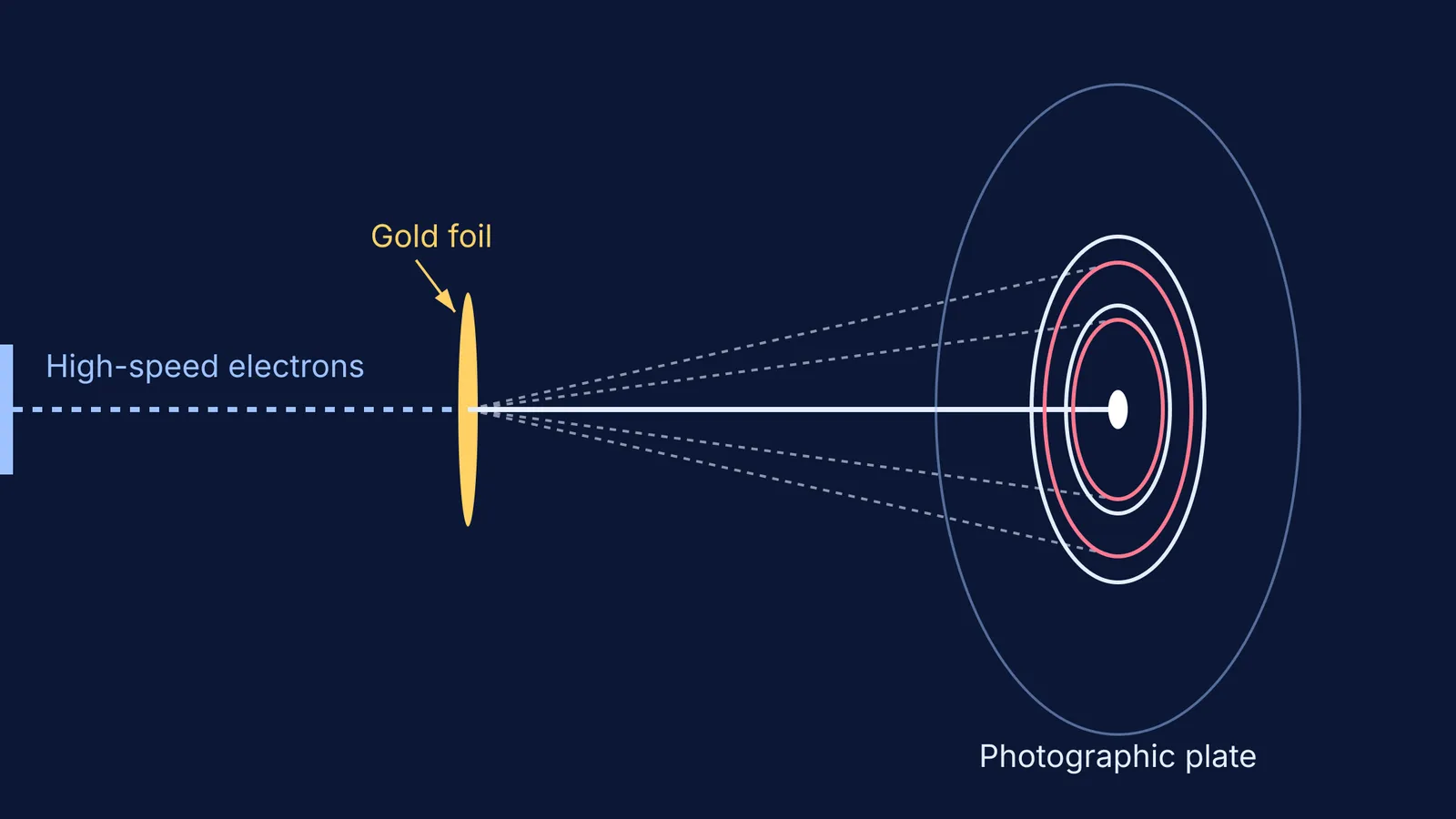
In 1927, George Paget Thomson fired high-speed electrons through extremely thin gold foils and recorded concentric diffraction rings on a photographic plate. This proved that particles act as waves, verifying Louis de Broglie's hypothesis and earning Thomson the 1937 Nobel Prize in Physics.
Who was George Paget Thomson?
George Paget Thomson was a British physicist working at the University of Aberdeen. He was the son of J.J. Thomson, the physicist who discovered the electron in 1897 and proved it was a particle with a distinct mass and charge.
In a neat twist of scientific history, while the father won the 1906 Nobel Prize for proving the electron was a particle, the son shared the 1937 Nobel Prize for proving it behaves as a wave. In 1924, Louis de Broglie had proposed that all matter has a wave nature, predicting that the wavelength of a particle is given by λ = h/p, where h is Planck's constant and p is momentum. Thomson set out to test this by trying to make electrons diffract, a behaviour unique to waves.
What was the thin film electron diffraction experiment?
To see diffraction, Thomson needed a grating with gaps roughly the same size as the expected wavelength of the electrons. The regular spacing of atoms in a crystal is perfect for this, as was well known from X-ray diffraction experiments at the time.
Thomson built a high-vacuum apparatus where a cathode ray tube fired a fine beam of electrons. He accelerated these electrons using high voltages to give them significant momentum, thereby shortening their de Broglie wavelength to a scale comparable to atomic spacing.
The beam was fired at extremely thin films of gold, aluminium, platinum and even celluloid. These metallic films were around 3 × 10⁻⁸ m thick — so thin that the electrons could pass through without colliding randomly and losing their path. Behind the film, a photographic plate waited to record where the electrons landed.
How did the experiment prove electrons are waves?
When particles like bullets are fired through a messy target, you expect a scattered blob on the wall behind. But when Thomson developed his photographic plates, he saw a bright central spot surrounded by sharp, concentric rings.
These were diffraction rings, visually identical to the Debye-Scherrer patterns produced when X-rays pass through a powder. Because X-rays are undeniably electromagnetic waves, the identical pattern proved that the electrons were diffracting just like waves as they passed through the atomic lattice of the gold foil.
The size of these rings is governed by Bragg's law, nλ = 2d sin θ, where d is the spacing between the atomic planes in the gold crystal. Because the foil consists of many randomly oriented microscopic crystals, the diffracted beams form continuous cones of radiation. When these cones intersect the flat photographic plate, they create the perfect circles Thomson observed. By measuring the radii of these rings and knowing the distance from the foil to the plate, he could calculate the diffraction angle and, consequently, the wavelength.
Visualising how a particle spreads into a wave and forms rings is famously difficult; you can adjust the accelerating voltage and see the rings shrink in the Simulation Lab.
Why does the de Broglie wavelength matter?
Thomson measured the size of the rings and found they matched de Broglie's prediction exactly. When he increased the voltage, the electrons sped up, gaining momentum. According to λ = h/p, higher momentum means a shorter wavelength. Sure enough, the diffraction rings shrank on the plate as the voltage increased.
This wave-particle duality is the foundation of quantum mechanics. It explains how electrons orbit in atoms without spiralling into the nucleus, and helps us understand Energy bands: conductors, semiconductors and insulators compared in modern electronics. It is also the principle behind electron microscopes, which use the tiny wavelengths of high-speed electrons to resolve details much finer than light can.
Just as we can calculate the Number of photons emitted per second by a lamp or a laser using wave-particle duality for light, Thomson's experiment lets us treat massive particles as waves. If you are stuck calculating the wavelength of an electron at high voltages, Fermi's AI tutor can work out what you already know and build a plan for the session to guide you through the equation.


