On this page
Structure of Atom is the second unit of Class 11 chemistry, and bonding, periodicity and coordination compounds build on it. Preparing it means fast formulas and a few traps you spot on sight.
What does the JEE Main syllabus include for Structure of Atom?
The official Syllabus for JEE (Main) - 2027, linked from the NTA JEE Main website, lists Atomic Structure as Chemistry Unit 2. It covers the photoelectric effect, the hydrogen spectrum, the Bohr model (including deriving its energy and radius relations, and its limitations), de Broglie's relation, the uncertainty principle, ψ and ψ² against r for 1s and 2s, quantum numbers, s, p and d orbital shapes, filling rules, and the extra stability of half-filled and fully filled orbitals.
The matching textbook chapter is Unit 2, Structure of Atom, in NCERT Class 11 Chemistry Part I (Reprint 2026-27). Read it in full first.
Which formulas do you need for Structure of Atom?
These come from the NCERT chapter:
Radius of a Bohr orbit: rₙ = 52.9 n²/Z pm.
Energy of a Bohr orbit: Eₙ = −2.18 × 10⁻¹⁸ Z²/n² J.
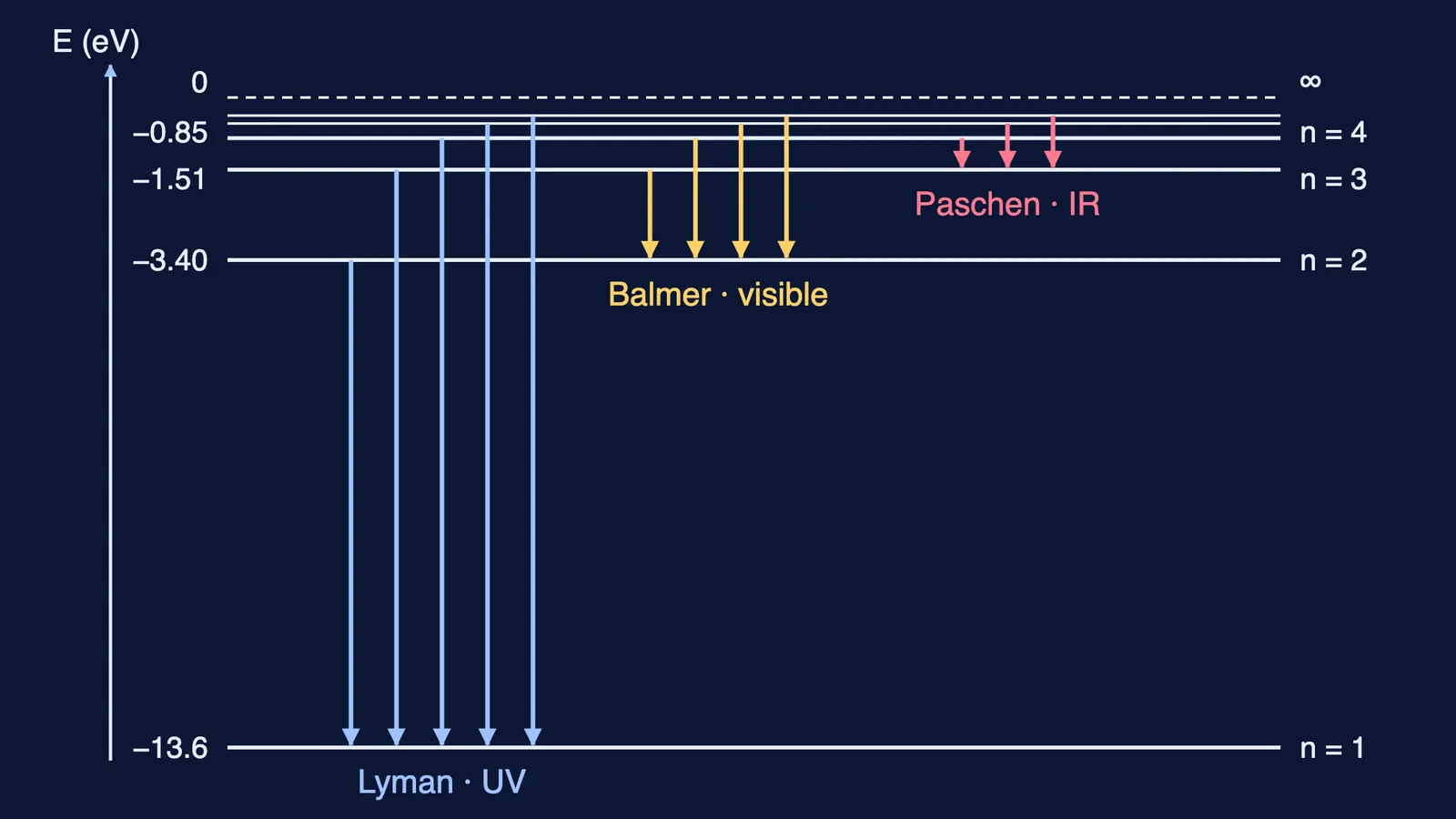
Hydrogen lines: 1/λ = 109,677 (1/n₁² − 1/n₂²) cm⁻¹, with Lyman (ending at n = 1) in the ultraviolet, Balmer (n = 2) in the visible and Paschen (n = 3) in the infrared.
de Broglie wavelength: λ = h/mv. Uncertainty: Δx · Δp ≥ h/4π.
Nodes: an orbital has n − l − 1 radial nodes and l angular nodes.
For constants, use the CODATA values from NIST: h = 6.626 × 10⁻³⁴ J s, electron mass = 9.109 × 10⁻³¹ kg and e = 1.602 × 10⁻¹⁹ C. The Rydberg energy is 13.606 eV, which is why the hydrogen ground state is −13.6 eV.
Background reading: why hydrogen has many spectral lines with only one electron, and where the Bohr model breaks and why.
How do you solve Structure of Atom problems? Six worked examples
Our own numbers. Try each before reading the answer.
Li²⁺ (Z = 3), n = 2. r = 52.9 × 4/3 = 70.5 pm. E = −2.18 × 10⁻¹⁸ × 9/4 = −4.91 × 10⁻¹⁸ J, or −30.6 eV.
Hydrogen, n = 4 → n = 3. 1/λ = 109,677 × (1/9 − 1/16) = 5,332 cm⁻¹, so λ = 1,876 nm. That is the first Paschen line, in the infrared.
Electron accelerated through 200 V. Kinetic energy = eV = 3.20 × 10⁻¹⁷ J. Momentum p = √(2mE) = 7.64 × 10⁻²⁴ kg m s⁻¹, so λ = h/p = 86.7 pm, about 0.87 Å.
Electron located to within 50 pm. Δv ≥ h/(4π m Δx) = 6.626 × 10⁻³⁴ / (4π × 9.109 × 10⁻³¹ × 5.0 × 10⁻¹¹) = 1.16 × 10⁶ m s⁻¹. An uncertainty this large is why NCERT says Bohr's precise orbits have no real meaning.
Shell n = 4. l can be 0, 1, 2 or 3 (4s, 4p, 4d, 4f), which gives n² = 16 orbitals and 32 electrons. A 4d orbital has 4 − 2 − 1 = 1 radial node and 2 angular nodes. The set n = 3, l = 3 is impossible because l only goes up to n − 1.
Cr (Z = 24) and Cu (Z = 29). Not 3d⁴4s² and 3d⁹4s²: NCERT gives [Ar]3d⁵4s¹ and [Ar]3d¹⁰4s¹, because half-filled and fully filled subshells are more stable (symmetry, exchange energy). Cr has 6 unpaired electrons.
If your answer differs and you cannot see why, the Fermi Problem Library has worked problems with a step-by-step solver that explains the reasoning rather than printing an answer.
Which mistakes cost marks in atomic structure?
Radius goes as n²/Z; energy as Z²/n².
With 109,677 cm⁻¹ you get 1/λ in cm⁻¹, so λ comes out in cm; convert before writing nm.
The uncertainty relation uses h/4π, not h/2π.
From n = 5, a sample of atoms gives up to 5 × 4/2 = 10 lines; a single atom gives at most 4 (5 → 4 → 3 → 2 → 1).
The (n + l) rule fills 4s (n + l = 4) before 3d (n + l = 5).
Radial nodes are n − l − 1; angular nodes are l. Don't swap them.
How should you plan Structure of Atom revision?
Two weeks, about an hour a day:
Days 1-3: read NCERT; derive rₙ and Eₙ yourself, as the syllabus asks.
Days 4-6: spectra and the photoelectric effect; drill wavenumber, wavelength and energy conversions.
Days 7-8: de Broglie and uncertainty, for an electron and a cricket ball, to see why only tiny masses matter.
Days 9-11: quantum numbers, orbital shapes, nodes, and ψ² against r for 1s and 2s.
Days 12-14: configurations, then a timed mixed set of past questions; log each error's cause.
If an idea stays hard to picture from the page, the Fermi Simulation Lab has interactive simulations for the ideas that are easier to see than to read.
Next unit: a two-week plan for chemical bonding.