On this page
You meet the Bohr model in Class 11, and exams keep asking the same follow-up: where does it fail? Knowing *why* each point fails, with real numbers, keeps you from mixing up Bohr and the quantum model in a JEE question.
What did the Bohr model get right?
Niels Bohr published his model in July 1913 in the paper On the constitution of atoms and molecules. If the postulates feel shaky, our walk-through of Bohr's postulates explained simply covers them one at a time.
For a single electron around a nucleus of charge Z, the model gives E = -13.6 Z²/n² eV. The constant is the Rydberg energy, which NIST lists as 13.605693 eV.
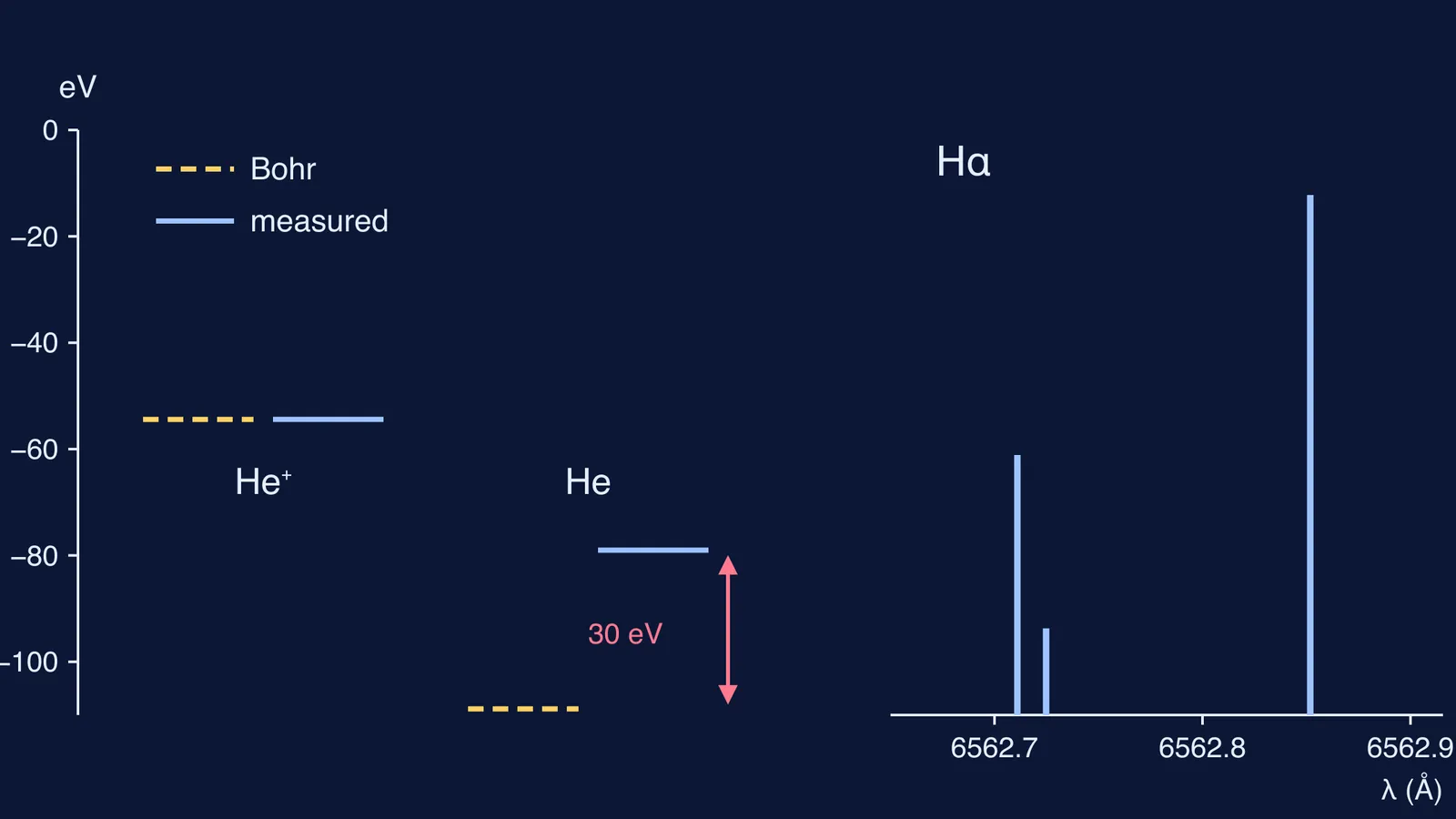
For He+ (Z = 2, one electron) it predicts an ionisation energy of 4 × 13.6057 = 54.42 eV, and the NIST helium ionisation table gives 54.417760 eV. A near-perfect match.
Why does the Bohr model fail for multi-electron atoms?
Bohr's energy formula assumes the electron feels only the nucleus. Add a second electron and the two repel each other, which the model cannot handle.
Ignore the repulsion and treat each of helium's two electrons as Bohr would: each sits at -54.42 eV, so the total is about -108.8 eV.
The real total is the sum of both ionisation energies. NIST gives 24.587387 eV and 54.417760 eV, so the true ground-state energy is about -79.0 eV.
Bohr is off by about 29.8 eV, roughly 38% too deep. The missing energy is the electron-electron repulsion the model cannot describe.
In short, multi-electron atoms do not have the energy levels the model predicts, starting with neutral helium.
Why can't Bohr explain line intensities and fine structure?
Bohr's rule tells you *where* a line sits: the photon energy equals the gap between two levels. Apart from a few simple cases, it cannot predict *how bright* the line is, because it has no general way to calculate how likely each jump is.
Look closely at the red H-alpha line (n = 3 to n = 2). Bohr predicts one line. The NIST table of strong hydrogen lines lists three components at 6562.7110 Å, 6562.7248 Å and 6562.8518 Å, with relative intensities 90, 30 and 180. Bohr explains neither the split nor the different brightnesses.
This splitting is called fine structure. HyperPhysics puts the splitting of the H-alpha line at about 0.016 nm, or about 0.000045 eV, and traces it to an interaction between the electron's spin and its orbital motion. Spin is not in Bohr's model at all.
Arnold Sommerfeld tried a repair in 1916 by adding elliptical orbits and relativity to account for hydrogen's split lines. But it still put the electron on a definite orbit, and multi-electron atoms stayed out of reach. Lines also split in a magnetic field, which you can read about in our story of how Pieter Zeeman found magnetic splitting.
What replaced the Bohr model?
Quantum mechanics, in three steps:
1925: Werner Heisenberg's paper on a quantum-theoretical reinterpretation of mechanics launched matrix mechanics, a new set of rules for atoms that did not rely on picturing orbits.
1926: Erwin Schrödinger's wave equation described the electron as a wave spread around the nucleus. Its solutions give the s, p, d and f orbitals you draw in Class 11, and the same equation applies to helium, with the repulsion term included. Our post on Schrödinger and his wave equation tells that story.
1928: Paul Dirac's relativistic theory of the electron explained, in his words, "all duplexity phenomena without further assumption": spin, and with it fine structure, came out of the theory.
How do you write the limitations answer in an exam?
Use this plan for a 3-to-5 mark answer: each point names the failure, then the reason.
Multi-electron atoms: the model ignores electron-electron repulsion, so it fails for helium and heavier atoms.
Line intensities: it gives line positions but no general way to calculate how bright each line is.
Fine structure: it predicts single lines where closely spaced lines are observed, because it leaves out electron spin and relativity.
Magnetic fields: it cannot account for lines splitting in an external magnetic field (the Zeeman effect).
Quantum ideas: fixed orbits with an exact radius and speed clash with de Broglie's matter waves and Heisenberg's uncertainty principle.
Ground-state angular momentum: Bohr says ħ; experiment says zero.
If you have room, add the helium numbers from the NIST helium table (-108.8 eV predicted, -79.0 eV real). One worked figure shows you understand the reason, not just the list.
If the jump from orbits to orbitals still feels abstract, the Fermi Concept Library gives each concept its own lesson and its place in the map, so you can see what leads to what. To practise the numbers, the Fermi Problem Library has worked problems with a step-by-step solver that explains the reasoning rather than printing an answer.