

On this page
Ernest Rutherford's 1911 discovery of the atomic nucleus created an immediate crisis in classical physics. In Rutherford's planetary model, negatively charged electrons orbited a positive nucleus. Because circular motion involves continuous centripetal acceleration, a = v² / r, classical electromagnetic theory and the Larmor formula dictate that the electron must continuously radiate electromagnetic energy.
As it radiates, the electron must spiral inward. Classical electrodynamics predicts that an orbiting electron should rapidly collapse into the nucleus, as detailed in OpenStax University Physics. That would make stable matter impossible. Furthermore, an inward-spiralling electron would emit a continuous rainbow smear of light. In reality, atoms remain stable, and excited hydrogen emits sharp, discrete spectral lines, as explored in why Rutherford's model failed to explain stability.
What are the three Bohr postulates?
In his July 1913 paper in *Philosophical Magazine*, Niels Bohr resolved this crisis by introducing three quantum postulates:
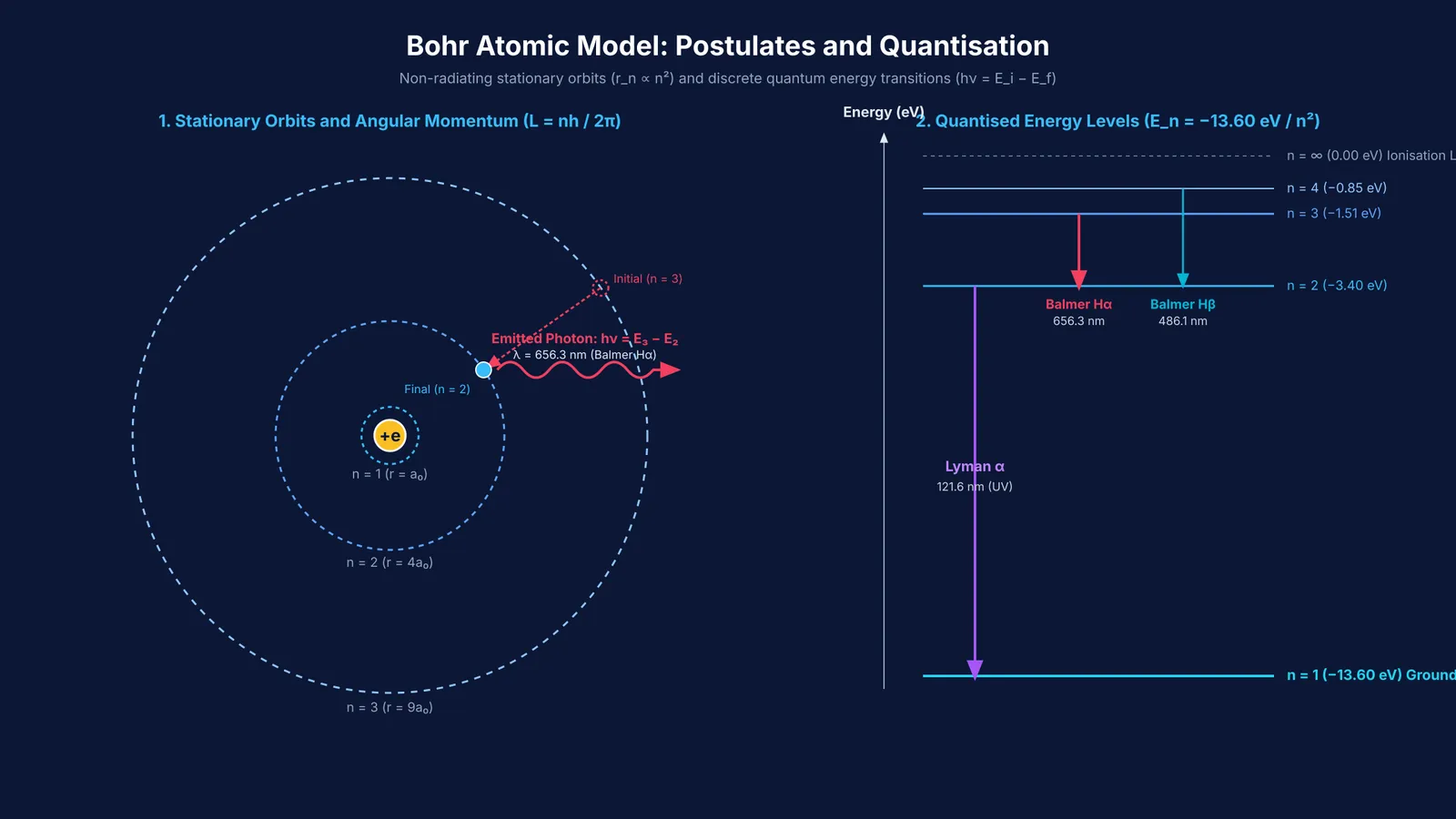
Stationary orbits: Electrons revolve only in specific non-radiating circular orbits known as stationary states. While in these orbits, an electron maintains constant energy without emitting electromagnetic radiation, fixing the classical instability of Rutherford's planetary atom.
Quantised angular momentum: An electron can only occupy orbits where its orbital angular momentum L is an integral multiple of h / (2π), where h is Planck's constant (6.626 × 10⁻³⁴ J s). Stated mathematically, L = mvr = nh / (2π), with n = 1, 2, 3, ... This condition eliminates arbitrary orbit sizes, fixing discrete allowed radii.
Transition radiation: Radiation is emitted or absorbed only when an electron jumps between stationary orbits. The emitted photon's frequency ν satisfies the Bohr frequency condition, hν = E_i − E_f, where E_i and E_f are the initial and final orbital energies. This explains why gas discharges produce discrete spectral lines instead of continuous spectra.
How does angular momentum quantisation shape the atom?
By equating Coulomb attraction to centripetal force, mv² / r = Ze² / (4πε₀r²), and applying mvr = nh / (2π), Bohr derived exact expressions for single-electron atoms:
Orbital radii: r_n = n² a₀ / Z, where a₀ is the Bohr radius for hydrogen (n = 1, Z = 1). The 2022 CODATA recommended value in the NIST CODATA database is a₀ ≈ 5.29177 × 10⁻¹¹ m, or roughly 0.529 Å. Because r_n scales with n², the second orbit is 4 times larger than the first, and the third is 9 times larger.
Energy levels: E_n = −13.60 eV × (Z² / n²), referenced to the Rydberg energy of 13.606 eV in the NIST CODATA database. The negative sign indicates a bound state. For hydrogen, E₁ = −13.60 eV, E₂ = −3.40 eV, E₃ = −1.51 eV, and E₄ = −0.85 eV.
Rydberg constant: Bohr's model derived the Rydberg constant from basic constants as R_H = m_e e⁴ / (8ε₀² h³ c). The value in the NIST CODATA database is R_∞ ≈ 10,973,731.57 m⁻¹ (about 1.097 × 10⁷ m⁻¹).
When students tackle energy signs and orbital scaling, the Fermi Concept Library maps every concept in physics, chemistry, biology, mathematics and computing, each with its own lesson and its place in the map.
Worked example: how do you calculate a spectral jump?
Consider an electron in hydrogen (Z = 1) dropping from n = 3 to n = 2, producing the red Balmer H-alpha line recorded in the NIST Atomic Spectra Database.
Find energy levels: E₃ = −13.60 / 9 = −1.511 eV, and E₂ = −13.60 / 4 = −3.400 eV.
Find emitted energy: ΔE = −1.511 − (−3.400) = 1.889 eV = 3.026 × 10⁻¹⁹ J.
Calculate wavelength: λ = hc / ΔE = (6.626 × 10⁻³⁴ J s × 2.998 × 10⁸ m/s) / (3.026 × 10⁻¹⁹ J) ≈ 656.3 nm.
The Rydberg formula confirms this directly: 1 / λ = R_H (1/2² − 1/3²) = (1.097 × 10⁷ m⁻¹) × (5 / 36), yielding λ ≈ 656.3 nm. Test these transitions in an interactive Bohr model hydrogen spectrum simulation.
For numerical practice on series limits and recoil speeds, the Fermi Problem Library provides worked problems with a step-by-step solver that explains the reasoning rather than printing an answer.
What are the key limitations to watch for in exams?
Bohr's model is a semi-classical framework with limitations that examiners frequently test:
Single-electron systems only: The model applies only to one-electron ions (H, He⁺, Li²⁺). It fails for helium or multi-electron atoms because it omits electron-electron repulsion.
Uncertainty principle: Postulating fixed circular paths violates Werner Heisenberg's uncertainty principle (Δx Δp ≥ h / (4π)). Modern physics replaces orbits with probability clouds, as explained in how orbits differ from quantum mechanical orbitals.
Spectral fine structure: Bohr cannot explain why spectral lines split into multiplets, nor can it account for the Zeeman effect (magnetic fields) or Stark effect (electric fields).
Line intensities: The model gives transition energies, but cannot predict why certain spectral lines appear brighter than others.


