

On this page
Rutherford’s α-particle scattering experiment changed how we view the physical world. It proved that the atom is mostly empty space with a tiny, dense, positively charged nucleus at its centre. To explain where the electrons were, Rutherford proposed a planetary model. He suggested that negatively charged electrons revolve around the nucleus in circular orbits, much like planets orbiting the Sun.
On the surface, this analogy makes perfect sense. The electrostatic force of attraction between the positive nucleus and the negative electron provides the centripetal force needed to keep the electron in orbit, just as gravity keeps the Earth circling the Sun. But this model had a fatal flaw. While planets are electrically neutral masses moving through a gravitational field, electrons are charged particles moving through an electromagnetic field.
Why should an orbiting electron radiate energy?
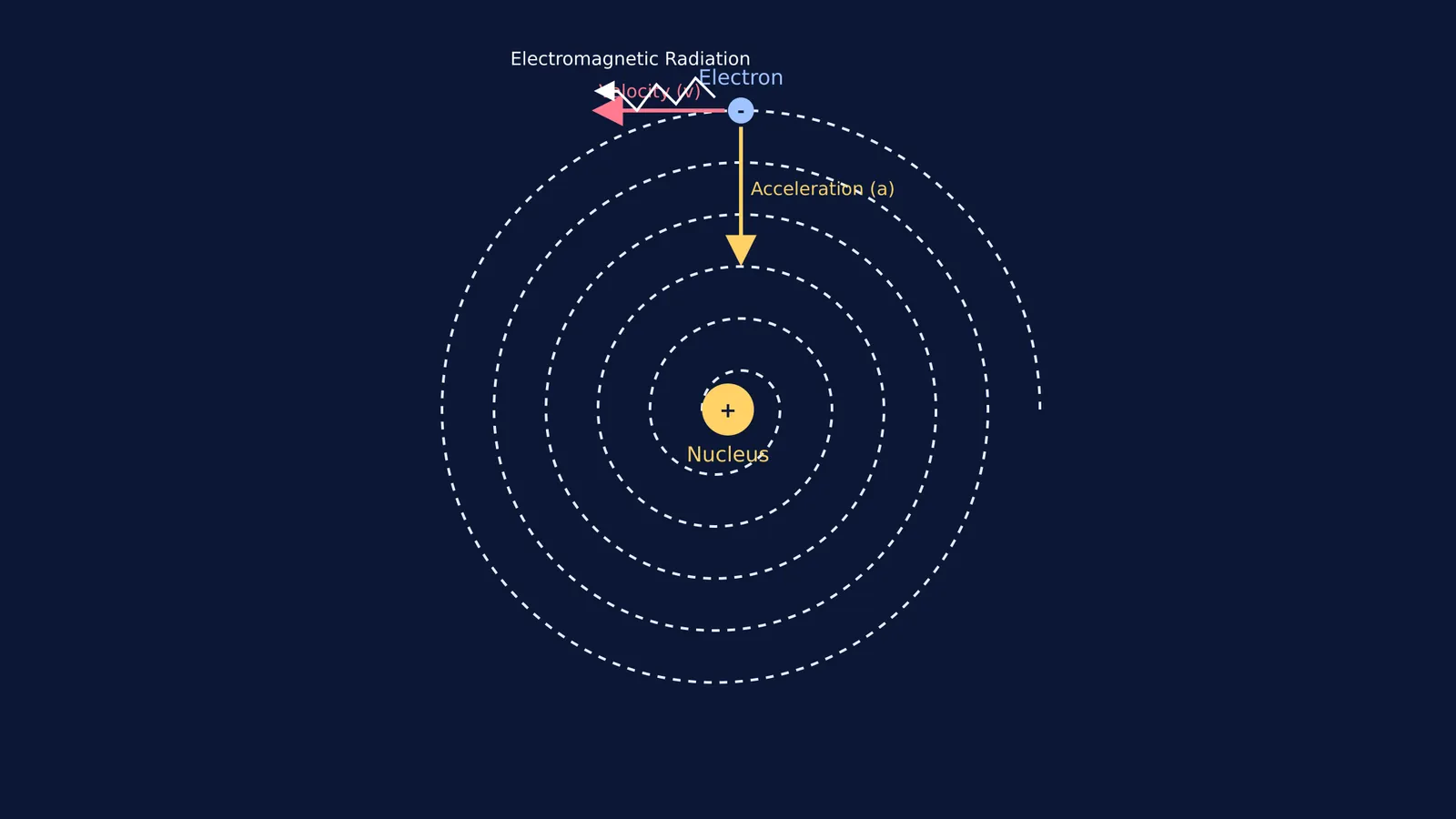
The fundamental problem comes from classical electromagnetism. To understand it, we have to look closely at the nature of circular motion. Even if an electron moves at a constant speed along its circular path, its direction is constantly changing. In physics, any change in velocity—whether a change in speed or a change in direction—is an acceleration. Therefore, an electron in a circular orbit is always accelerating towards the centre of the circle.
According to Maxwell's electromagnetic theory, an accelerated charged particle must continuously emit electromagnetic radiation. You cannot have an accelerating charge that does not broadcast energy into space. As the electron radiates this energy in the form of electromagnetic waves, it has to pay the cost from its own mechanical energy. You can see how energy relates to light by calculating the photons emitted per second by a radiating source. The electron's kinetic and potential energy must decrease to fuel this radiation.
How fast would the atom collapse?
Because the electron continuously loses energy to radiation, it cannot maintain its original orbit. A lower energy state means a smaller orbital radius. Its path must shrink. Instead of tracing a stable, repeating circle, the electron would follow a spiral path, drawing closer and closer to the nucleus with every revolution.
This number is staggering. If Rutherford's planetary model were completely correct, an atom would not last even a fraction of a second. It would collapse almost instantly. Everything around us, including the screen you are reading this on and the cells in your own body, would be violently unstable.
Since we exist, and atoms are known to be remarkably stable, the classical theory clearly missed a crucial piece of the puzzle. When you encounter concept gaps in modern physics, the Fermi Concept Library can help you trace exactly how these models evolved from classical failures to quantum successes.
Why couldn't it explain line spectra?
The model also failed the rigorous test of experimental spectroscopy. If an electron were spiralling inward toward the nucleus, its orbital radius and speed would change smoothly and continuously over that brief window. Because its orbital frequency changes continuously, the frequency of the electromagnetic radiation it emits should also change continuously across a wide range.
This means that a sample of atoms should emit a continuous spectrum of light—an unbroken rainbow containing all possible wavelengths. However, experimental evidence from the late 19th and early 20th centuries showed the exact opposite. Atoms like hydrogen emit discrete line spectra. When hydrogen gas is heated, it only gives off light at very specific, sharply defined wavelengths.
Rutherford’s model offered no explanation for why these specific energy levels existed or why the spectrum was chopped up into distinct lines rather than a continuous band.
The framework: spotting the classical trap
When revising the drawbacks of Rutherford's model for your JEE or NEET exams, it is easy to get lost in the historical details. Instead, use this three-step logical chain to quickly recall why the model broke down:
Circular motion equals acceleration: Changing direction means the electron is always accelerating, even if its speed is constant.
Acceleration of charge equals radiation: Maxwell's classical theory dictates that accelerating charges must broadcast electromagnetic energy.
Radiation equals energy loss: The electron loses energy, its orbit shrinks into a spiral, and the atom collapses.
This logical breakdown is exactly why Niels Bohr had to introduce his radical postulates a few years later. Bohr kept Rutherford's nucleus but abandoned classical electromagnetism at the atomic scale, adding the rule that electrons revolve in specific "stationary states" where they simply do not radiate energy.
Visualising these atomic models can be tricky, especially when the math contradicts our everyday intuition about how planets and orbits work. Before jumping into quantum mechanics or drawing Class 10 electron dot structures, seeing the limits of classical physics is an essential step. Fermi's AI tutor can work out what you already know and build a plan for the session, ensuring you master these fundamental concepts before moving on to harder quantum equations.


