On this page
Chemical bonding quietly decides marks in other chapters. If you can predict a shape, a hybridisation and a bond order quickly, coordination compounds, p-block chemistry and organic mechanisms all get easier. Here is what the syllabus asks for, how to learn each tool, and a two-week plan.
Is chemical bonding in the JEE Main 2027 syllabus?
Yes. The NTA syllabus for JEE (Main) 2027, linked from jeemain.nta.nic.in, lists "Chemical Bonding and Molecular Structure" as Unit 3 of Physical Chemistry. It names these topics:
Kossel-Lewis approach, ionic bonds and lattice enthalpy
Electronegativity, Fajans' rule and dipole moment
VSEPR theory and shapes of simple molecules
Valence bond theory, hybridisation involving s, p and d orbitals, and resonance
Molecular orbital theory for homonuclear diatomic molecules, bond order, bond length and bond energy
An elementary idea of metallic bonding and hydrogen bonding
The matching textbook chapter is Unit 4 of NCERT Class 11 Chemistry Part I, "Chemical Bonding and Molecular Structure". NTA does not publish chapter-wise weightage, so treat percentages you see online as estimates.
The JEE (Main) 2027 Information Bulletin includes numerical-value questions in Chemistry, answered as integers, with negative marking. Counting lone pairs or unpaired electrons fits that format well.
How do you get VSEPR shapes and hybridisation right every time?
Use one routine for every molecule:
Count the atoms bonded to the central atom (each counts once, whether the bond is single, double or triple).
Count the lone pairs left on the central atom.
Add them: that steric number fixes the electron geometry and hybridisation (2 sp, 3 sp2, 4 sp3, 5 sp3d, 6 sp3d2).
Name the shape from the atoms only, ignoring lone pairs.
Check yourself:
NH3: 3 bonds + 1 lone pair, sp3, trigonal pyramidal
H2O: 2 bonds + 2 lone pairs, sp3, bent
SF4: 4 bonds + 1 lone pair, sp3d, see-saw
ClF3: 3 bonds + 2 lone pairs, sp3d, T-shaped
XeF2: 2 bonds + 3 lone pairs, sp3d, linear
XeF4: 4 bonds + 2 lone pairs, sp3d2, square planar
In a trigonal bipyramid, lone pairs take equatorial positions, which explains SF4, ClF3 and XeF2. Lone pairs also squeeze bond angles below the tetrahedral 109.5° given in NCERT; our post on why water is bent and how lone pairs squeeze bond angles shows this in 3D. If shapes stay flat on paper, rotating them helps: the Fermi Simulation Lab has interactive simulations for the ideas that are easier to see than to read.
How do you find bond order and magnetic behaviour with MOT?
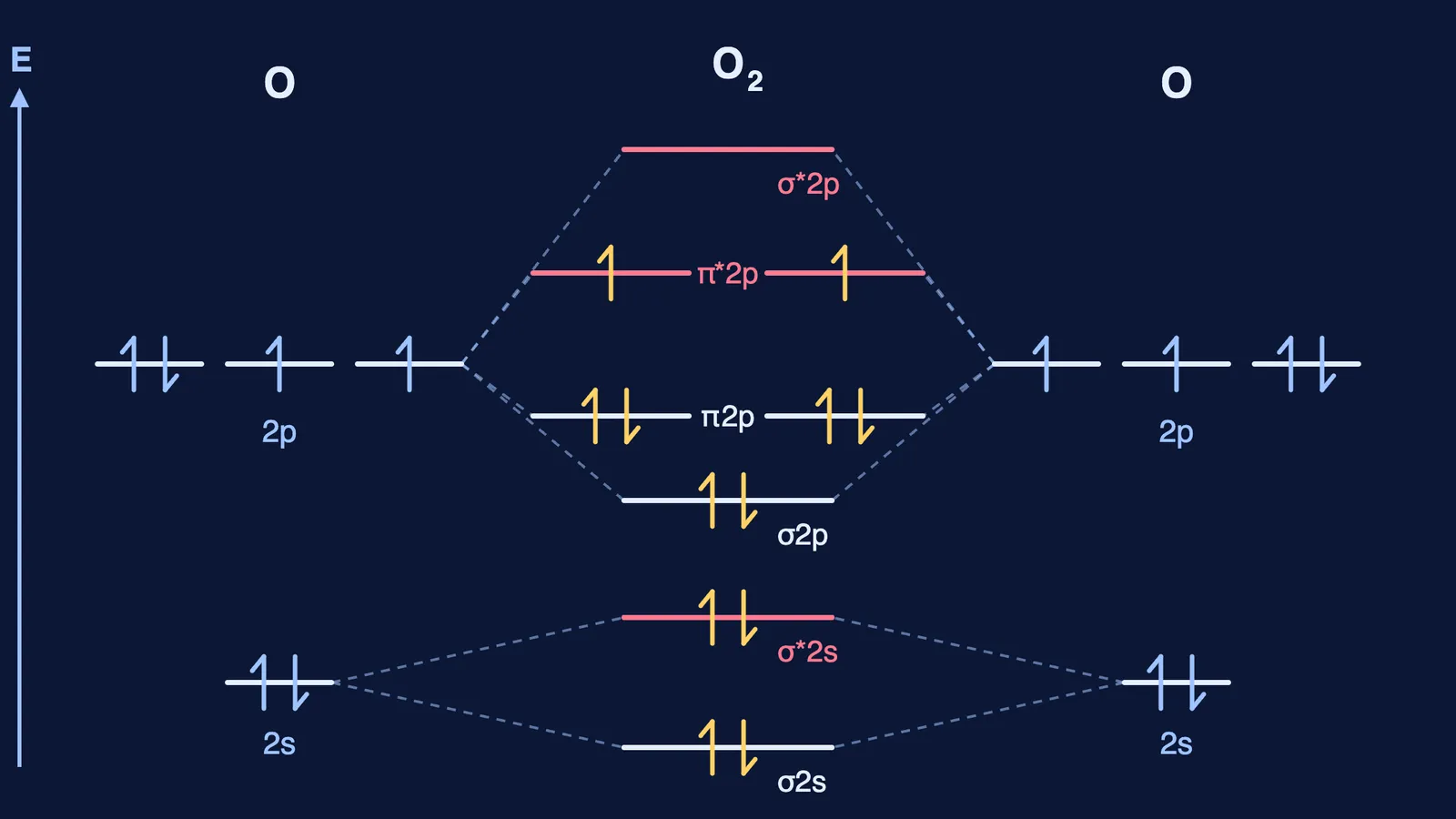
Bond order is half of (bonding electrons minus antibonding electrons), as defined in NCERT Unit 4. Higher bond order means a shorter, stronger bond; zero means the molecule should not exist, as with He2.
For B2, C2 and N2 the π2p orbitals fill before σ2p. For O2 and F2, σ2p comes first, as in the diagram at the top of this page.
Worked example, using valence electrons only:
O2 (12 electrons): 8 bonding, 4 antibonding. Bond order 2. Two unpaired electrons in π*, so paramagnetic.
O2⁻ (13 electrons): one more π* electron. Bond order 1.5. One unpaired electron, so paramagnetic.
O2²⁻ (14 electrons): π* full. Bond order 1. No unpaired electrons, so diamagnetic.
So bond length rises in the order O2 < O2⁻ < O2²⁻. Equal bond orders need one more step; see N2+ vs N2-: same bond order, so which is more stable?
Which traps cost marks in this chapter?
All of these are covered in NCERT Unit 4.
Polar bonds, non-polar molecule. CO2, BeF2 and BF3 have polar bonds but zero net dipole moment because their symmetric shapes cancel the bond dipoles.
NH3 vs NF3. Both are pyramidal, but the lone pair adds to the bond dipoles in NH3 and opposes them in NF3, so NH3 has the larger dipole moment.
Fajans' rule direction. A small, highly charged cation and a large anion give more covalent character, not less.
Wrong filling order. Using the O2 order for B2 wrongly makes it diamagnetic; it is paramagnetic.
What is a good two-week practice plan?
Days 1-2: NCERT Unit 4 on Lewis structures, ionic bonds and bond parameters; write ten Lewis structures with formal charges.
Days 3-5: VSEPR and hybridisation. Run the four-step routine on 25 species.
Days 6-8: MOT. Draw both filling orders from memory; tabulate bond order and unpaired electrons from H2 to F2 and common ions.
Days 9-10: dipole moment, Fajans' rule, resonance and hydrogen bonding.
Days 11-13: timed mixed sets from previous papers, 20 questions a day.
Day 14: redo every question you got wrong.
Log each error by cause in an error notebook you review every week. When the method itself is the problem, the Fermi Problem Library has worked problems with a step-by-step solver that explains the reasoning rather than printing an answer.
Start today: cover the answers in the VSEPR list and work all six.