On this page
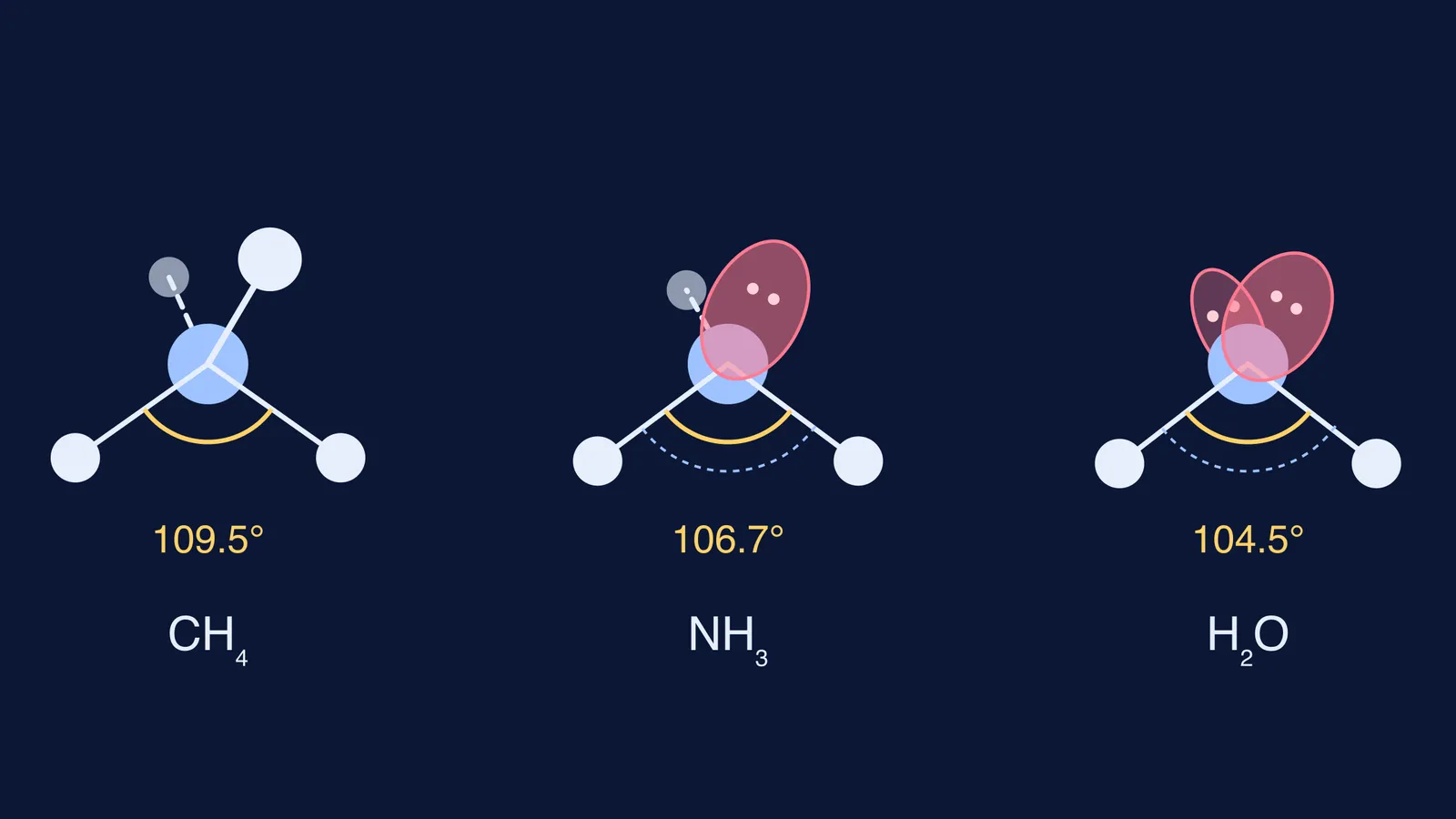
On paper, methane, ammonia and water look like three different shapes: a tetrahedron, a pyramid and a bent line. In 3D they are really one shape with parts hidden. Carbon, nitrogen and oxygen each sit inside four electron pairs that point roughly at the corners of a tetrahedron. What changes is how many of those pairs hold a hydrogen atom, and how many are lone pairs that hold nothing.
Why is water bent and not straight?
Valence shell electron pair repulsion (VSEPR) theory says that electron pairs around a central atom push each other as far apart as they can. Ronald Gillespie and Ronald Nyholm of University College London refined this idea into a detailed theory in 1957, according to the VSEPR theory article on Wikipedia. Their review, Inorganic Stereochemistry, appeared in Quarterly Reviews of the Chemical Society.
The oxygen in water has two bonding pairs and two lone pairs. Four pairs spread out best towards the corners of a tetrahedron. But a molecule's shape names only where the atoms are, and two of those corners hold no atom. What you see is the oxygen and two hydrogens: a bent molecule.
So water is not bent because something bends it. It is a tetrahedron with two corners you cannot see.
How much does each lone pair squeeze the angle?
The experimental bond angles from the US National Institute of Standards and Technology (NIST) tell the story:
Methane, CH4, with no lone pairs: 109.471° (NIST CCCBDB, methane)
Ammonia, NH3, with one lone pair: 106.67° (NIST CCCBDB, ammonia)
Water, H2O, with two lone pairs: 104.4776° (NIST CCCBDB, water)
The LibreTexts chapter on the VSEPR model/09%3A_Molecular_Geometry_and_Bonding_Theories/9.02%3A_The_VSEPR_Model) explains why: because a lone pair is not shared by two nuclei, it occupies more space near the central atom than a bonding pair. That gives the repulsion order: lone pair–lone pair is greater than lone pair–bond pair, which is greater than bond pair–bond pair.
Here is the arithmetic from the NIST numbers. Ammonia's single lone pair takes about 2.8° off the tetrahedral angle (109.47 − 106.67). Water's second lone pair takes about 2.2° more (106.67 − 104.48). We go through the full ranking in our post on lone pair repulsion and the bond angle order.
How do you see it in 3D?
Flat drawings hide the lone pairs, so the shape looks arbitrary. With a 3D model, on screen or from a kit, try three views:
Turn each molecule until two hydrogens lie flat in your screen. The angle you see is now the true bond angle. The diagram at the top is drawn this way.
In ammonia, look straight down the lone pair. The three hydrogens form a tripod, which is why the shape is called trigonal pyramidal.
In water, give the molecule a quarter turn about the line that halves the H–O–H angle. The two lone pairs sit in the plane at right angles to the hydrogens, filling the hidden corners.
If the corners of a tetrahedron are hard to picture, our 3D guide to sp, sp2 and sp3 hybridisation builds the same shape from orbitals. Shapes like these are hard to read from a flat page, which is what the Fermi Simulation Lab is for: interactive simulations for the ideas that are easier to see than to read.
How do you explain the water bond angle in an exam?
Use the same four steps for any molecule with four electron groups:
Count the electron groups on the central atom: bonds plus lone pairs.
Arrange four groups tetrahedrally.
Name the shape from the bonded atoms only: four gives tetrahedral, three gives trigonal pyramidal, two gives bent.
Compare repulsions to decide whether the angle is smaller than 109.5°.
A two-line answer you can adapt, with angles rounded from the NIST experimental geometries:
"In H2O, oxygen has two bond pairs and two lone pairs arranged tetrahedrally. Since lone pair–lone pair > lone pair–bond pair > bond pair–bond pair repulsion, the O–H bonds are pushed closer together, giving about 104.5°, less than 106.7° in NH3 and 109.5° in CH4."
Two mistakes cost marks:
Saying the electron arrangement of water is bent. The electron pairs are tetrahedral; only the shape is bent.
Leaving out lone pairs because they are not drawn. They decide the shape.
The bent shape is also why the bond dipoles in water do not cancel, which our post on molecule polarity in a simulation shows step by step.
If you can follow the steps but still cannot say why lone pairs need more room, Fermi's AI tutor notices where you are stuck and decides whether to explain, ask or show, drawing the figure as it goes.