On this page
The wavy curve method, also called the sign-chart method, is a common way to solve inequalities like (x − 1)(x + 2)² / (x − 3) ≥ 0. It is quick, but one slip, usually at a squared factor, flips every sign after it. Below is one worked example and a prompt that makes an AI chatbot check exactly that slip.
If you want the method from scratch first, read our step-by-step guide to the wavy curve method for rational inequalities.
How does the wavy curve method work on a rational inequality?
Take (x − 1)(x + 2)² / (x − 3) ≥ 0.
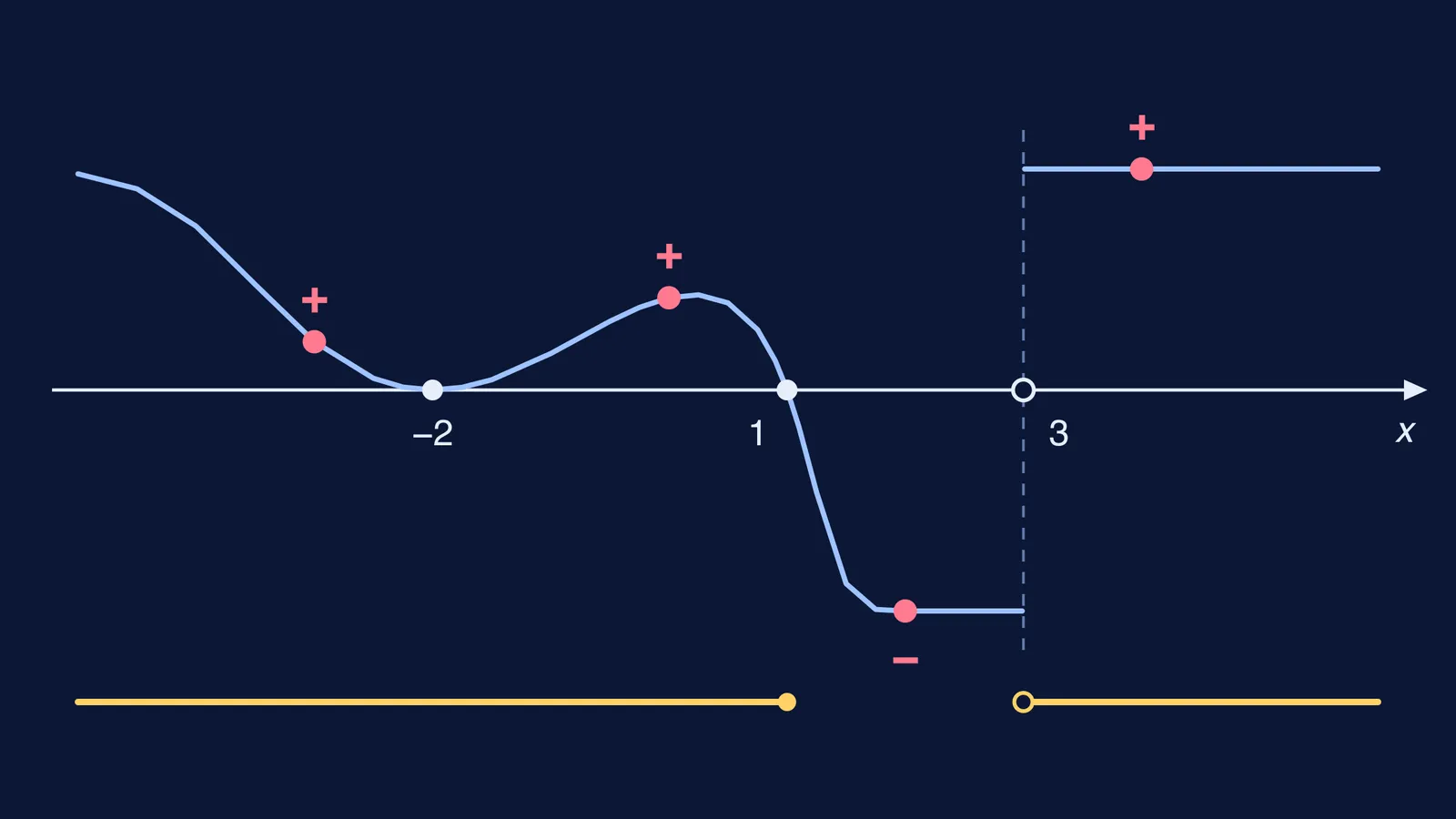
Find the critical points: the zeros of the numerator (x = 1 and x = −2) and of the denominator (x = 3).
Mark them on a number line. The denominator point is always hollow, because the expression is undefined there.
Start at the far right, where every factor is positive, so the sign is +.
Move left. The sign changes at a point with an odd power and stays the same at a point with an even power. The factors at x = 3 and x = 1 are single, so the sign flips; (x + 2)² is squared, so it does not.
Read off where the expression is positive or zero.
The chart reads: + on (3, ∞), − on (1, 3), + on (−2, 1), and + again on (−∞, −2). Because the inequality includes "= 0", the zeros x = 1 and x = −2 are included and x = 3 is not. The answer is x ∈ (−∞, 1] ∪ (3, ∞).
The common wrong answer is [−2, 1] ∪ (3, ∞). It comes from alternating + − + − blindly and forgetting that a squared factor does not flip the sign. Endpoints have their own traps; our post on which endpoints to include in a rational inequality covers them.
Why ask AI to test points instead of solving it again?
Ask a chatbot to "solve this inequality" and you get a second full solution, and must then judge which of two long arguments is right. The chatbot is not a reliable referee of its own work. A study presented at ICLR 2024 found that large language models "struggle to self-correct their responses without external feedback" on reasoning tasks, and that their performance sometimes got worse after trying (Huang et al., 2024).
A 2023 study of five AI assistants found they tend to agree with what the user believes rather than what is true, and that people and preference models sometimes preferred a convincing agreeable answer over a correct one (Sharma et al., 2023). So if you paste your answer and ask "is this right?", you are inviting a yes. More on that in why AI agrees with your wrong answer.
Substituting a number is different: short, one output, and easy to redo by hand. You keep the method; the AI only plugs in.
What prompt should you type to check the sign chart?
Pick one test point inside each interval, away from the critical points. Whole numbers are easiest. For our example: x = −3, 0, 2 and 4. Then type:
"Here is an expression: (x − 1)(x + 2)² / (x − 3). Substitute each of these values separately: x = −3, 0, 2, 4. For each one, show the value of every factor, then the final value and whether it is positive or negative. Do not solve any inequality and do not tell me the answer."
What you should get back:
x = −3: (−4)(1) / (−6) = 2/3, positive
x = 0: (−1)(4) / (−3) = 4/3, positive
x = 2: (1)(16) / (−1) = −16, negative
x = 4: (3)(36) / (1) = 108, positive
Compare each line with your chart. A student who wrote − on (−∞, −2) sees the mismatch at x = −3 at once. Seeing every factor lets you check an odd line yourself.
What if the AI and your chart disagree?
Do not pick a side by gut feeling:
Recompute the disputed point by hand, factor by factor. The slip may be in the AI's arithmetic, not in your chart.
If your hand value matches the AI, go back to your critical points. Did you miss one, or treat a squared factor as a single one?
Check that you did not cancel a factor such as (x − 3) from top and bottom. Cancelling hides a point where the expression is undefined.
Redo the chart from the right-hand end and compare again.
If the disagreement keeps coming back to the same step, that is a gap in the method rather than a one-off slip. The Fermi Problem Library has worked problems with a step-by-step solver that explains the reasoning rather than printing an answer, and Fermi's AI tutor notices where a student is stuck and decides whether to explain, ask or show.
Next time you finish a wavy curve, spend one minute on four test points before you move on.