

On this page
You drew the sign chart, found the right intervals, and still lost a mark on one bracket. This post gives you one rule for endpoints, a worked example, and a short check to run before you write the final answer.
Which endpoints do you include in a rational inequality ≥ 0?
Start with the points where the sign can change. In OpenStax's Intermediate Algebra, section 7.7/07%3A_Rational_Expressions_and_Functions/7.07%3A_Solve_Rational_Inequalities), a critical point is a number that makes the rational expression zero or undefined.
Those two kinds of critical point get opposite treatment:
Zeros of the numerator make the expression equal to 0. With ≥ or ≤, 0 satisfies the inequality, so they go in with a square bracket. With > or <, they stay out.
Zeros of the denominator make the expression undefined. They are always out, with a round bracket, whatever the inequality sign.
The same OpenStax section solves (x − 1)/(x + 3) ≥ 0 and gets (−∞, −3) ∪ 1, ∞): a square bracket at 1, where the numerator is zero, and a round bracket at −3, where the denominator is zero ([OpenStax via LibreTexts/07%3A_Rational_Expressions_and_Functions/7.07%3A_Solve_Rational_Inequalities)). If brackets themselves still trip you up, our guide to square and round brackets in interval notation goes through them one at a time.
Why is the zero of the denominator never included?
Read ≥ 0 as a question: "is this value positive, or exactly zero?" At a zero of the denominator, the expression has no value at all, because you cannot divide by zero. A thing with no value is neither positive nor zero, so the answer is no.
It still goes on the sign chart, because the sign can change across it. It marks a boundary but is never part of the answer.
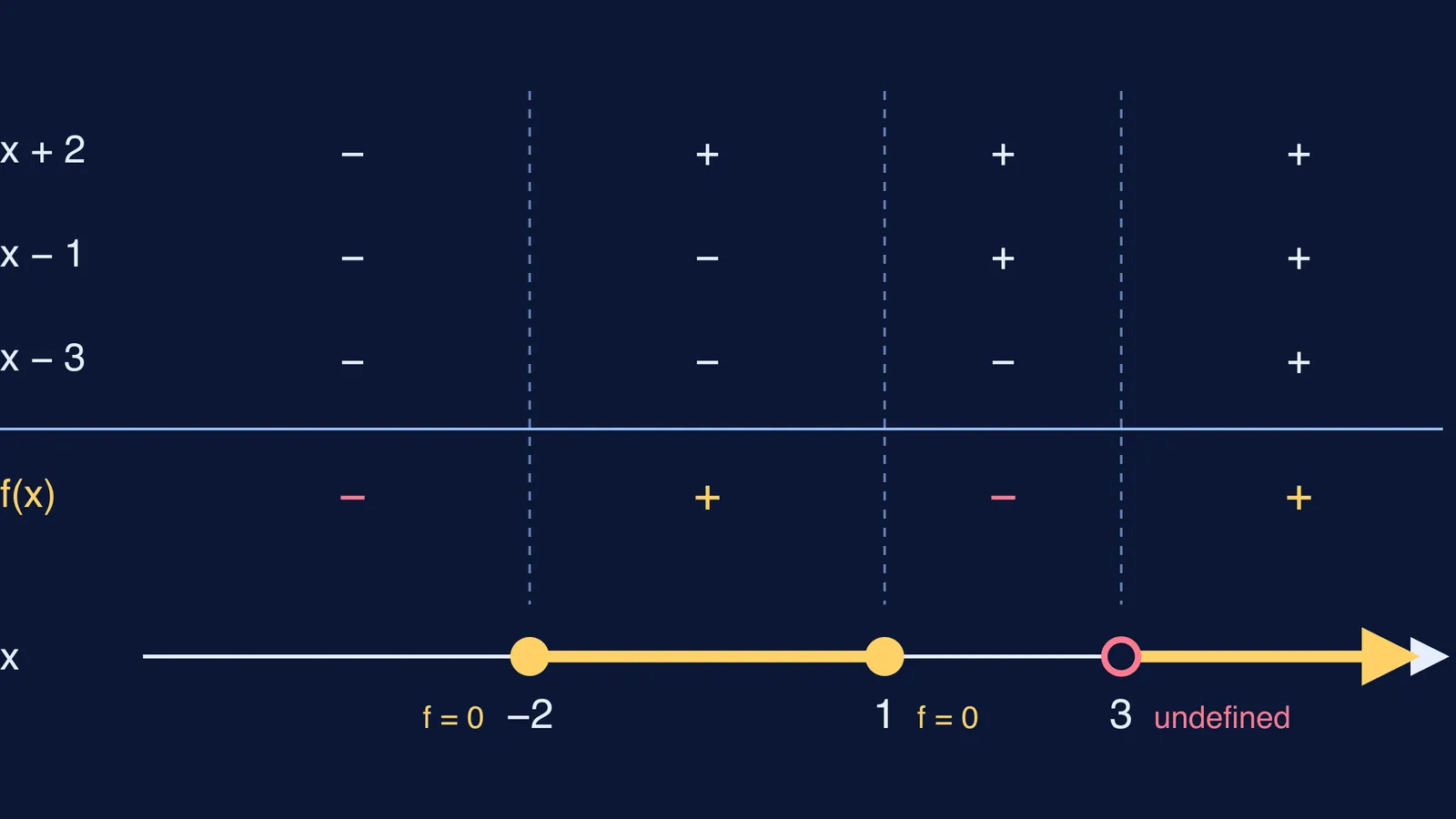
Worked example: how do you solve (x + 2)(x − 1)/(x − 3) ≥ 0?
Do not multiply both sides by (x − 3): its sign is unknown, so you can't tell whether the inequality flips. Our post on solving x/(x − 2) > 0 without cross-multiplying shows what goes wrong if you do. Use a sign chart instead.
Check the form. One fraction on the left, 0 on the right, everything factorised. Done.
Find the critical points. Numerator: x = −2 and x = 1. Denominator: x = 3.
Label them before you test anything. Write a filled dot over −2 and 1 (numerator zeros, the sign is ≥) and an open circle over 3 (denominator zero).
Split the number line into four intervals: x < −2, −2 < x < 1, 1 < x < 3 and x > 3.
Test one value in each. At x = −3: (−1)(−4)/(−6) is negative. At x = 0: (2)(−1)/(−3) is positive. At x = 2: (4)(1)/(−1) is negative. At x = 4: (6)(3)/(1) is positive.
Keep the positive intervals: −2 to 1, and beyond 3.
Copy the endpoint labels from step 3 into brackets.
The answer is x ∈ [−2, 1] ∪ (3, ∞).
Check the endpoints directly. At x = −2 the expression is 0, and 0 ≥ 0 is true. At x = 1 it is 0 again, also true. At x = 3 it is undefined, so it cannot be in.
What if a factor cancels?
Take (x − 1)(x + 2)/(x − 1) ≥ 0. It is tempting to cancel (x − 1) and solve x + 2 ≥ 0, giving x ≥ −2. But the original expression is still undefined at x = 1, so 1 must come out.
The answer is [−2, 1) ∪ (1, ∞). Before you cancel anything, write down every zero of the original denominator and keep them excluded.
For longer problems with repeated factors, such as (x − 1)²(x + 4)/(x − 2)³, the sign does not always change at a critical point. Our walkthrough of the wavy curve method for rational inequalities covers even and odd powers. The endpoint rule above stays the same.
A 30-second endpoint check before you write the answer
Did I list the denominator zeros of the original expression, before cancelling?
Does every denominator zero have a round bracket?
Is the sign ≥ or ≤? Then every numerator zero gets a square bracket, unless it is also a denominator zero.
Is the sign > or <? Then every critical point gets a round bracket.
Does ∞ or −∞ appear with a round bracket?
Did I plug one included endpoint back in and get exactly 0?
If you keep getting the intervals right but the brackets wrong, practise with problems where you can compare your reasoning, not just your answer. The Fermi Problem Library has worked problems with a step-by-step solver that explains the reasoning rather than printing an answer. If the idea of an undefined point is still fuzzy, the Fermi Concept Library has a lesson for each concept in mathematics, so you can go back a step and rebuild it.


