

On this page
You see x/(x − 2) > 0, remember how to clear fractions in equations, and multiply both sides by x − 2. You get x > 0. It looks clean, and it is wrong. At x = 1 the fraction is −1, not positive. At x = −1 it is 1/3, positive, yet x > 0 threw it away.
The correct answer is x < 0 or x > 2. Here is why the shortcut fails, and a method that works every time, including in exam questions where one missed interval makes the answer wrong.
Why can't you cross-multiply an inequality with x in the denominator?
NCERT's Class 11 chapter on linear inequalities states it as Rule 2: both sides can be multiplied or divided by the same positive number, "but when both sides are multiplied or divided by a negative number, then the sign of inequality is reversed."
So you must know the sign of whatever you multiply by. x − 2 is negative when x < 2 and positive when x > 2. As Paul Dawkins explains in his notes on rational inequalities, because the value of x is unknown, "we don't know if the denominator is positive or negative and so we won't know if we need to switch the direction of the inequality or not."
Multiplying by x − 2 quietly assumes it is positive. You could split into two cases, but that gets messy with more factors. If the flip itself trips you up, our explainer on when the inequality sign flips goes through the four rules.
How do you solve x/(x − 2) > 0 with a sign chart?
OpenStax Intermediate Algebra defines a critical point as a number that makes the rational expression zero or undefined. Paul's Online Notes adds that these are the only numbers where the fraction may change sign, so one test value tells you the sign of a whole interval.
Get zero on one side. Here it already is: x/(x − 2) > 0.
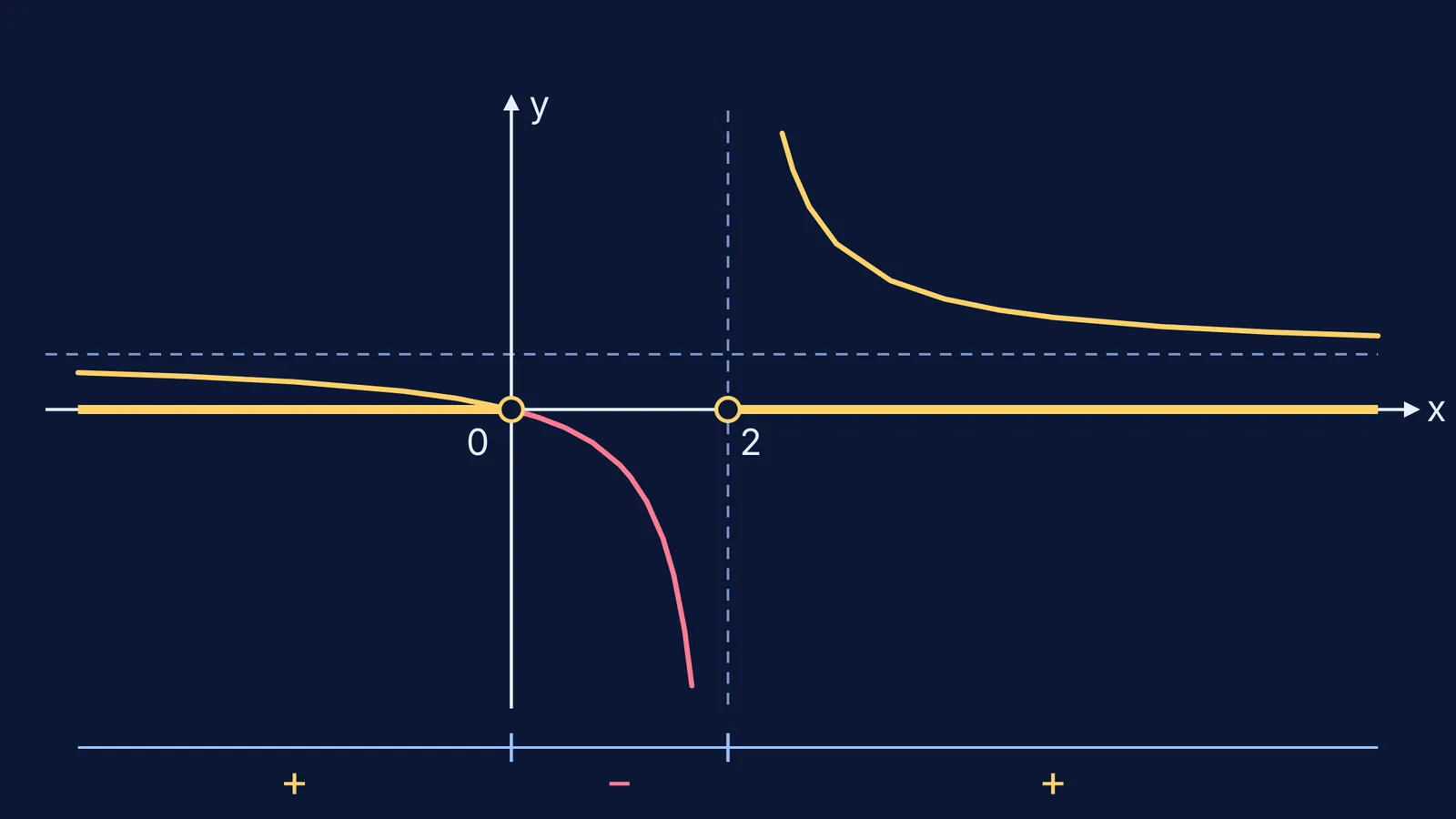
Find the critical points. The numerator is zero at x = 0; the denominator is zero at x = 2.
Mark them on a number line. They split it into x < 0, 0 < x < 2 and x > 2.
Test one value in each interval. x = −1 gives (−1)/(−3), positive. x = 1 gives 1/(−1), negative. x = 3 gives 3/1, positive.
Keep the positive intervals, then decide the endpoints. At x = 0 the fraction is 0, not greater than 0, so 0 is out. At x = 2 the denominator is zero, so 2 is always out.
Answer: x ∈ (−∞, 0) ∪ (2, ∞), with round brackets because neither endpoint is included. If brackets are the shaky part, see square versus round brackets in interval notation.
How do you solve (x + 3)/(x − 1) ≥ 2?
Cross-multiplying gives x + 3 ≥ 2x − 2, so x ≤ 5. But x = 0 satisfies x ≤ 5 and gives 3/(−1) = −3, which is not at least 2. Instead, subtract 2 and combine over one denominator:
(x + 3)/(x − 1) − 2 = (x + 3 − 2x + 2)/(x − 1) = (5 − x)/(x − 1) ≥ 0
The critical points are x = 5 (numerator) and x = 1 (denominator). Test x = 0: 5/(−1), negative. Test x = 2: 3/1, positive. Test x = 6: (−1)/5, negative. At x = 5 the fraction is 0, which satisfies ≥ 0, so include it; x = 1 stays out. Answer: (1, 5]. Check: (5 + 3)/(5 − 1) = 2.
Is there a faster way to check your answer?
Multiply by the square of the denominator. (x − 2)² is positive for every x except 2, so it never flips the sign: x/(x − 2) > 0 becomes x(x − 2) > 0 with x ≠ 2, which again gives x < 0 or x > 2.
With several factors, such as (x + 1)(x − 3)/(x − 5)², the sign chart grows into the wavy curve method for rational inequalities, which also handles repeated factors.
What should you check before writing the final answer?
Did I move everything to one side, with 0 on the other, before finding critical points?
Did I list the zeros of the denominator as critical points, and leave them out of the answer?
Did I test one value in every interval, instead of assuming the signs alternate?
For ≥ or ≤, did I include the zeros of the numerator?
Does one value from inside my answer, and one from outside it, behave correctly in the original inequality?
If you got x > 0 the first time, the mistake was in the method, and method mistakes repeat until you see them. The Fermi Problem Library has worked problems with a step-by-step solver that explains the reasoning rather than printing an answer, so you can see where each sign decision is made, not just the final interval.
Try the checklist on 1/x < 1 next. Cross-multiplying gives x > 1; the sign chart gives x < 0 or x > 1.


