

On this page
You solve the inequality correctly, then lose the mark on the last line. A square bracket sits next to infinity, a closed end lands where the denominator is zero, or two pieces get stuck together with "and". A bracket is part of the answer, not decoration: [2, 5] and [2, 5) are different sets, and only one of them can be right.
What is the difference between square and round brackets?
The NCERT Class 11 Mathematics chapter on Sets (section 1.6.2) defines the open interval (a, b) as the numbers strictly between a and b, so a and b themselves are left out. The same section defines the closed interval [a, b] as {x : a ≤ x ≤ b}, which contains both end points. It also gives the mixed forms: [a, b) includes a but not b, and (a, b] includes b but not a.
The rule in one line, as OpenStax College Algebra explains it: parentheses go with strict "greater than" or "less than", and brackets go with "greater than or equal to" or "less than or equal to".
On a number line, a round bracket matches an open (hollow) circle and a square bracket matches a filled dot, as in Fig 1.1 of the NCERT chapter. If you meet ]a, b in some books, it means the same as (a, b); [Wikipedia's interval article) notes that both forms are described in the ISO 31-11 standard.
Why is infinity always written with a round bracket?
Infinity is not a value x can reach. OpenStax says to "use parentheses to represent infinity or negative infinity, since positive and negative infinity are not numbers in the usual sense of the word and, therefore, cannot be 'equaled.'"
So x ≥ 3 is [3, ∞), never [3, ∞]. NCERT writes the non-negative real numbers as [0, ∞) and the whole real line as (−∞, ∞), round on both ends.
How do you write a solution set that comes in two pieces?
Join the pieces with the union symbol ∪. OpenStax's example: all real numbers less than or equal to −1 or greater than or equal to 1 is written (−∞, −1] ∪ [1, ∞).
A common slip is the chain 1 ≤ x ≤ −1, which asks x to be at least 1 and at most −1 at once. "Or" between pieces becomes ∪; "and" (both conditions together) becomes ∩. If the difference feels fuzzy, our post on union and intersection of intervals on a number line works through it with pictures.
Worked examples: a domain and a solution set
Example 1. Find the domain of f(x) = √(x − 1) / (x − 3).
The square root needs x − 1 ≥ 0, so x ≥ 1. Zero is allowed under a root, so 1 is included: square bracket.
The denominator needs x ≠ 3. A point you remove is always open on both sides.
Domain: [1, 3) ∪ (3, ∞).
For more cases like this, see finding the domain of f + g, f × g and f / g.
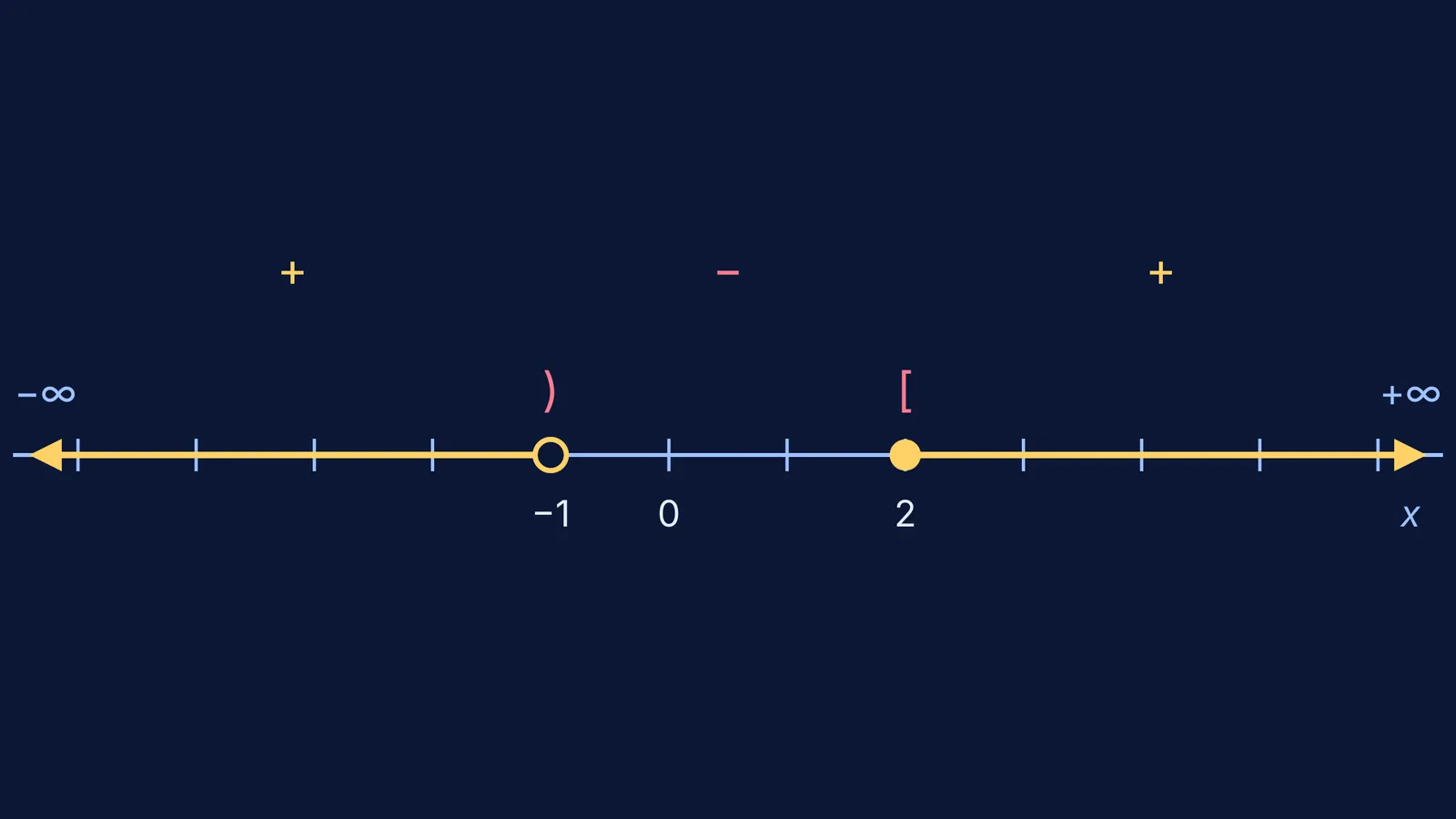
Example 2. Solve (x − 2) / (x + 1) ≥ 0.
Critical points: the top is zero at x = 2; the bottom is zero at x = −1.
Test one number in each region: x = −2 gives (−4)/(−1) = 4, positive; x = 0 gives −2, negative; x = 3 gives 1/4, positive.
Endpoints: x = 2 gives 0, and 0 ≥ 0 is true, so 2 is included. At x = −1 the expression is undefined, so −1 is left out, even though the sign is ≥.
Solution: (−∞, −1) ∪ [2, ∞).
The "or equal to" lets the top be zero, but never the bottom.
How do you check your brackets before you hand in?
Run this checklist on every final answer:
Every ∞ and −∞ has a round bracket.
Every value that makes a denominator zero is round. The same goes for a log's argument, which must be strictly positive (see the domain of log(log x) and nested functions).
≤ and ≥ give square brackets; < and > give round ones. Multiplying by a negative number flips the direction of the sign but never turns ≤ into <, so check strictness against the original question.
Separate pieces are joined by ∪, not by a comma or the word "and".
In each interval the left number is smaller than the right: (5, 2) is not an interval.
Pick one number inside each piece and check it in the original question.
If your algebra is right but the endpoints keep slipping, the Fermi Problem Library has worked problems with a step-by-step solver that explains the reasoning rather than printing an answer, so you can see why each end is open or closed. If the idea of a set itself feels shaky, the Fermi Concept Library gives each mathematics concept its own lesson.
Tonight, run the checklist on your last five inequality answers to find the rule you tend to forget.


