

On this page
In the CBSE Class 11 Mathematics curriculum, intervals are defined as continuous subsets of the real number line ℝ. Yet translating algebraic conditions into interval notation remains a persistent trouble spot. Students routinely confuse square brackets [ ] with round parentheses ( ), shade in the wrong direction, or misjudge whether boundary values belong to a solution set.
In a study of 160 students published in the *International Journal of Mathematical Education in Science and Technology*, researchers Pessia Tsamir and Nava Almog found that students relying solely on algebraic manipulation had the highest error rates, often confusing "and" and "or." Students who translated inequalities onto a coordinate line reached correct solutions far more consistently. A 2026 study by Muhammad Daut Siagian and Izwita Dewi in the *Mathematics Teaching Research Journal* similarly found that while students execute procedural rules like reversing inequality signs, they struggle to visualize solution sets on a number line and misinterpret interval boundaries.
Why do endpoint brackets and circles cause so many mistakes?
The primary source of error is treating brackets and parentheses as interchangeable formatting choices rather than functional set definitions. Two conventions govern every boundary on the real line:
Round parenthesis `(` or `)` (Strict inequality `<` or `>`): The endpoint is excluded, drawn as a hollow circle ○. Unbounded limits (−∞ and ∞) always take round parentheses because infinity is a direction of growth rather than a real number.
Square bracket `[` or `]` (Non-strict inequality `≤` or `≥`): The endpoint is included, drawn as a filled solid dot ●.
When combining inequalities, an endpoint must be evaluated against the specific operation—intersection or union—being performed.
How do you draw intervals and find their intersection?
An intersection represents the logical operator AND (symbol ∩). The set A ∩ B contains only numbers belonging to set A and set B simultaneously.
To find an intersection on a number line:
Mark all boundary values on a horizontal axis in ascending order.
Draw each interval on a separate track above the axis, using solid dots ● for included endpoints and open circles ○ for excluded ones.
Drop vertical guide lines to identify the span where both tracks are shaded simultaneously.
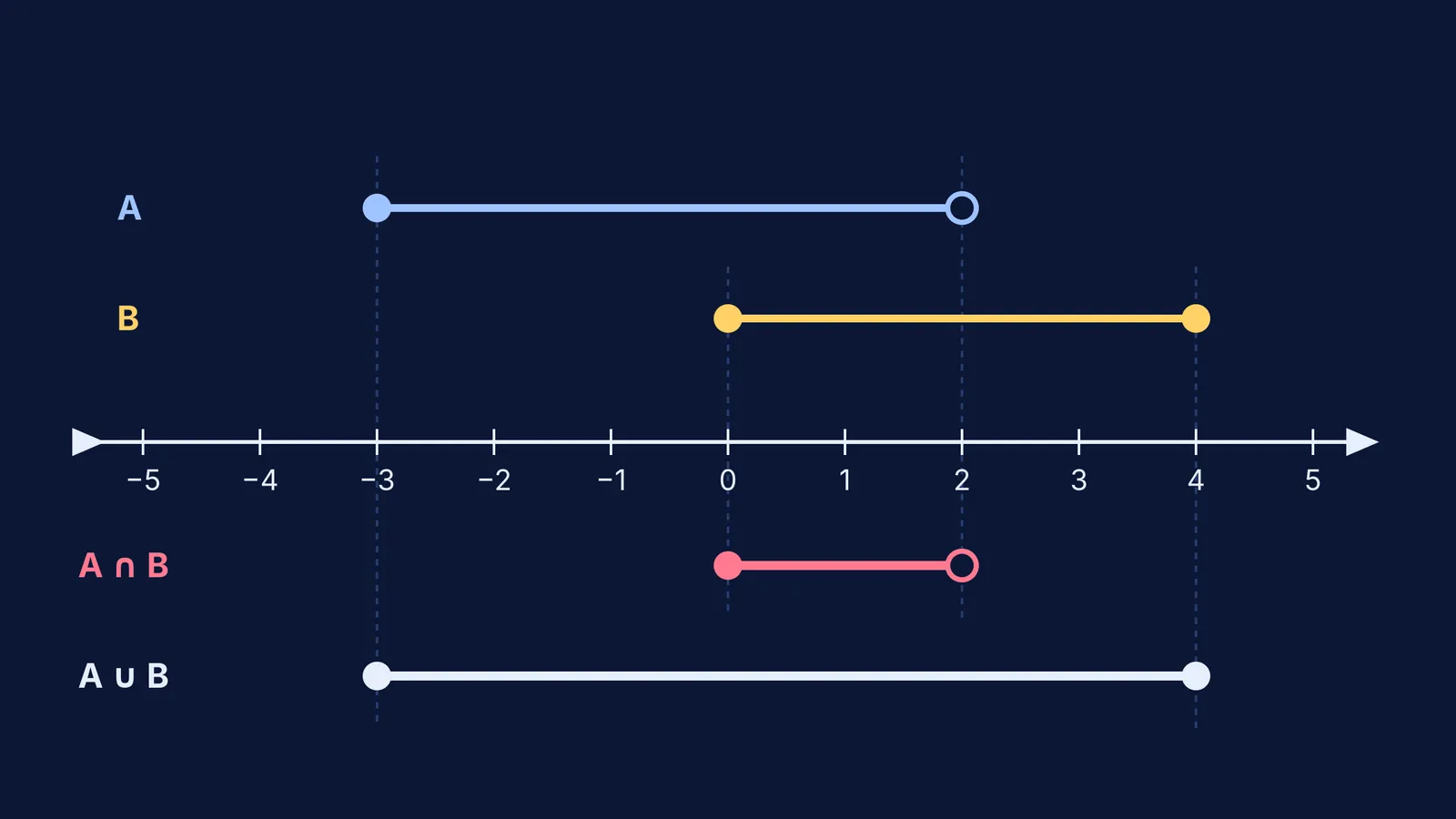
For [−3, 2) ∩ [0, 4]:
At x = 0: 0 is inside [−3, 2) and closed in [0, 4], so both sets contain it, giving [0.
At x = 2: 2 is inside [0, 4] but excluded by the open circle in [−3, 2), giving 2).
The intersection is 0, 2). This visual check prevents boundary errors when solving systems of [linear inequalities in Class 11 or finding function domains.
How do you find the union when intervals overlap or have gaps?
A union represents the logical operator OR (symbol ∪). The set A ∪ B contains all numbers belonging to set A, set B, or both, forming their combined footprint on the line.
To graph a union:
Plot both intervals on parallel tracks above the axis with their open circles and solid dots.
Project all shaded points onto the main line, merging overlapping or touching segments.
If intervals do not touch, keep them as separate pieces joined by the ∪ symbol.
For the same pair, [−3, 2) ∪ [0, 4]:
At x = −3: Interval A has a solid dot, giving [−3.
At x = 2: Interval A is open, but interval B contains 2. The shading continues through 2 without a gap up to 4.
At x = 4: Interval B has a solid dot, giving 4].
The union is [−3, 4]. When intervals have gaps, such as (−∞, 1] ∪ (3, 7), numbers between 1 and 3 belong to neither set and cannot be merged. This disjoint structure occurs when recording solutions from the wavy curve method for inequalities and solving modulus inequalities with case splits.
What is the step-by-step checklist for endpoint brackets?
Verify each boundary point against three rules:
Is the boundary infinite? Unbounded limits (−∞ or ∞) always take a round parenthesis.
For an intersection (∩): Use a square bracket only if both sets include the point; if either set excludes it, use a round parenthesis.
For a union (∪): Use a square bracket if either set includes the point; use a round parenthesis only if both sets exclude it.
When working through multi-stage algebra, the Fermi Problem Library provides worked problems with a step-by-step solver that explains the reasoning rather than printing an answer. To explore how interval operations underpin domain analysis and calculus, the Fermi Concept Library covers every concept in physics, chemistry, biology, mathematics and computing, each with its own lesson and its place in the map. When boundary rules become confusing, Fermi's AI tutor notices where a student is stuck and decides whether to explain, ask, or show the coordinate representation step by step.


