

On this page
When you combine two functions using basic algebra—such as adding them to form f(x) + g(x) or multiplying them to form f(x)g(x)—the new function only works for inputs that are valid for *both* original functions. The domain of these combined functions is simply the overlap, or intersection, of the two individual domains.
However, division brings one extra rule. Because dividing by zero is mathematically undefined, the quotient function f(x) / g(x) must exclude any x-values that make the denominator function evaluate to zero.
What is the domain of a function?
The domain of a function is the complete set of possible values of the independent variable. In plain terms, it is the set of all possible x-values which will make the function work and output real y-values. Before you can combine functions, you need to identify the restrictions on each individual function.
The most common restrictions in high school mathematics are square roots and fractions. The expression inside a square root must be non-negative, and the denominator of a fraction cannot be zero.
What happens when you add or multiply functions?
Think of a function as a machine that accepts certain numbers and produces an output. If you build a larger machine that uses both f(x) and g(x) at the same time, it can only accept numbers that both smaller machines can handle.
When you add, subtract, or multiply two functions, you are asking both functions to produce an output for the same input x. For example, if you want to evaluate (f + g)(5), you must first evaluate f(5) and g(5), and then add the results. If the number 5 is outside the domain of f(x), then f(5) is undefined, making the entire sum undefined.
Because both f(x) and g(x) must be defined simultaneously, the domain of the new function is strictly the intersection of their individual domains. If the domain of f(x) is D_f and the domain of g(x) is D_g, then the domain of f ± g and fg is D_f ∩ D_g.
Think of it as two students working on a project together. They can only meet during the times when both of their schedules overlap. In the same way, the combined function only operates on the overlapping interval of inputs.
Why does f / g have an extra rule?
The quotient function f/g behaves mostly the same way, taking the intersection of the two domains. But fractions come with a strict restriction: the denominator cannot be zero.
According to page 36 of the NCERT Class 11 Mathematics textbook, the quotient of two real functions is defined "provided g(x) ≠ 0". This means you must first find the intersection of the domains of f and g, and then manually remove any x-values that cause the bottom function to equal zero.
How do you find the domain of a combined function?
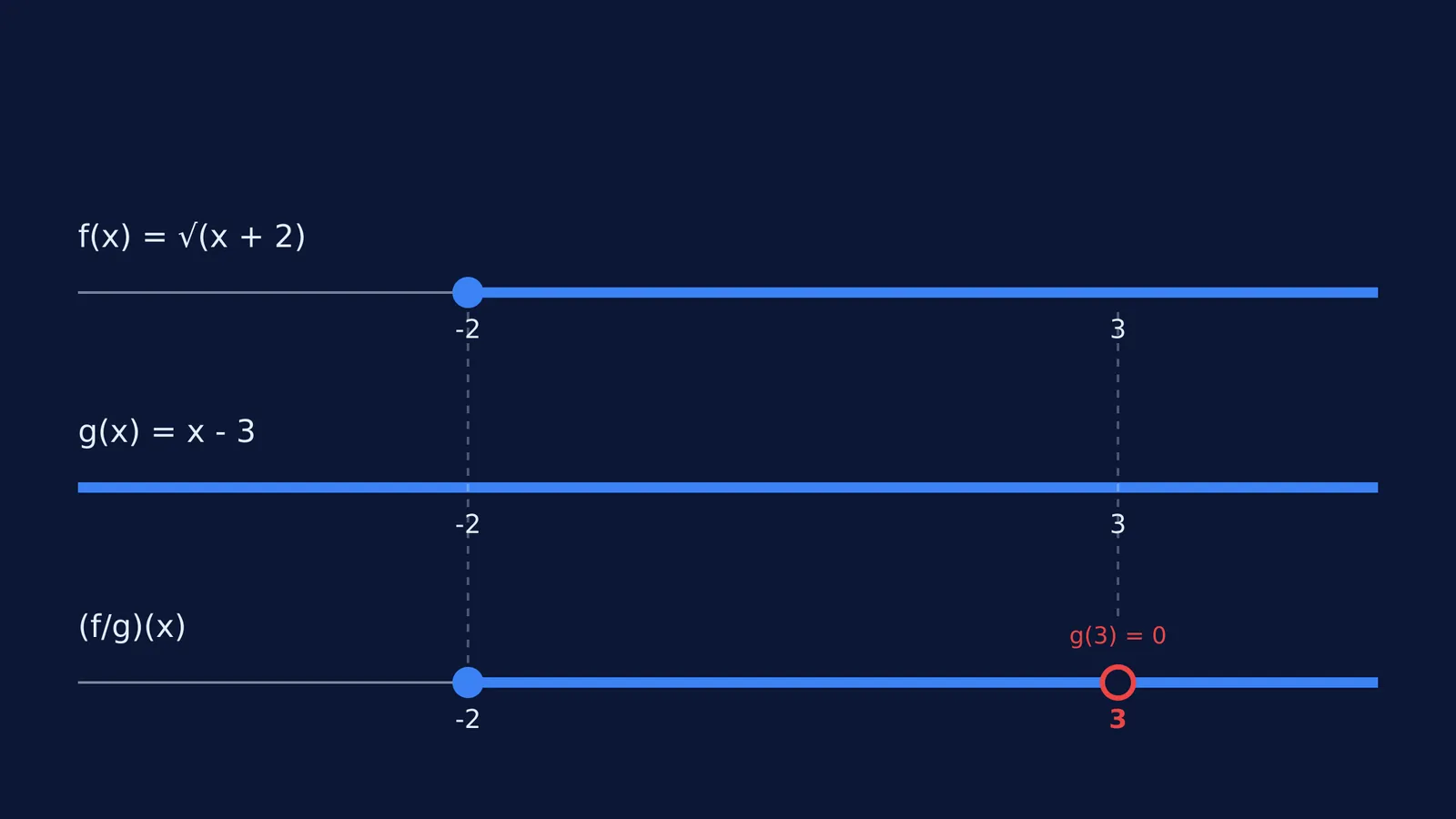
Let us find the domain of the sum and quotient of these two functions: f(x) = √(x + 2) g(x) = x − 3
First, find the domain of each function on its own:
For f(x), the expression under the square root must be non-negative. We set x + 2 ≥ 0, which simplifies to x ≥ -2.
For g(x), a linear polynomial has no restrictions. You can plug in any real number and get a valid output.
Next, find their intersection: The overlap of "x ≥ -2" and "all real numbers" is simply x ≥ -2. If you draw this on a number line, the region where both conditions are satisfied is the interval from -2 extending infinitely to the right. Therefore, the domain of the sum (f + g)(x), the difference (f - g)(x), and the product (fg)(x) is x ≥ -2.
Finally, find the domain of the quotient (f / g)(x). We start with the intersection x ≥ -2, but we must also check where the denominator equals zero. The function g(x) is zero when x − 3 = 0, which gives x = 3. Because division by zero is undefined, we must remove x = 3 from our intersection. The final domain of the quotient is x ≥ -2 and x ≠ 3.
If you are stuck on finding the intersection of domains or dealing with absolute values and roots, the Fermi Problem Library has worked problems with a step-by-step solver that explains the reasoning rather than printing an answer.
For a deeper look into the rules governing these mathematical operations, explore the Concept Library, or review how to find the Range of a rational function using the discriminant method. You can also read our guide on Functions for JEE: domain, range and composite functions done right.


