On this page
Most industrial hydrogen starts as natural gas, and the step that squeezes out the last of it is the water gas shift reaction. If you are studying equilibrium, enthalpy or catalysis for Class 11 and 12, JEE Main or a board exam, this one process uses all three. Here is the route in three steps, with the equations, the conditions real plants use and a worked calculation.
How is hydrogen made commercially from natural gas?
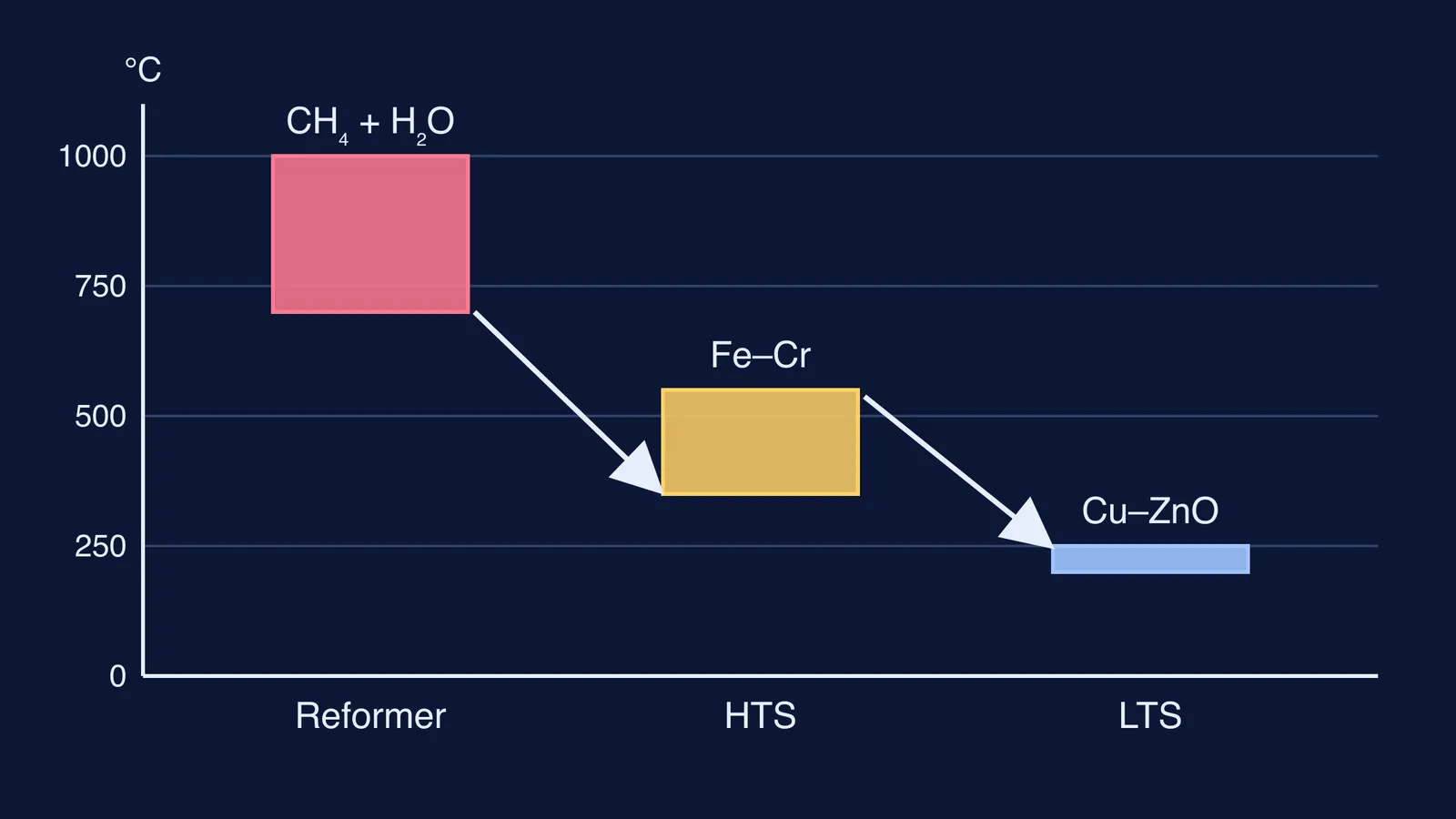
The first step is steam-methane reforming. According to the US Department of Energy, methane reacts with high-temperature steam (700–1,000 °C) under 3–25 bar pressure in the presence of a catalyst:
CH₄ + H₂O (+ heat) → CO + 3H₂
The product, a mixture of carbon monoxide and hydrogen, is called synthesis gas or syngas. The reaction takes in heat, which is one reason the reformer runs so hot. The same DOE page says 95% of the hydrogen produced in the United States is made by natural gas reforming in large central plants.
What is the water gas shift reaction?
The water gas shift reaction converts carbon monoxide and steam into carbon dioxide and more hydrogen:
CO + H₂O ⇌ CO₂ + H₂, ΔH° = −41.2 kJ/mol
The water gas shift reaction is reversible and moderately exothermic, with ΔH° = −41.2 kJ/mol, according to a doctoral thesis on water gas shift kinetics by Caitlin Callaghan at Worcester Polytechnic Institute (2006). Because the reaction gives out heat, its equilibrium constant falls as temperature rises, so lower temperatures favour hydrogen. A 2020 review in Emergent Materials by Parisa Ebrahimi, Anand Kumar and Majeda Khraisheh agrees: pressure has no thermodynamic effect, and low temperatures favour high hydrogen selectivity.
Now count the moles of gas: two on the left, two on the right. That is why pressure does not shift this equilibrium, so temperature is the lever that matters. Our post on predicting equilibrium shifts with Le Chatelier's principle walks through this kind of reasoning step by step.
Why is the water gas shift done in two stages?
Here is the catch. Low temperature favours the products, but the reaction is slow when cold. The Callaghan thesis describes how industry gets both speed and yield:
High-temperature shift (HTS): an iron oxide catalyst with chromia, with the gas entering at about 350 °C. The temperature climbs as the reaction releases heat, up to a maximum of about 530–550 °C.
Cooling: the gas leaving the HTS reactor is cooled, usually by quenching with water, which also adds steam.
Low-temperature shift (LTS): a catalyst of copper, zinc oxide and alumina, active down to about 200 °C and kept below about 250 °C because copper sinters easily. Here the equilibrium lies further towards hydrogen, so more of the leftover CO is converted.
If that trade-off feels familiar, compare it with why the Haber process uses 450 °C and 200 atm. Both shift catalysts are solids acting on gases, which makes them textbook cases in our guide to homogeneous and heterogeneous catalysis.
How is CO₂ removed to get pure hydrogen?
After the shift, the gas is mostly hydrogen and carbon dioxide. The US Department of Energy says the final step is pressure-swing adsorption, which removes carbon dioxide and other impurities to leave essentially pure hydrogen.
Add the reforming and shift equations and the CO cancels, giving the overall change:
CH₄ + 2H₂O → CO₂ + 4H₂
Worked example: how much hydrogen from 16 kg of methane?
Take the ideal case, where every molecule reacts completely.
Moles of methane: 16 kg ÷ 16 g/mol = 1,000 mol CH₄.
Reforming: 1,000 mol CH₄ gives 1,000 mol CO and 3,000 mol H₂.
Shift: 1,000 mol CO gives another 1,000 mol H₂ and 1,000 mol CO₂.
Total hydrogen: 4,000 mol × 2 g/mol = 8 kg H₂. The shift supplied one quarter of it.
Carbon dioxide: 1,000 mol × 44 g/mol = 44 kg, or 5.5 kg of CO₂ for every kilogram of hydrogen, from the reaction alone.
Real plants fall short of this ceiling: the shift is an equilibrium, and the heat for the reformer has to come from somewhere. If a step of a numerical like this goes wrong, the Fermi Problem Library has worked problems with a step-by-step solver that explains the reasoning rather than printing an answer.
What should you write in an exam answer?
A full-marks answer on commercial hydrogen production usually covers five points:
The reforming equation, with high temperature, a catalyst and the word syngas.
The shift equation, written as reversible, with a negative ΔH.
Why there are two stages: a fast hot stage, then a cooler stage for better yield.
CO₂ removal by pressure-swing adsorption.
The overall equation, CH₄ + 2H₂O → CO₂ + 4H₂.
If point 3 feels shaky, the gap is usually equilibrium constants and temperature rather than this process. The Fermi Concept Library gives each chemistry concept its own lesson, so you can fix that first and come back.
Cover the equations, rewrite them from memory, then redo the 16 kg calculation with 8 kg of methane.