

On this page
Le Chatelier's principle says ammonia forms best when the gases are cold and squeezed, yet real plants run hot. The answer examiners want is a trade-off between where the equilibrium lies and how fast the reaction gets there, and a full-mark answer names both sides.
What does Le Chatelier's principle say about making ammonia?
The reaction is N₂(g) + 3H₂(g) ⇌ 2NH₃(g). The standard enthalpy of formation of ammonia gas is −45.94 kJ/mol (NIST Chemistry WebBook), so the forward reaction releases about 92 kJ for every 2 mol of ammonia formed.
Two predictions follow:
The forward reaction is exothermic, so lowering the temperature shifts the equilibrium to the right.
Four molecules of gas become two, so raising the pressure shifts the equilibrium to the right.
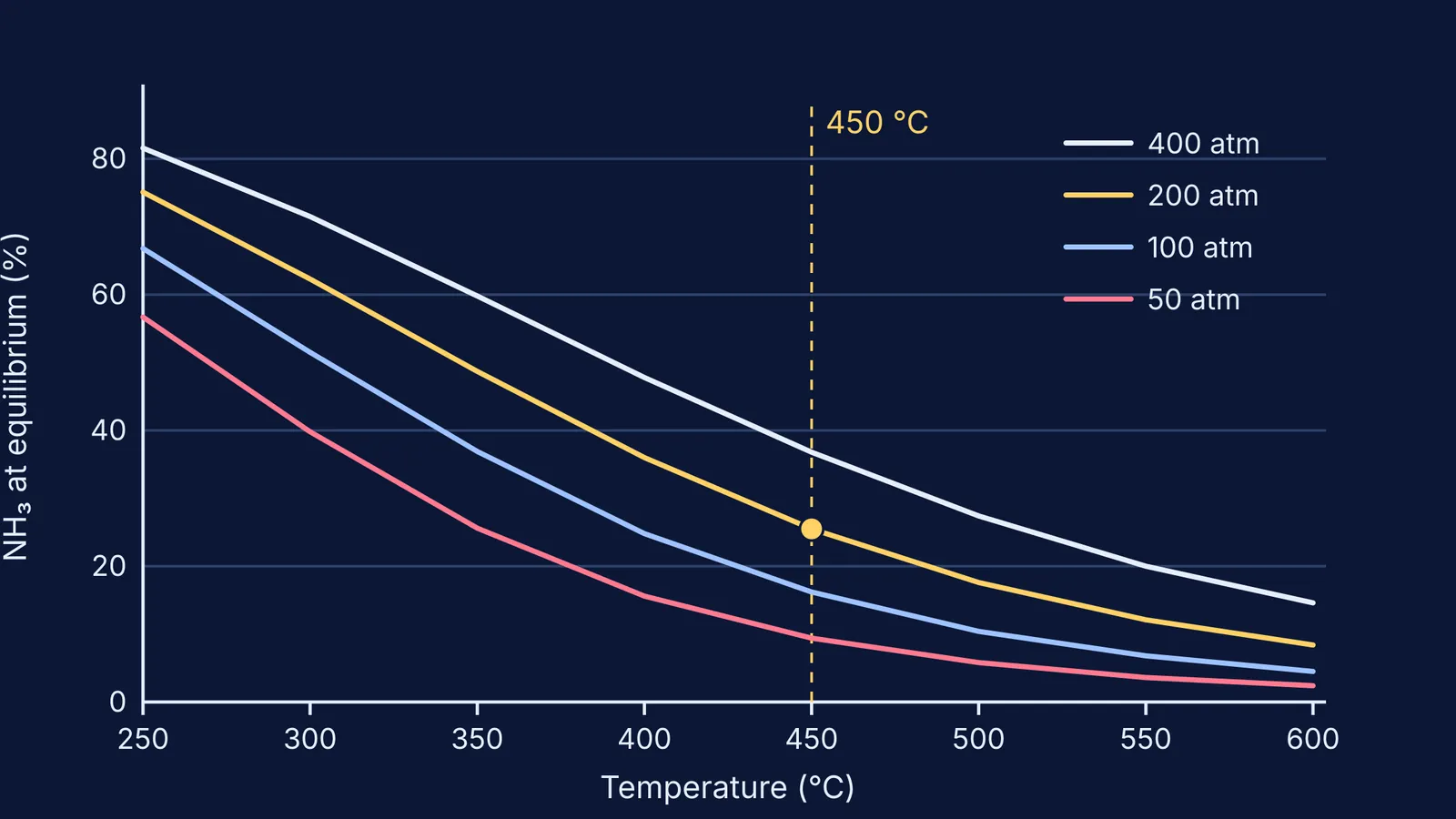
The diagram above shows how strong both effects are. We calculated the equilibrium share of ammonia for a 1:3 nitrogen-hydrogen mix, treating the gases as ideal, using free energies from the NIST-JANAF ammonia table. At 200 atm, ammonia falls from about 62% of the equilibrium mixture at 300 °C to about 25% at 450 °C. At 450 °C, raising the pressure from 50 atm to 200 atm lifts it from about 9% to about 25%.
Why does the Haber process use 450 °C instead of a lower temperature?
Because of rate. As Chemguide's page on the Haber process puts it, "The lower the temperature you use, the slower the reaction becomes." The same page gives typical conditions of 400-450 °C and 200 atmospheres, with an iron catalyst and potassium hydroxide as a promoter.
A plant is judged on tonnes per hour, not percentage at equilibrium. A high yield that takes weeks is worth less than a moderate yield that arrives in seconds.
Chemguide is blunt that the catalyst "has no effect whatsoever on the position of the equilibrium". Its job is to make a moderate temperature fast enough. For how strongly temperature drives rate, see our post on the temperature coefficient of reaction rate.
Why 200 atm and not 1,000 atm?
Higher pressure raises the yield and speeds the reaction. But Chemguide notes that "very high pressures are very expensive to produce", in both the energy to compress the gas and the strength of the equipment. In our calculation, doubling from 200 atm to 400 atm at 450 °C raises the equilibrium share from about 25% to about 37%, for a far costlier plant.
How does the same trade-off work in the Ostwald process?
The Ostwald process makes nitric acid from ammonia in three steps (overview of the Ostwald process):
4NH₃ + 5O₂ → 4NO + 6H₂O, over platinum gauze alloyed with 10% rhodium, at about 900 °C and up to 8 atm.
2NO + O₂ → 2NO₂, after the gases are cooled from around 900 °C to roughly 250 °C.
3NO₂ + H₂O → 2HNO₃ + NO, with the NO sent back round.
Step 1 is strongly exothermic, yet it runs hot, because speed matters: the same overview says a side reaction that wastes ammonia is kept down by a short contact time with the catalyst. Pressure works slightly against step 1, as nine gas molecules become ten. A 2024 Heliyon paper tabulates nitric oxide yields of 97% below 1.7 bar, 96% at 1.7-6.5 bar and 95% above 6.5 bar, where the temperature is also higher (Alhasan et al., Heliyon).
In step 2, Le Chatelier and the plant agree: it is exothermic and three gas molecules become two, so cooling helps. For the people behind both processes, read our profiles of Wilhelm Ostwald and catalysis and Fritz Haber and the questions ammonia synthesis raises.
How do you write a full-mark answer on industrial conditions?
In a CBSE board paper or a JEE Main test, use four lines per condition:
Equilibrium: which way it shifts, and why (the sign of ΔH, or the moles of gas).
Rate: faster or slower, and why (collisions, activation energy).
Cost: energy, equipment or safety.
Verdict: the chosen value is a compromise between these.
Worked example. "Explain why about 450 °C is used in the Haber process, although a lower temperature gives more ammonia." (3 marks)
The forward reaction is exothermic, so a lower temperature shifts the equilibrium right and raises the yield.
At a low temperature, fewer molecules have energy above the activation energy, so the rate is too slow, even with the iron catalyst.
About 450 °C gives an acceptable yield at an acceptable rate; unreacted gases are recycled.
If the shift rules feel shaky, the Fermi Concept Library gives each concept its own lesson and its place in the map. When you practise, the Fermi Problem Library has worked problems with a step-by-step solver that explains the reasoning rather than printing an answer, so you can check that your justification covers all four lines.
Next, try the four-line method on the Contact process for sulphuric acid.


