

On this page
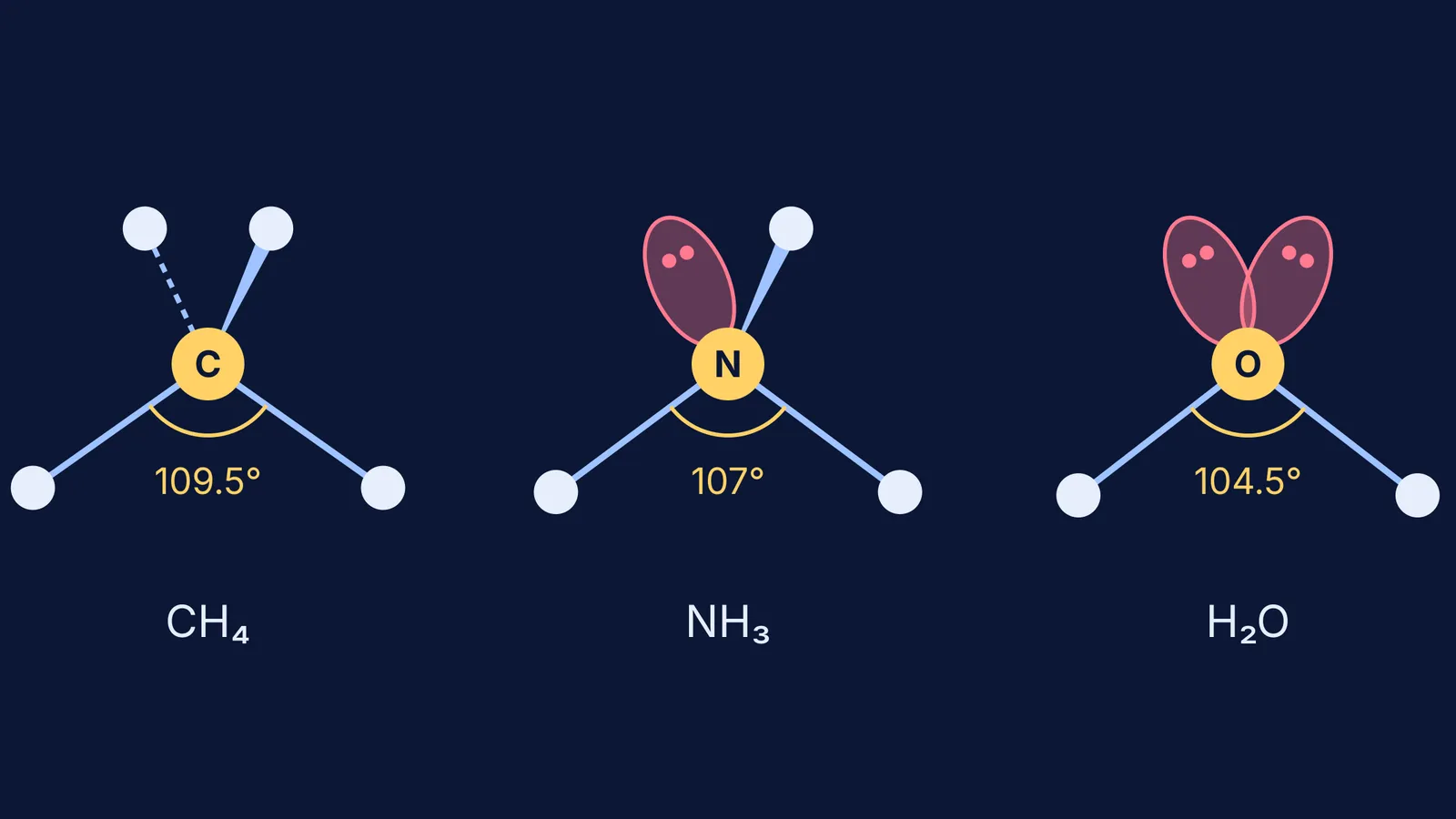
In VSEPR theory, methane (CH4), ammonia (NH3) and water (H2O) share one arrangement with one change. Each central atom carries four electron pairs. What changes is how many of those pairs are bonds and how many are lone pairs, and each swap of a bond for a lone pair squeezes the H–X–H angle a little more.
Why do bond angles drop from CH4 to NH3 to H2O?
Four electron pairs around a central atom point towards the corners of a tetrahedron, because that keeps them as far apart as possible. In methane all four are bond pairs, so every H–C–H angle is the full tetrahedral angle. NIST's Computational Chemistry Comparison and Benchmark Database lists the experimental H–C–H angle in methane as 109.47°.
Ammonia replaces one bond with a lone pair. The same database gives the H–N–H angle in ammonia as 106.67°, or about 107° when rounded.
Water replaces a second bond with a lone pair. The same database lists the equilibrium H–O–H angle in water as 104.48°, usually written as 104.5°.
So the pattern is: no lone pairs, 109.5°; one lone pair, about 107°; two lone pairs, 104.5°.
Why does a lone pair repel more than a bond pair?
A bond pair is shared between two nuclei, so it is drawn out along the bond, away from the central atom. A lone pair belongs to the central atom alone. In the words of an open general chemistry textbook, "Because a lone pair is not shared by two nuclei, it occupies more space near the central atom than a bonding pair" (LibreTexts, The VSEPR Model/09%3A_Molecular_Geometry_and_Bonding_Theories/9.02%3A_The_VSEPR_Model)).
The same textbook gives the order of repulsions as BP–BP < LP–BP < LP–LP. Written out in full:
lone pair–lone pair repulsion is the strongest
lone pair–bond pair repulsion comes next
bond pair–bond pair repulsion is the weakest
R. J. Gillespie and R. S. Nyholm set out this electron-pair repulsion approach to molecular shape in their 1957 review Inorganic stereochemistry in Quarterly Reviews, Chemical Society. For the full set of VSEPR shapes, see our guide to VSEPR theory and molecular shapes.
Now apply the ranking. Methane has only equal bp–bp repulsions, so nothing distorts the tetrahedron. In ammonia, the lone pair pushes on three bonds through lp–bp repulsion, which is stronger than bp–bp repulsion, so the bonds bend towards each other. In water, the two lone pairs repel each other most strongly and both push on the two bonds, so the bonds close up further.
How do you use the lp–lp > lp–bp > bp–bp rule in an exam?
Use this four-step check whenever a question asks you to compare bond angles:
Count the electron pairs (domains) around the central atom: bonds plus lone pairs. A double bond counts as one domain.
Check that the molecules have the same central atom and the same number of domains. The rule works most cleanly then.
Count the lone pairs. More lone pairs means a smaller angle between the bonds.
Name the shape from the atoms only, not the lone pairs.
Worked example: rank NH4+, NH3 and NH2− by H–N–H angle.
NH4+: nitrogen's 5 valence electrons minus 1 for the charge leaves 4, all used in 4 bonds. That's 4 bond pairs and no lone pairs, so it is tetrahedral, like methane at 109.47°.
NH3: 3 bond pairs and 1 lone pair, so it is trigonal pyramidal at about 107°.
NH2−: 5 plus 1 for the charge gives 6 electrons; 2 go into the N–H bonds and 4 are left as 2 lone pairs. It is bent like water, so its angle is smaller again.
Answer: NH4+ > NH3 > NH2−. The central atom is nitrogen each time and there are always four domains, so the number of lone pairs decides the order.
To practise more bond-angle questions, try the Fermi Problem Library. Its step-by-step solver explains the reasoning rather than printing an answer, so you can see where your counting went wrong.
When does the lone-pair rule not settle the answer?
The ranking compares molecules with the same central atom and the same number of electron pairs. Once the central atom or the outer atoms change, other effects come in, such as electronegativity and atom size. NH3 and PH3 both have one lone pair, yet their angles differ; our explainer on comparing the bond angles of NH3 and PH3 explains why. Likewise, H2O, OF2 and Cl2O all have two lone pairs on oxygen but different angles; see bond angles in H2O, OF2 and Cl2O.
If VSEPR still feels like a list of shapes to memorise, start from the idea underneath: electron pairs repel each other, and lone pairs repel the most. The Fermi Concept Library gives every concept in chemistry its own lesson and its place in the map, so you can see how VSEPR connects to the ideas around it.


