

On this page
If a question asks you to arrange H2O, OF2 and Cl2O by bond angle, the answer is OF2 < H2O < Cl2O. This exact trend appeared as a statement to judge in JEE Main 2026 (6 April, shift 2), as reproduced by Cracku's archive of the paper. The reasoning matters more than the order, because the same two ideas sort many other molecules.
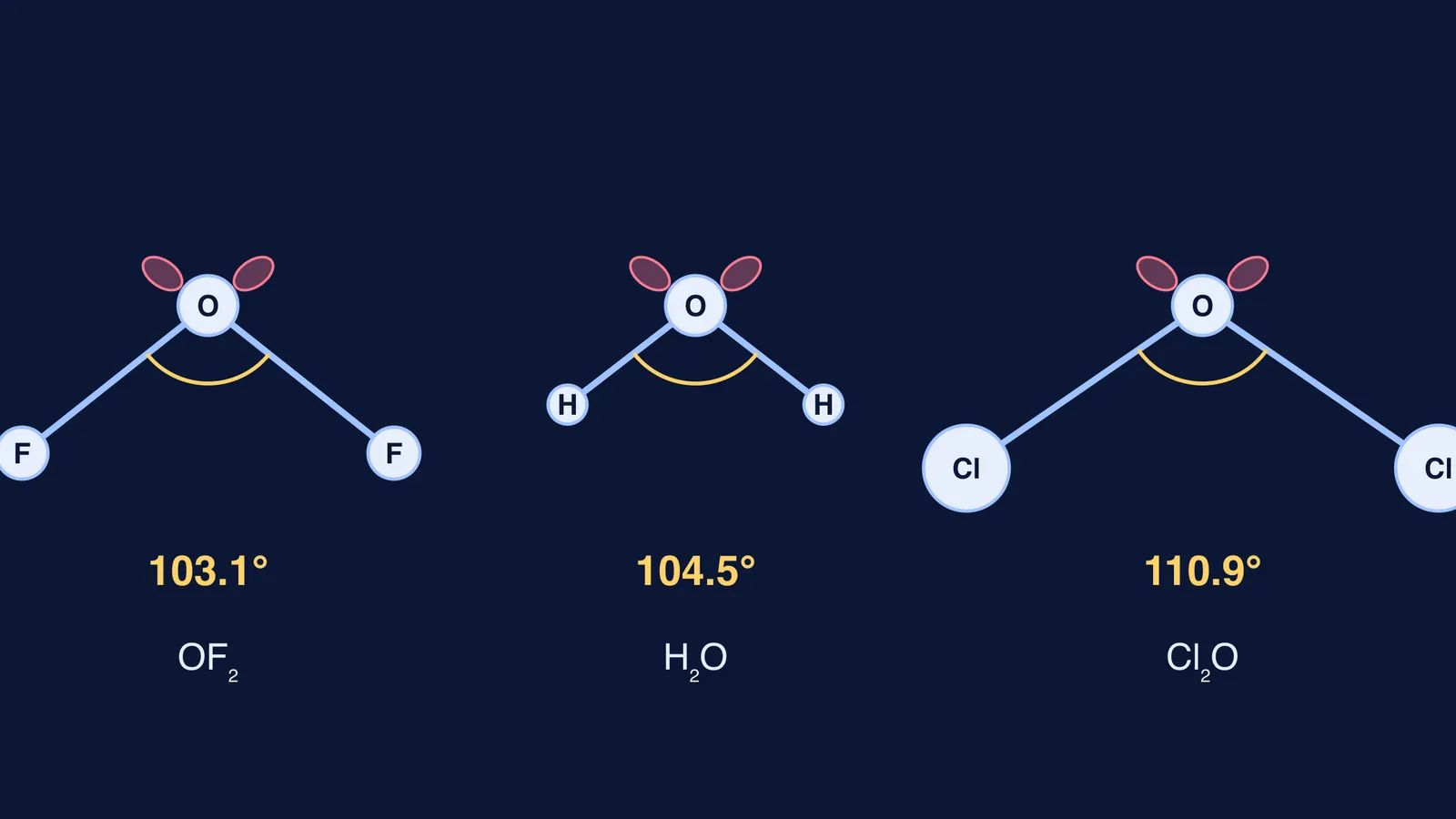
What are the measured bond angles of OF2, H2O and Cl2O?
NIST's Computational Chemistry Comparison and Benchmark Database (CCCBDB) lists experimental gas-phase geometries for all three molecules:
OF2: the F–O–F angle is 103.1° and each O–F bond is 1.405 Å (NIST CCCBDB, F2O).
H2O: the H–O–H angle is 104.48° and each O–H bond is 0.958 Å (NIST CCCBDB, H2O).
Cl2O: the Cl–O–Cl angle is 110.88° and each O–Cl bond is 1.696 Å (NIST CCCBDB, Cl2O).
Rounded, these are 103°, 104.5° and 111°. Notice that Cl2O comes out wider than the tetrahedral 109.5°, even though its oxygen still carries two lone pairs.
Why is the bond angle of OF2 smaller than H2O?
In all three molecules oxygen has four electron pairs: two bonding pairs and two lone pairs. VSEPR theory, credited to Gillespie and Nyholm in an NPTEL lecture on VSEPR, therefore predicts a bent shape. The lone pairs repel more strongly than bond pairs and squeeze the two bonds below 109.5°. What changes from molecule to molecule is where the bonding electrons sit.
The Pauling electronegativities are F 3.98, O 3.44, Cl 3.16 and H 2.20, according to the LibreTexts electronegativity table.
The NPTEL lecture states the rule: "when the difference in electronegativity between the two connecting atoms increases the electron pair is shifted towards the more electronegative atom". It uses the same argument for the larger H–O–H angle compared with F–O–F.
In OF2, fluorine is more electronegative than oxygen, so the two bonding pairs are pulled out towards the fluorine atoms. Near oxygen they repel each other less, the lone pairs win, and the angle closes to about 103°.
In H2O, oxygen is the more electronegative atom, so it pulls the bonding pairs in towards itself. Crowded near oxygen, they repel each other more and the angle opens a little, to about 104.5°.
Why is the bond angle of Cl2O larger than H2O?
Electronegativity alone gets Cl2O wrong. Chlorine (3.16) is less electronegative than oxygen but more electronegative than hydrogen, so by that argument Cl2O should land a little below water. The measured 110.9° says something else wins, and that something is size.
The O–Cl bond is 1.696 Å against 0.958 Å for O–H (NIST values above), and each chlorine carries three lone pairs of its own. At a water-like angle the two chlorine atoms would sit too close together. The WebMO periodic trends exercise key puts the wider angle down to "Pauli repulsion due to the significant overlap of the two chlorine electron clouds". In plain words, the two big outer atoms push each other apart.
How do you answer an arrange-by-bond-angle question?
Use this three-step check for any set of molecules with the same central atom:
Count lone pairs on the central atom. More lone pairs mean a smaller angle, and this check comes first.
If the lone pairs are equal, compare the outer atoms' electronegativity. A more electronegative outer atom pulls the bond pairs away from the centre and gives a smaller angle (OF2 < H2O).
Check size. Large outer atoms such as chlorine crowd each other and can override step 2 (Cl2O > H2O).
How close do the outer atoms get in OF2, H2O and Cl2O?
For a bent molecule, the distance between the two outer atoms is d = 2 × (bond length) × sin(angle ÷ 2). Using the NIST CCCBDB values for OF2, H2O and Cl2O:
OF2: d = 2 × 1.405 × sin(51.55°) = 2.20 Å between the two fluorines.
H2O: d = 2 × 0.958 × sin(52.24°) = 1.51 Å between the two hydrogens.
Cl2O: d = 2 × 1.696 × sin(55.44°) = 2.79 Å between the two chlorines.
Now squeeze Cl2O to water's 104.48°: d = 2 × 1.696 × sin(52.24°) = 2.68 Å. That would push two large, lone-pair-rich chlorine atoms about 0.11 Å closer together. Opening the angle by about 6° is how the molecule avoids it.
Bent's rule gives another way to see why electronegative outer atoms close an angle; our post on how to use Bent's rule to predict bond angles works through it. If you check answers like this with a chatbot, read whether you can trust AI on inorganic chemistry exceptions first.
If VSEPR itself feels shaky, the Fermi Concept Library gives each chemistry concept its own lesson and shows its place in the map. To practise the three-step check on more molecules, the Fermi Problem Library has worked problems with a step-by-step solver that explains the reasoning rather than printing an answer.


