

On this page
VSEPR tells you a carbon with four groups is roughly tetrahedral. It cannot tell you why the angles in CH₂F₂ are not all 109.5°. Bent's rule fills that gap. Here is what it says, a five-step method, two worked examples with measured angles, and where it goes wrong.
What is Bent's rule?
Henry A. Bent stated the rule in a 1961 review in Chemical Reviews: an atom concentrates its s-character in the hybrid orbitals directed toward electropositive substituents. Put the other way round, the bonds to electronegative atoms get more p-character.
The reasoning is about energy. An s orbital holds electrons closer to the nucleus than a p orbital. Fluorine pulls the bonding pair away anyway, so the central atom saves its s-character for bonds where electrons stay close, such as bonds to hydrogen, and for lone pairs.
Why does this change angles? Pure p orbitals sit at 90° to each other, sp³ hybrids at 109.5° and sp² hybrids at 120°. More p-character means a narrower angle. For two equivalent hybrids written as spⁿ, Coulson's relation gives cos θ = −1/n, as set out in the Wikipedia article on Bent's rule, which cites Coulson's textbook Valence.
If hybridisation itself still feels shaky, start with our guide to finding sp, sp² and sp³ hybridisation quickly, then come back.
How do you use Bent's rule to predict bond angles?
Find the central atom and its ideal shape with VSEPR (our four-step VSEPR method covers this).
Rank the groups on it from most electropositive to most electronegative. Lone pairs behave like the most electropositive group: they take the most s-character.
Give the s-rich orbitals to the electropositive groups. Angles between those bonds open up past the ideal value.
Give the p-rich orbitals to the electronegative groups. Angles between those bonds close below the ideal value.
For a trigonal bipyramid, remember the equatorial positions are s-rich and the axial positions are p-rich, so electronegative atoms go axial.
Why is F–C–F in CH₂F₂ below 109.5°?
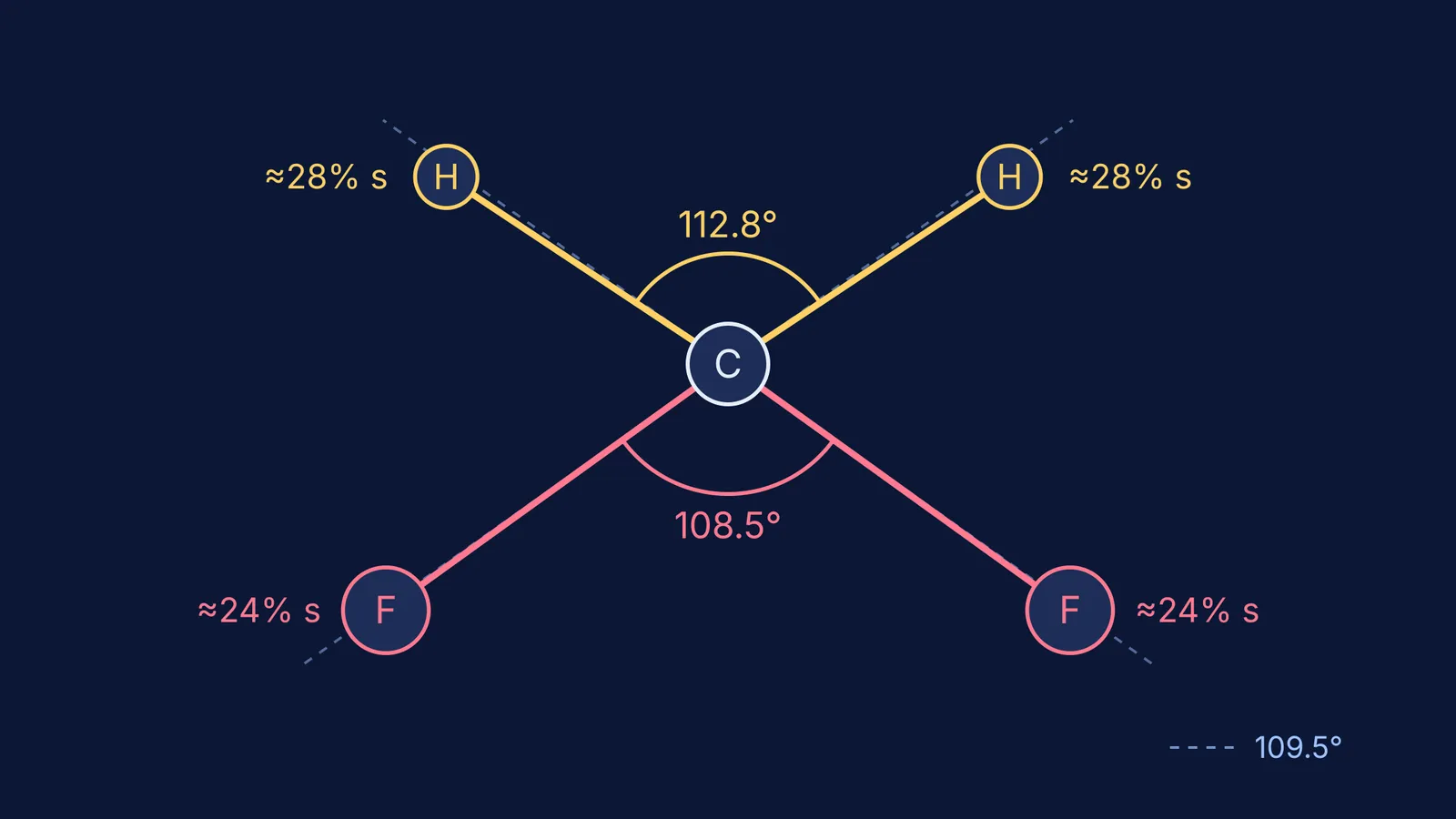
Fluorine is far more electronegative than hydrogen, so Bent's rule predicts H–C–H above 109.5° and F–C–F below it. The measured geometry in the NIST Computational Chemistry Comparison and Benchmark Database agrees: H–C–H is 112.8° and F–C–F is 108.49°.
You can turn those angles into s-character with Coulson's relation. For H–C–H, cos 112.8° is about −0.388, so n is about 2.58 and each C–H hybrid is about 28% s. For F–C–F, cos 108.49° is about −0.317, so n is about 3.15 and each C–F hybrid is about 24% s. The four add up to roughly 104% rather than exactly 100%, a reminder that this is a model and real bonds need not point exactly along their hybrids.
Where do the fluorines go in PCl₃F₂?
Phosphorus here has five bonds and no lone pairs, so the frame is a trigonal bipyramid. Step 5 says the two fluorines should take the p-rich axial sites and the three chlorines the equatorial ones. Vibrational spectra reported by Griffiths, Carter and Holmes in 1964 support that: in PCl₃F₂ the fluorine atoms occupy the axial positions, giving a D3h structure. The same paper found that in PCl₂F₃ two fluorines are axial and one is equatorial, consistent with fluorine taking the axial sites first.
Where does Bent's rule fail?
The rule is a tendency, not a law, and other effects can beat it.
Other effects can win. Compare three oxygen-centred molecules in NIST's measured data. Water's H–O–H angle is 104.48°. OF₂ has 103.1°, in line with the rule. But Cl₂O, where chlorine is also more electronegative than hydrogen, has a Cl–O–Cl angle of 110.88°, wider than water's. Bent's rule alone predicts the opposite, so something else wins here; the size of the two chlorine atoms is one likely factor.
Heavier central atoms hybridise less. The H–S–H angle in H₂S is 92.1°, close to the 90° of pure p orbitals, which suggests little s/p mixing to redistribute. For atoms from lower periods, trends depend on orbital size as well as electronegativity, as the Wikipedia summary notes. Our post on comparing bond angles in NH₃ vs PH₃ and H₂O vs H₂S goes deeper into this.
It gives direction, not numbers. The rule tells you which angle is bigger. It cannot predict 108.49° on its own.
How should you practise this?
Take five molecules with mixed substituents, such as CH₂Cl₂, CH₃F, PCl₄F, SF₄ and NF₃. Run the five steps, write your prediction, then look up the measured angles. Where you miss, write one line on which effect won.
If a step feels shaky, the Fermi Concept Library has a lesson on each idea underneath, from hybridisation to electronegativity. For practice, the Fermi Problem Library has worked problems with a step-by-step solver that explains the reasoning rather than printing an answer, so you can see where your method went wrong.


