

On this page
You ask a chatbot for the electronic configuration of chromium, or why zinc salts are white, and you get a fluent, confident answer. Often it is right. The trouble is that NCERT inorganic chemistry is full of exceptions, and an exception is exactly the kind of fact an AI can smooth over.
How accurate is AI at chemistry questions?
One large test is ChemBench, published in Nature Chemistry in 2025 by Adrian Mirza, Kevin Maik Jablonka and colleagues (paper). The team curated more than 2,700 question-answer pairs and found that the best models outperformed the best human chemists in their study on average, but "struggle with some basic tasks and provide overconfident predictions" (arXiv abstract).
Overconfidence is the part that matters for you. In the full text, on questions about the safety of chemical compounds, GPT-4 rated its confidence 1.0 on a 1-5 scale for the one question it got right and 4.0 for the six it got wrong. The authors also report that models are "still limited in their ability to answer knowledge-intensive questions": the ones you can only answer by recalling a specific fact.
Much of NCERT inorganic chemistry works like that: configurations, colours of ions, anomalous properties, the one element in a group that behaves differently.
Why does AI slip on inorganic chemistry exceptions?
A 2025 paper by Adam Tauman Kalai and colleagues, Why Language Models Hallucinate, puts it plainly: like students facing hard exam questions, models "sometimes guess when uncertain, producing plausible yet incorrect statements instead of admitting uncertainty". The authors link these errors to facts that appear only once in the training data. Their example: if 20% of birthday facts appear exactly once, expect a base model to hallucinate on at least 20% of birthday facts.
Our reading, which those studies did not test on NCERT questions: an exception is a single fact that sits against a strong pattern. The aufbau order appears in almost every worked example on configurations. "Chromium breaks it" appears far less often. When a model is unsure, the answer that sounds most likely is the rule.
A worked example: chromium, copper and a colourless ion
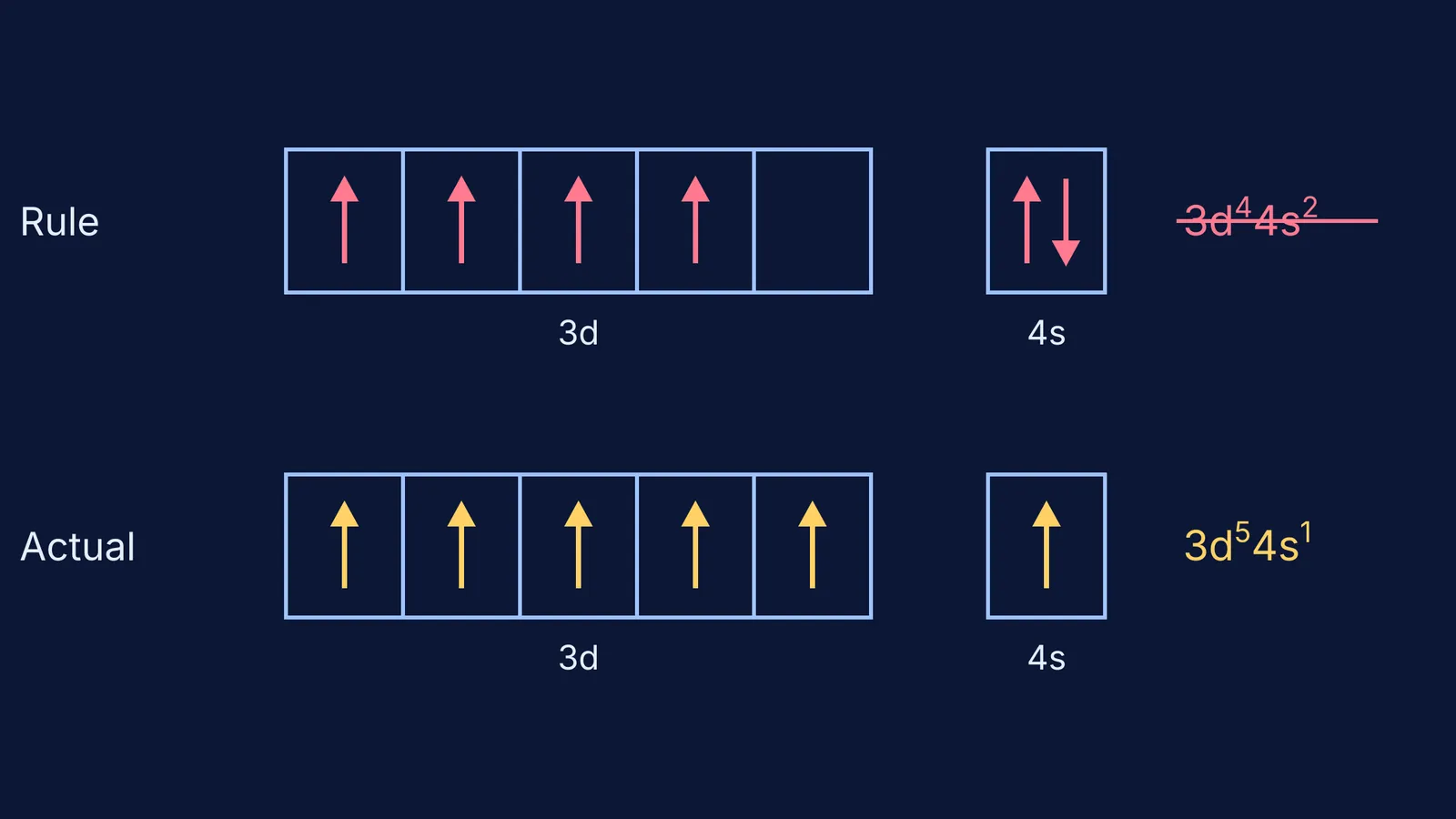
Follow the filling order and chromium should be 3d4 4s2. The measured ground state, listed in the NIST Atomic Spectra Database, is 3d5 4s1. Copper is the same story: the pattern says 3d9 4s2, NIST lists 3d10 4s1.
Now colour. Zinc's ground state is 3d10 4s2, so Zn2+ is 3d10: a full d subshell. LibreTexts explains that with no gap to promote an electron into, "zinc complexes are also colorless", and that "scandium(III) complexes are colorless" because the 3d level of Sc3+ is empty (LibreTexts/Coordination_Chemistry/Complex_Ion_Chemistry/Origin_of_Color_in_Complex_Ions)). So if an AI tells you zinc sulphate solution is coloured because "transition metal ions are coloured", it has given you the rule and missed the exception.
How do you check an AI answer against NCERT quickly?
This takes a few minutes per topic and works for the p-block, d- and f-block and coordination chapters.
Tag the question. Configurations, colours, magnetic behaviour, oxidation states, "anomalous" properties and "which of these is different" are exception-prone. Check these every time.
Ask for the rule and the exception separately. Paste this: "First state the general rule. Then tell me whether [element or ion] is an exception, and why. If you are not sure, say so."
Open the NCERT chapter and find the table or line that settles it. Look for a table or a single sentence first: you are checking one fact, not rereading the chapter.
Match the reason, not only the answer. A right answer with a wrong reason (say, "half-filled 4s") can cost you marks in a question that asks you to explain.
Log it in an exceptions sheet: element, what the rule predicts, what NCERT says, the reason, page number. Revise the sheet, not the chat.
Red flags that mean "check now":
The answer restates a trend without naming any exception.
It gives a reason NCERT never uses.
It changes its answer when you ask "are you sure?"
Should you stop using AI for inorganic chemistry?
No. Use it for what it does well: explaining why a half-filled d subshell is stable, quizzing you on your exceptions sheet, or turning a table into practice questions. Keep NCERT as the source for facts the exam will mark.
If the gap is the idea behind an exception rather than the fact itself, the Fermi Concept Library covers every concept in chemistry, each with its own lesson. Fermi's AI tutor is built to teach rather than only answer: it notices where you are stuck and checks your understanding as it goes.
Start tonight: pick one chapter, list five exceptions, and check each against your NCERT book.


