

On this page
When atoms form bonds, their atomic orbitals mix to create new hybrid orbitals. This mixing, called hybridisation, determines the 3D shape of the resulting molecule. For carbon, the three most common hybridisation states are sp, sp², and sp³, each creating a distinct geometry that dictates how the molecule reacts and behaves in three-dimensional space.
What are hybridisation shapes in 3D?
Hybridisation happens when an atom's s and p orbitals combine to form new, equivalent orbitals. The number of orbitals that mix determines the shape:
sp³ hybridisation forms when one s and three p orbitals mix. This creates four equivalent orbitals arranged in a tetrahedral shape, with bond angles of 109.5° (Wikipedia).
sp² hybridisation forms from one s and two p orbitals. The three resulting orbitals lie flat in a trigonal planar arrangement, with bond angles of 120° (Wikipedia).
sp hybridisation mixes just one s and one p orbital. These two orbitals point in opposite directions, creating a linear shape with a 180° bond angle (Wikipedia).
Why do ethane, ethene and ethyne have different shapes?
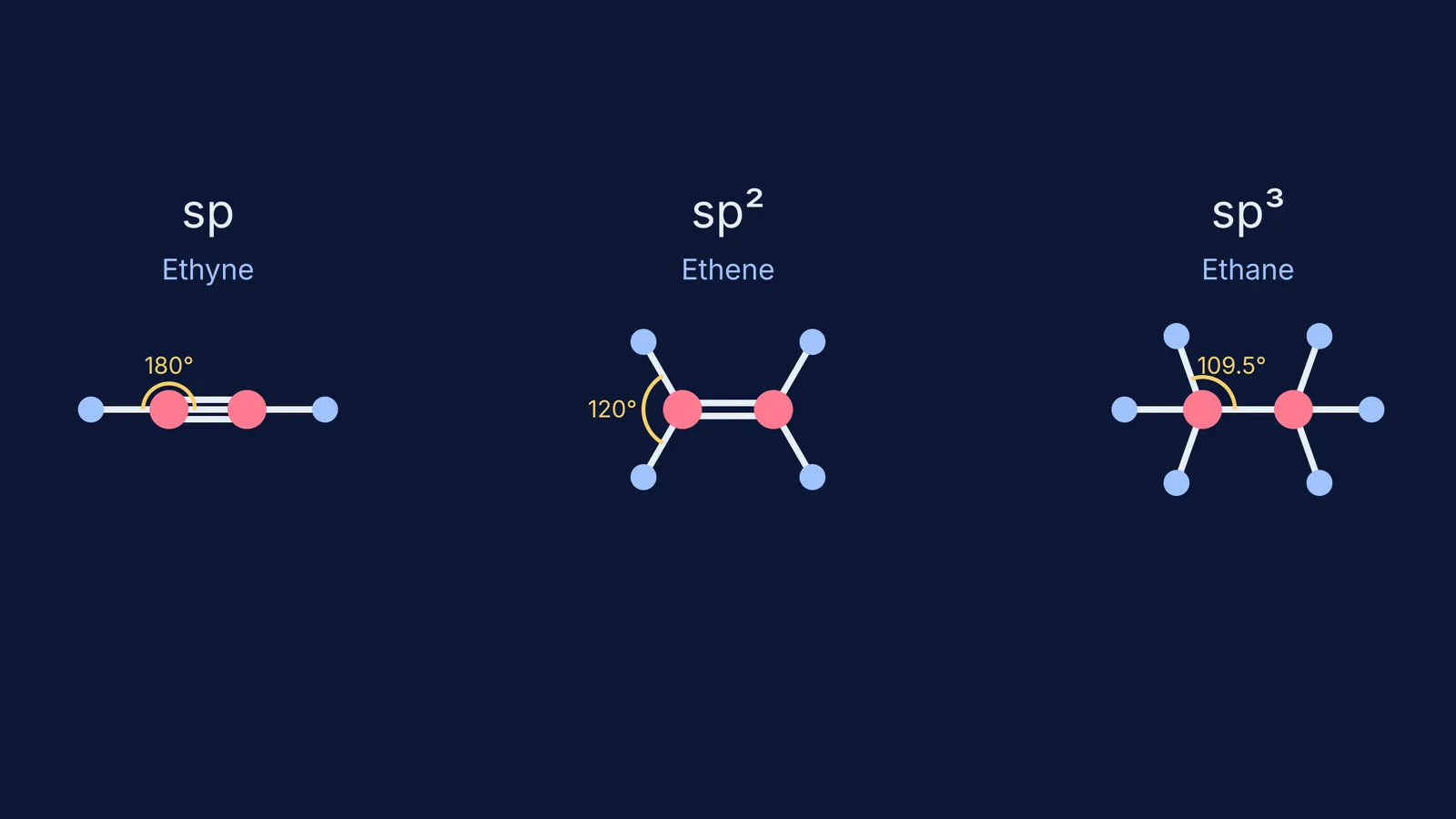
The simplest way to see these shapes in action is to look at the two-carbon hydrocarbons: ethane, ethene, and ethyne. Even though naming carbon compounds relies on counting the carbons and checking for multiple bonds, their 3D geometries are entirely driven by hybridisation.
In ethane (C₂H₆), each carbon atom forms four single bonds (three to hydrogen, one to the other carbon). This requires four sp³ hybrid orbitals. Because electron pairs repel each other, these four orbitals spread out as far as possible, forming a 3D tetrahedron around each carbon. The resulting molecule has a staggered or eclipsed 3D structure, but the local geometry at each carbon is strictly tetrahedral.
In ethene (C₂H₄), the two carbon atoms are joined by a double bond. Each carbon uses three sp² hybrid orbitals to form single bonds (one to the other carbon, two to hydrogens). These three orbitals lie flat in a plane. The remaining unhybridised p orbital on each carbon overlaps sideways to form the second part of the double bond (the pi bond). This locks the molecule into a flat, trigonal planar shape.
In ethyne (C₂H₂), the carbons share a triple bond. Each carbon uses two sp hybrid orbitals: one to bond with a hydrogen atom and one to bond with the other carbon. These two orbitals point away from each other. The two unhybridised p orbitals on each carbon overlap to form the rest of the triple bond, resulting in a completely straight, linear molecule. You can see how this affects reactions like the hydration of alkynes, where the linear triple bond breaks open to form new products.
Visualising these flat and 3D shapes from a textbook page can be difficult. The Fermi Simulation Lab lets you build these molecules and rotate the 3D models to see exactly why a tetrahedron looks different from a flat plane, and how the unhybridised orbitals overlap.
How do you predict bond angles for sp, sp² and sp³?
To predict the bond angle around any central atom, you do not need to memorise every molecule. Instead, count the regions of electron density. A region is either a bond (single, double, or triple all count as one region) or a lone pair of electrons (Wikipedia).
Four regions mean sp³ hybridisation. The base shape is tetrahedral (109.5°). If one region is a lone pair, the shape becomes trigonal pyramidal, and the angle shrinks slightly because lone pairs repel more strongly than bonds. This explains the comparing bond angles between molecules like ammonia and water.
Three regions mean sp² hybridisation. The shape is trigonal planar, and the angle is 120°.
Two regions mean sp hybridisation. The shape is linear, and the angle is exactly 180°.


