

On this page
The free Molecule Polarity simulation from PhET at the University of Colorado Boulder is built around one question: when is a molecule polar? Its main controls are the electronegativity of each atom, the bond angle, and an electric field. Used well, they turn “CO₂ is nonpolar, H₂O is polar” from two facts to memorise into one rule you can apply to many molecules in the chemical bonding chapter.
What does a molecule polarity simulation let you change?
PhET's listing says you can “change the electronegativity of atoms in a molecule to see how it affects polarity”, “see how the molecule behaves in an electric field” and “change the bond angle to see how shape affects polarity” (PhET listing, mirrored by TISS CLIx). One of its sample learning goals is to predict molecular polarity from bond polarity and molecular shape.
Two ideas do all the work, both set out in OpenStax Chemistry 2e, section 7.6:
Bond dipole: the more electronegative atom in a bond pulls electron density towards itself and carries a partial negative charge (δ−); the bond dipole's size is μ = Qr, partial charge times separation.
Molecular dipole: the vector sum of all the bond dipoles in three dimensions, so direction matters as much as size.
On the Pauling scale, hydrogen is 2.20, carbon 2.55 and oxygen 3.44 (LibreTexts electronegativity table). So C=O and O–H bonds are both polar, with oxygen as the negative end.
Why is CO₂ nonpolar but H₂O is polar?
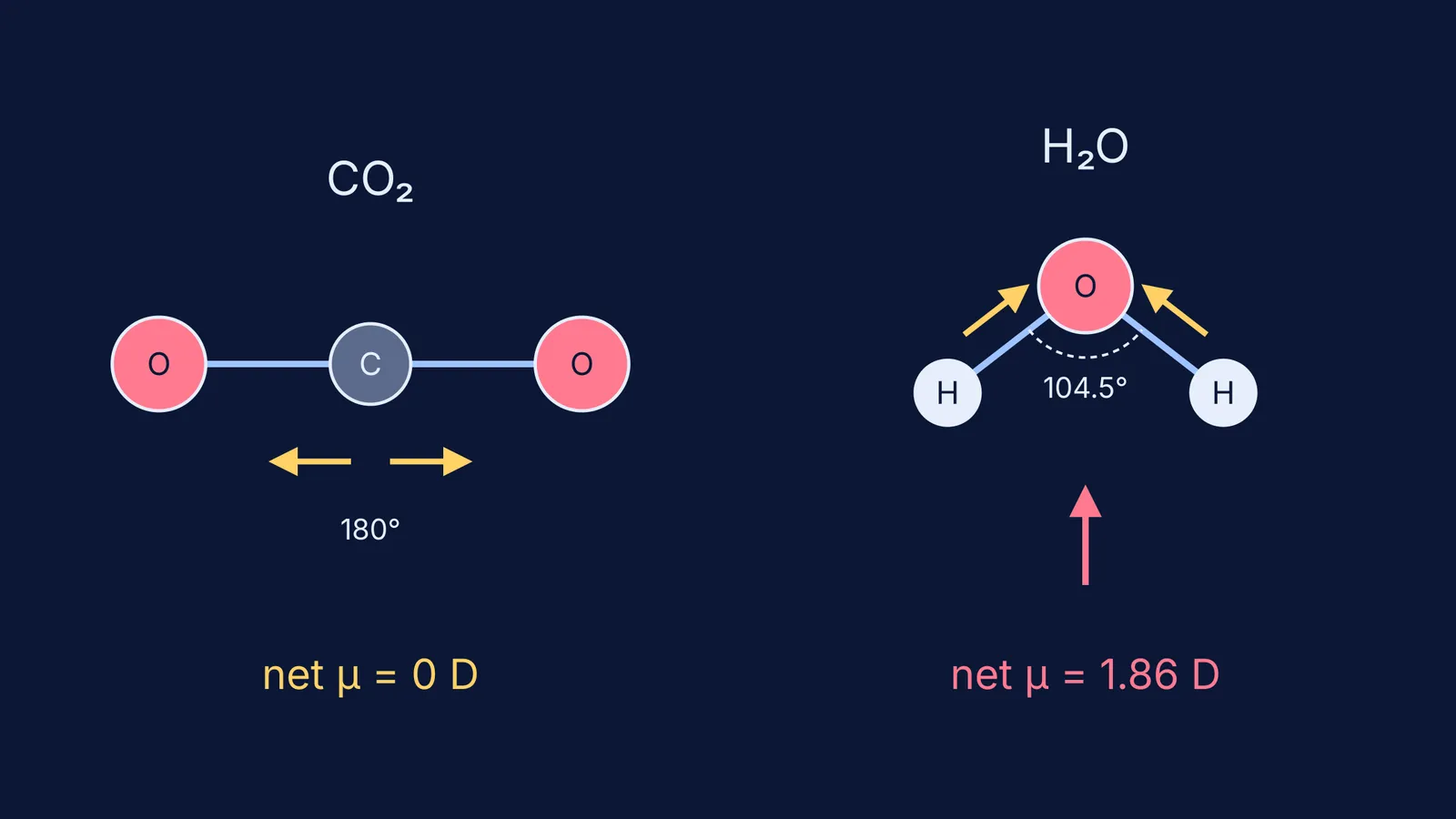
Both molecules have polar bonds pointing towards oxygen. The difference is shape.
CO₂ is linear: NIST's Computational Chemistry Comparison and Benchmark Database lists its O–C–O angle as 180° and its measured dipole moment as 0.000 D (NIST CCCBDB, CO₂). Its two C=O dipoles are equal and point in exactly opposite directions, so they cancel.
Water is bent: NIST gives an H–O–H angle of 104.48° and a measured dipole moment of 1.857 D (NIST CCCBDB, H₂O). Both O–H dipoles lean towards oxygen, so their sideways parts cancel but their upward parts add.
The same test works elsewhere. Flat BF₃, with 120° angles, has a listed dipole moment of 0.000 D (NIST CCCBDB, BF₃), while pyramidal NH₃ has 1.476 D (NIST CCCBDB, NH₃).
How do you predict when bond dipoles cancel?
Here is a worked example to check as you change the bond angle in the simulation. For two equal bond dipoles μ at angle θ, the net dipole is 2μ × cos(θ/2).
Find the bond dipole. Water's 1.857 D at 104.48° (NIST) implies μ(O–H) = 1.857 ÷ (2 × cos 52.24°) ≈ 1.52 D.
Straighten it to 180°: cos 90° = 0, so the net dipole is 0 D. This is the CO₂ case.
Open it to 120°: 2 × 1.52 × cos 60° ≈ 1.52 D.
Close it to 90°: 2 × 1.52 × cos 45° ≈ 2.15 D.
The pattern: the net dipole is zero only at 180° and grows as the angle closes. Treat this as a toy model. In real molecules, bond dipoles and lone pairs shift when geometry changes, so these numbers show the trend, not measured values.
What does an electric field do to a polar molecule?
In a uniform field, the forces on the two ends are equal and opposite, so there is no net force, but a torque τ = p × E turns the dipole to line up with the field (OpenStax University Physics Volume 2, section 5.7). Polar molecules tend to align with their positive end towards the negative plate and their negative end towards the positive plate (OpenStax Chemistry 2e).
So the prediction is simple: switch the field on and a bent, polar molecule swings round; a molecule with zero net dipole has no permanent dipole for the field to turn.
A 15-minute plan for your first session
Minutes 0–3: two atoms. Start with equal electronegativities, then move the two values apart. Before each change, say which atom becomes δ−.
Minutes 3–8: three atoms. Make both outer atoms more electronegative than the centre, set 180°, and predict the molecular dipole before looking. Then bend it.
Minutes 8–12: switch on the field. Predict how the molecule turns at 180° and at about 105°, then check.
Minutes 12–15: write the rule in one sentence, then apply it on paper to BF₃ and NH₃.
When an idea is easier to see than to read, the Fermi Simulation Lab has interactive simulations to try, and the Fermi Concept Library gives every chemistry concept its own lesson.
For more molecules, work through predicting geometry with VSEPR, dipole moments and molecular polarity and tools for seeing molecules in 3D.


