On this page
Organic chemistry in JEE Main rests on one short unit. Get the electronic effects right and you can reason through acidity, basicity, intermediates and much of the hydrocarbon and functional-group chemistry that follows.
What does the JEE Main 2027 syllabus include in GOC?
GOC is Unit 14, "Some Basic Principles of Organic Chemistry", in the official Syllabus for JEE (Main) - 2027 published by NTA on jeemain.nta.nic.in. It lists:
tetravalency of carbon and hybridisation (s and p) in simple molecules
classification by functional group, homologous series, and isomerism (structural and stereo)
trivial and IUPAC nomenclature
homolytic and heterolytic fission; free radicals, carbocations and carbanions; stability of carbocations and free radicals; electrophiles and nucleophiles
inductive, electromeric, resonance and hyperconjugation effects
substitution, addition, elimination and rearrangement reactions
Your textbook is Unit 8 of NCERT Class 11 Chemistry Part II, Organic Chemistry – Some Basic Principles and Techniques. Sections 8.1 to 8.7 carry the GOC theory, from hybridisation and nomenclature to isomerism (8.6) and reaction mechanism basics (8.7). Sections 8.8 onward (purification and analysis) map to the syllabus's separate Unit 13.
How do inductive, resonance and hyperconjugation effects differ?
Inductive effect is a permanent pull or push of electrons through sigma bonds, and it fades quickly with distance. Halogens pull in the order F > Cl > Br > I, so fluoroacetic acid is more acidic than chloroacetic acid, which beats bromoacetic, iodoacetic and then acetic acid. Distance matters just as much: 2-chlorobutanoic acid is more acidic than 3-chlorobutanoic acid, which is more acidic than 4-chlorobutanoic acid.
Resonance effect spreads charge through pi bonds and lone pairs. Phenol is more acidic than ethanol because phenoxide's negative charge spreads into the ring; ethoxide's cannot. Aniline is a weaker base than cyclohexylamine for the mirror reason: its lone pair is shared with the ring.
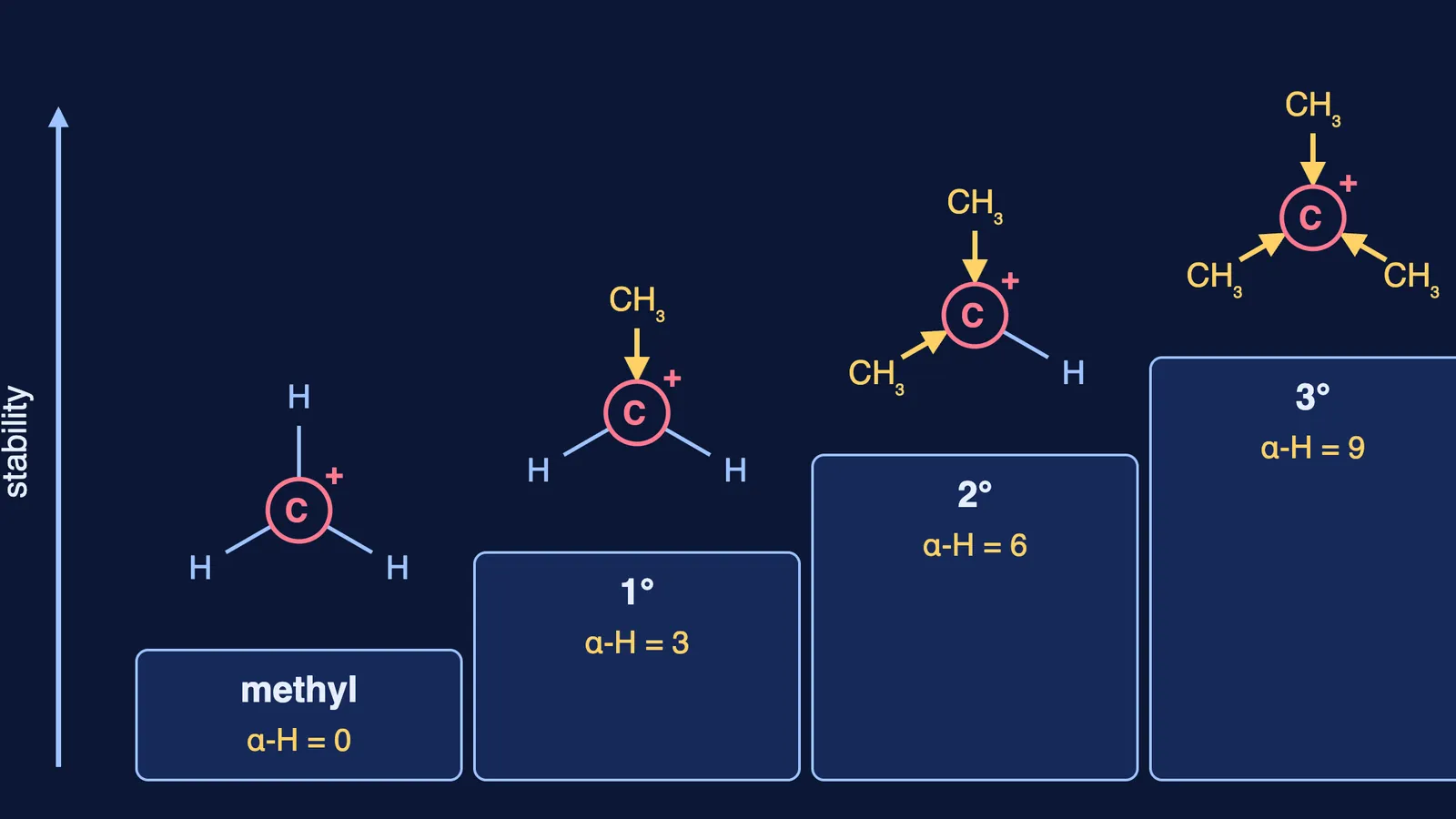
Hyperconjugation is the delocalisation of electrons from a C–H sigma bond on an alpha carbon (the carbon attached to the positive, radical or doubly bonded carbon) into the neighbouring empty p orbital, half-filled p orbital or pi bond. More alpha-hydrogens mean more stabilisation.
Electromeric effect is temporary: a pi bond shifts its electrons fully to one atom only when a reagent attacks, and the shift reverses when the reagent leaves.
If you are unsure which effect is even operating, the Fermi Concept Library covers every concept in chemistry, each with its own lesson, so you can fix the idea before drilling questions.
How do you rank carbocations, carbanions and free radicals?
Worked example. Rank CH3+, CH3CH2+, (CH3)2CH+ and (CH3)3C+.
Count alpha-hydrogens: 0, 3, 6, 9.
Count alkyl groups pushing electrons (+I) toward the positive carbon: 0, 1, 2, 3.
Both point the same way, so the order is (CH3)3C+ > (CH3)2CH+ > CH3CH2+ > CH3+.
Free radicals follow the same order (3° > 2° > 1° > methyl), for the same reasons. Carbanions reverse it: alkyl groups push more electron density onto a carbon that already has too much, so CH3− is the most stable of the four. For carbanions, hybridisation also counts: HC≡C− is more stable than CH2=CH−, which is more stable than CH3CH2−, because more s character holds the lone pair closer to the nucleus. That is why ethyne is the most acidic of ethyne, ethene and ethane.
How do you get isomers and IUPAC names right?
For C4H10O: butan-1-ol and butan-2-ol are position isomers; butan-1-ol and 2-methylpropan-1-ol are chain isomers; methoxypropane and ethoxyethane are metamers; butan-1-ol and ethoxyethane are functional isomers. Butan-2-ol has a chiral carbon, so it shows optical isomerism; but-2-ene shows geometrical (cis and trans) isomerism.
For names, find the principal group, then the lowest locants, then alphabetical order. CH3CH(OH)CH2CH=CH2 is pent-4-en-2-ol: the OH gets the lower number, not the double bond. ClCH2CH2CH(Br)CH3 is 3-bromo-1-chlorobutane, because the locant set {1,3} beats {2,4} before alphabetical order is ever used.
What are the common traps in GOC?
Treating 2° and 3° as the whole story. Vinyl and phenyl cations are less stable than even primary ones; see why vinyl and phenyl carbocations are so unstable.
Assuming resonance reaches every position. A meta-nitro group acts only by its inductive pull, so m-nitrophenol is less acidic than the ortho and para isomers; work it through in the acidity order of substituted phenols.
Ranking amines by +I alone. In water, solvation changes the order; the basicity order of methylamines in water shows why dimethylamine comes first.
A 12-day practice plan for GOC
Days 1-2: hybridisation, classification, IUPAC names. Name 15 structures a day and draw 15 from names.
Days 3-4: isomer types. Take three formulas and list every isomer by type.
Days 5-7: inductive, resonance and hyperconjugation. For every acidity or basicity order, write the effect that decides each step.
Days 8-9: intermediates. Rank sets of four carbocations, radicals and carbanions, with a reason per step.
Days 10-12: mixed timed sets, then redo every wrong question a day later.
When your order comes out wrong but you can't see why, the Fermi Problem Library has worked problems with a step-by-step solver that explains the reasoning rather than printing an answer.