On this page
Ask which methylamine is the strongest base and most students reason from one idea: methyl groups donate electrons, so more methyls means a stronger base. That logic puts trimethylamine at the top. In water, it lands third. Here are the numbers, the three competing effects and a method for ranking questions.
What is the basicity order of methylamines in water?
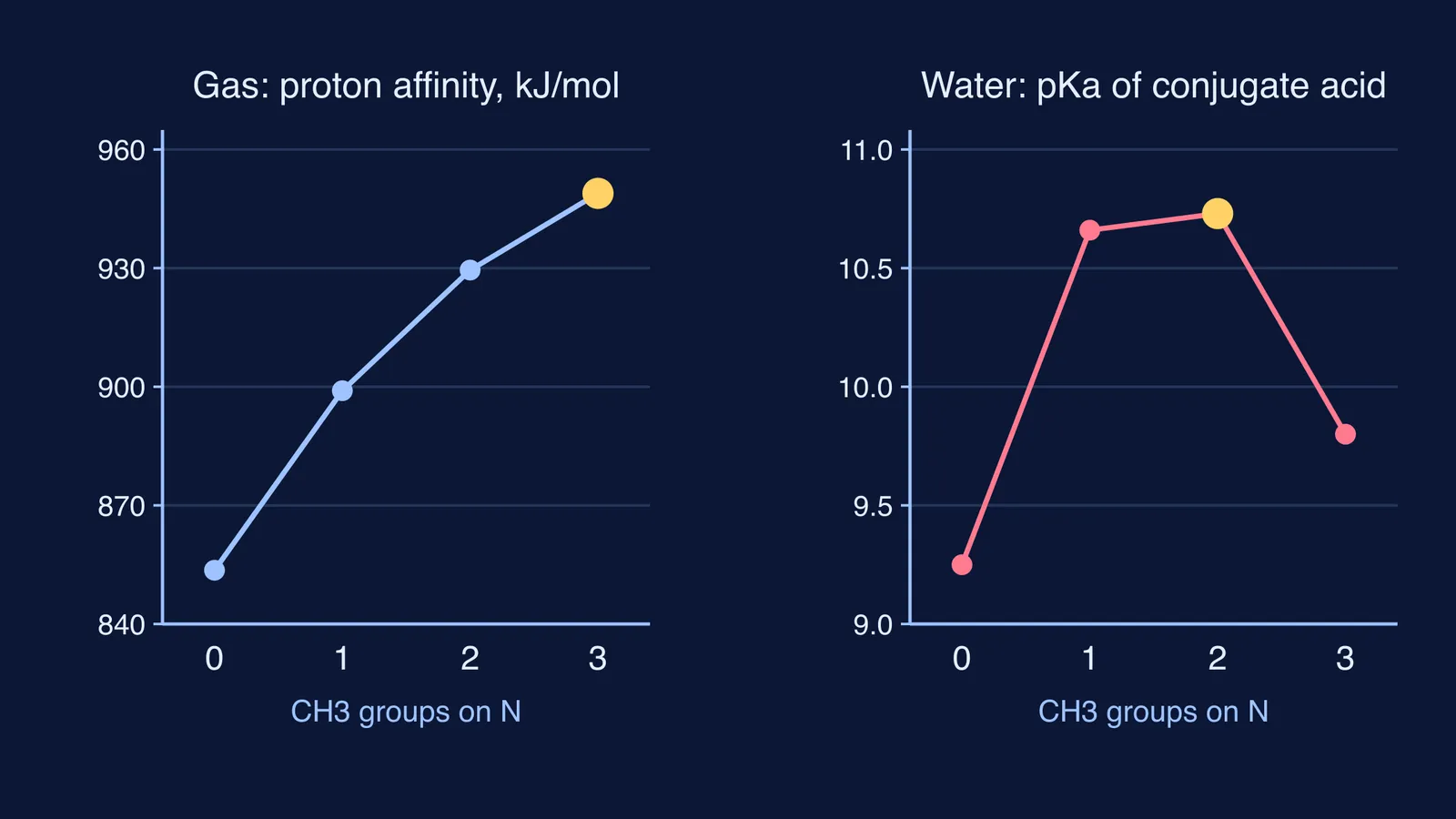
Chemists compare bases by the pKa of their conjugate acids: the higher the pKa of the ammonium ion, the stronger the base. The aqueous values listed by PubChem (at 25 °C where a temperature is given) are:
(CH3)2NH, dimethylamine: pKa 10.73 (PubChem, dimethylamine)
CH3NH2, methylamine: pKa 10.66 (PubChem, methylamine)
(CH3)3N, trimethylamine: pKa 9.80 (PubChem, trimethylamine)
NH3, ammonia: pKb 4.751, which gives a conjugate-acid pKa of 9.25 (PubChem, ammonia)
So the order is (CH3)2NH > CH3NH2 > (CH3)3N > NH3. If your textbook lists pKb instead, subtract each pKa from 14 (valid at 25 °C) to get 3.27, 3.34, 4.20 and 4.75. A lower pKb means a stronger base, so the ranking is the same.
Why is the secondary amine the most basic in water?
Three effects pull in different directions, and the winner is the amine with the best balance.
Inductive effect (favours more methyls). Each methyl group pushes electron density towards nitrogen and helps spread the positive charge of the ammonium ion. On this effect alone the order would be 3° > 2° > 1° > NH3. Our post on the order of +I and −I effects of groups covers why alkyl groups count as electron donors.
Solvation by hydrogen bonding (favours fewer methyls). Once protonated, the ion is stabilised by water molecules hydrogen-bonding to its N–H hydrogens. CH3NH3+ has three such hydrogens, (CH3)2NH2+ has two and (CH3)3NH+ only one. Fewer N–H bonds means a less stabilised ion, and so a weaker base.
Steric crowding (works against the tertiary ion). Three methyl groups also crowd out the water molecules that would surround the charge. Course notes on amines from the University of Texas at Austin call this "steric inhibition of solvation": "The presence of three alkyl groups sharply diminishes the ability of the solvent to stabilize the corresponding ammonium ion" (UT Austin, Chapter 21: Amines).
Dimethylamine sits in the sweet spot: two donating methyls, and still two N–H hydrogens for water to hold on to. Trimethylamine gains more inductive push but loses so much solvation that it drops below methylamine. Ammonia has no donating groups, so it comes last.
Why is trimethylamine the strongest base in the gas phase?
Remove the water and the solvation effect disappears. Gas-phase proton affinity, the energy released when a molecule picks up a proton, then follows the inductive order. The NIST Chemistry WebBook lists proton affinities of 853.6 kJ/mol for ammonia (NIST, ammonia), 899.0 kJ/mol for methylamine (NIST, methylamine), 929.5 kJ/mol for dimethylamine (NIST, dimethylamine) and 948.9 kJ/mol for trimethylamine (NIST, trimethylamine).
That steady rise shows that water is what reshuffles the order. A 1976 paper by Donald Aue, Hugh Webb and Michael Bowers in the Journal of the American Chemical Society gives a thermodynamic analysis of solvation effects on the basicities of alkylamines (DOI: 10.1021/ja00418a002). For the same comparison step by step, see how AI explains the basicity order of methylamines in water and gas.
Worked example: how much stronger is dimethylamine?
pKb is a logarithm, so a difference of 1 in pKb is a factor of 10 in Kb. Using the pKb values from the PubChem data above (dimethylamine, methylamine, trimethylamine, ammonia):
Dimethylamine vs trimethylamine: 4.20 − 3.27 = 0.93, and 10^0.93 ≈ 8.5, so dimethylamine's Kb is about 8.5 times larger.
Dimethylamine vs methylamine: 3.34 − 3.27 = 0.07, and 10^0.07 ≈ 1.2. The top two are almost tied.
Dimethylamine vs ammonia: 4.75 − 3.27 = 1.48, and 10^1.48 ≈ 30.
The gap between 1° and 2° is small; the drop from 2° to 3° is large. Do not stretch this to every alkyl group: OpenStax's table lists triethylamine at pKa 10.76, only 0.22 below diethylamine at 10.98 (OpenStax Organic Chemistry, 24.3), so the size of the tertiary drop depends on the alkyl group.
How should you answer this in JEE Main or NEET-UG?
Use this four-step check for any "arrange in order of basicity" question:
Phase first. Gas phase: rank by inductive effect alone (3° > 2° > 1° > NH3). Aqueous: go on to step 2.
Count donating groups on nitrogen for the inductive push.
Count N–H hydrogens on the protonated ion for solvation: RNH3+ has three, R2NH2+ two, R3NH+ one.
Look for resonance or electron-withdrawing groups. These outweigh everything above, which is why amides are far weaker bases than amines; our explainer on why amides are less basic than amines walks through the lone pair.
If the inductive effect or hydrogen bonding still feels shaky, the Fermi Concept Library has a lesson for every concept in chemistry, each with its place in the map. To practise ranking questions, the Fermi Problem Library has worked problems with a step-by-step solver that explains the reasoning rather than printing an answer.