

On this page
The basicity order of amines is a classic trap in the Class 12 chemistry syllabus. It is also a clear way to test if an AI tutor is actually teaching you rather than just reciting facts.
If you ask a standard chatbot for the basicity order of methylamines, it will often give you a single list. But a good tutor will stop and ask you an important question: "Are we talking about the gas phase or an aqueous solution?"
Here is how the basicity order changes between the two environments, why solvation is the missing piece, and how to use this topic to check your AI's reasoning.
What is the basicity order in the gas phase?
In the gas phase, there are no solvent molecules to interfere with the chemical reaction. The basic strength of methylamines in this environment is decided purely by the +I (inductive) effect of the methyl groups attached to the central nitrogen atom.
Methyl groups are electron-donating. The more methyl groups attached to the nitrogen atom, the higher the electron density on the nitrogen. This increased electron density makes the nitrogen more willing to donate its lone pair of electrons to a proton.
Therefore, in the gas phase, the basicity strictly follows the number of methyl groups:
Tertiary > Secondary > Primary > Ammonia
(CH₃)₃N > (CH₃)₂NH > CH₃NH₂ > NH₃
This is the straightforward rule you learn when you are first introduced to the inductive effect. The logic is simple and linear.
What is the basicity order in aqueous solution?
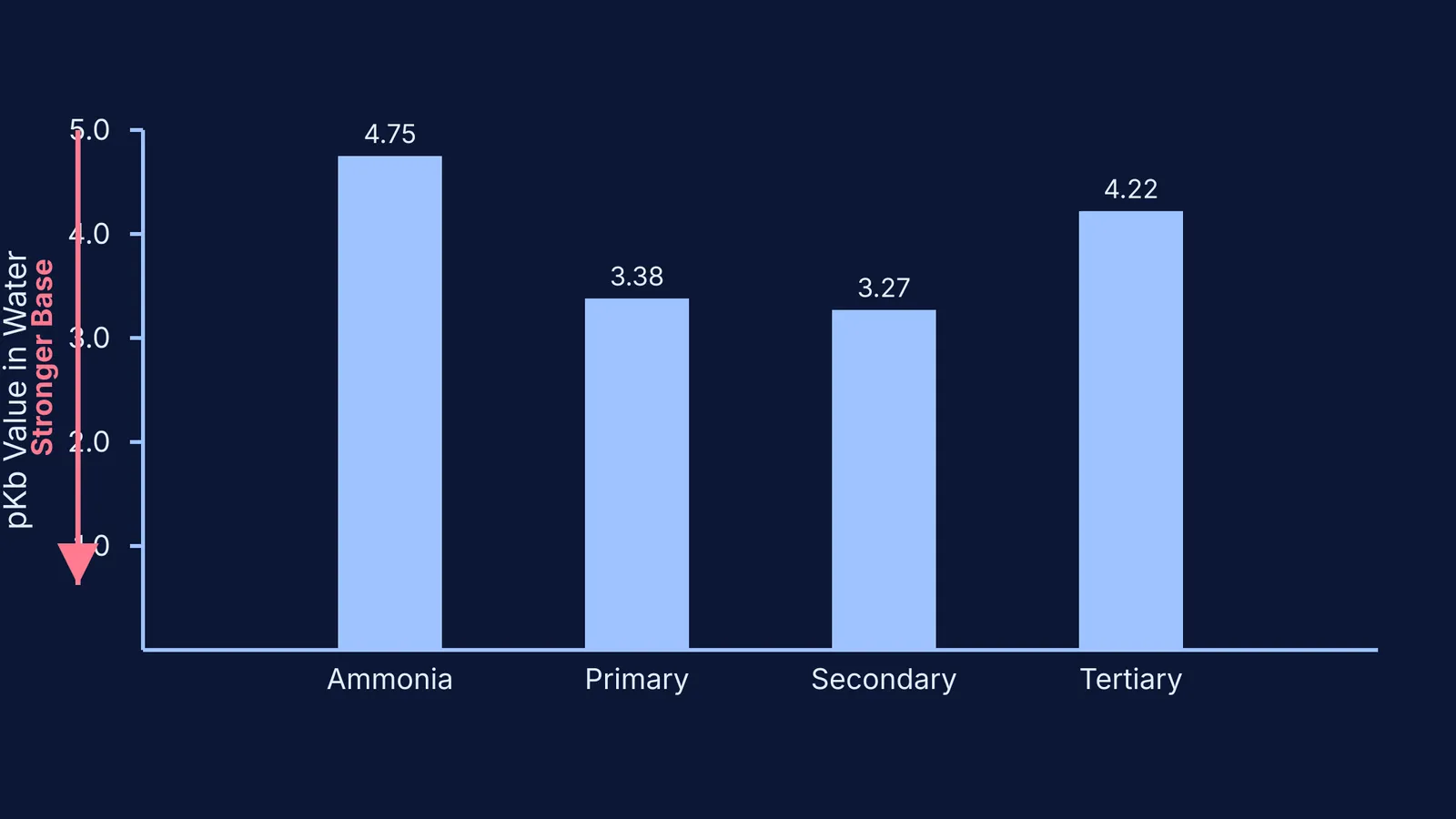
When you dissolve these amines in water, the order turns upside down. According to the NCERT Class 12 Chemistry textbook, the pKb values for methylamines in water are 4.75 for ammonia, 3.38 for primary (methanamine), 3.27 for secondary (N-methylmethanamine), and 4.22 for tertiary (N,N-dimethylmethanamine).
Since a lower pKb means a stronger base, the actual basicity order in water is:
Secondary > Primary > Tertiary > Ammonia
(CH₃)₂NH > CH₃NH₂ > (CH₃)₃N > NH₃
Dimethylamine (secondary) is the most basic, while trimethylamine (tertiary) drops behind both primary and secondary amines.
Why does the basicity order change?
In an aqueous solution, basicity is not just about how easily the nitrogen can accept a proton. It is also about how stable the resulting protonated ion is after the reaction has occurred.
When an amine accepts a proton, it becomes a positively charged ammonium ion. Water molecules immediately surround this ion and stabilise it by forming hydrogen bonds—a process known as solvation or hydration.
Primary amines form the most stable ions because they have three hydrogen atoms available for hydrogen bonding with water. Tertiary amines have only one hydrogen atom on the protonated ion, and their three bulky methyl groups physically block water molecules from getting close, creating steric hindrance.
The final basicity order in water is a subtle interplay of three competing factors:
Inductive Effect: Pushes for 3° > 2° > 1° by increasing electron density on the nitrogen.
Solvation Effect: Pushes for 1° > 2° > 3° by stabilising the protonated ion with surrounding water molecules.
Steric Hindrance: Pushes against 3° because bulky groups block incoming protons and water molecules.
When you balance these three effects for methyl-substituted amines, the secondary amine hits the sweet spot, making it the strongest base in water.
How to check your AI tutor's reasoning?
When you are revising this topic for your exams, you can test how deeply your AI tutor understands the chemistry. Try typing this prompt:
*"Explain why dimethylamine is a stronger base than trimethylamine in aqueous solution, step by step."*
Here is a checklist of what a strong AI response should include:
Does it identify the environment? The AI should explicitly state that this anomaly only happens in an aqueous solution.
Does it name solvation? It must explain that water molecules stabilise the conjugate acid (solvation effect), which heavily favours primary and secondary amines.
Does it mention steric hindrance? The AI should explain that three methyl groups physically block water molecules from hydrating the tertiary ion.
Does it balance the effects? It should conclude that the final order is a net result of the inductive effect competing against hydration and steric hindrance.
If an AI just prints the final order without explaining the competition between inductive and solvation effects, it is skipping the underlying science. Fermi's AI tutor is designed to avoid this shortcut. Rather than just printing the answer, it works out what you already know and holds a line of reasoning, checking your understanding of the inductive effect first before introducing hydration. If you are struggling to picture the molecules blocking each other, you can explore the lessons in the Fermi Concept Library to see how these invisible forces balance out.


