On this page
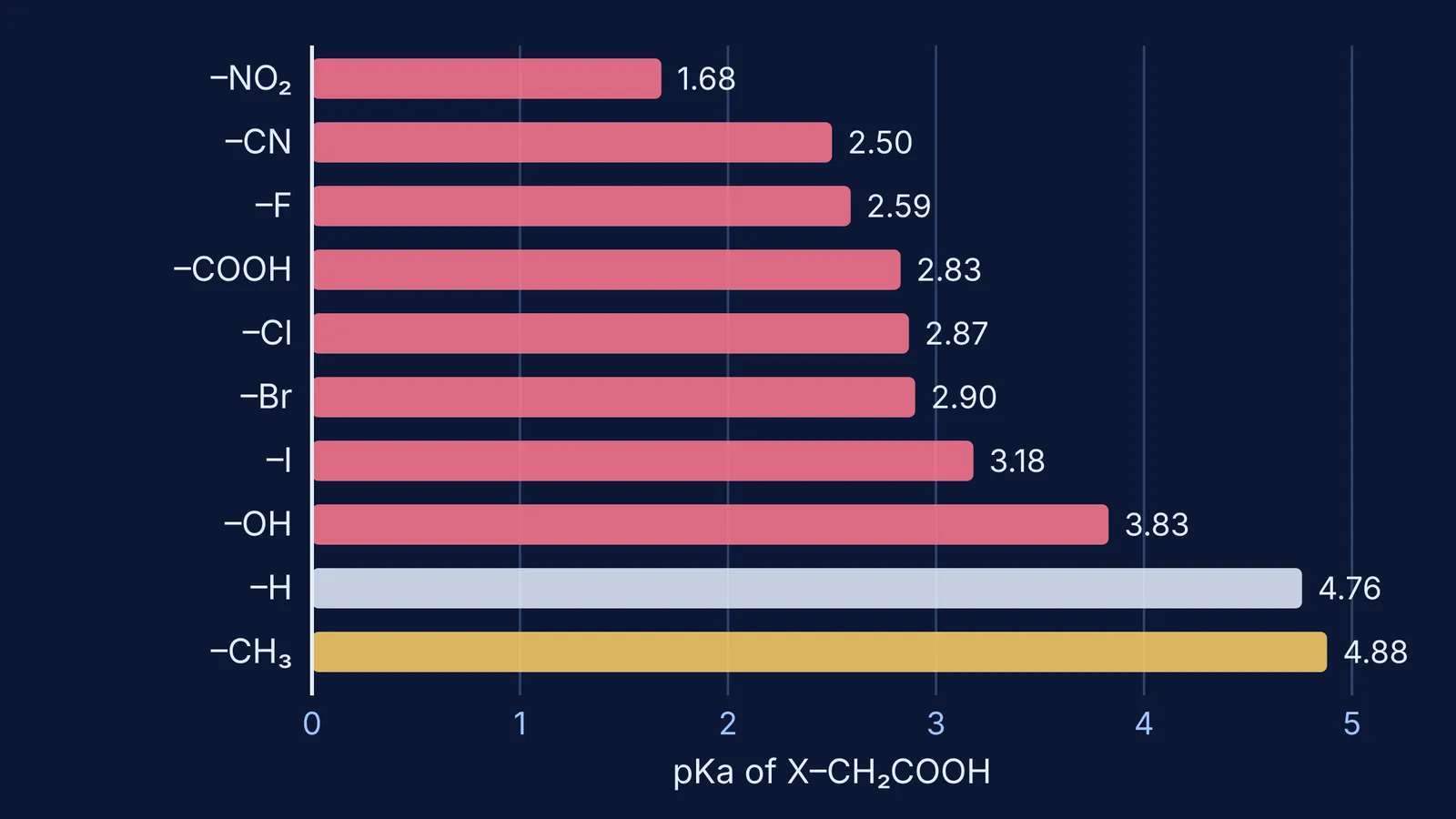
Most students memorise the inductive order without seeing why it holds. You can check it yourself. Put each group on the carbon next to a carboxylic acid, X–CH2–COOH. The harder X pulls electron density away, the more it stabilises the carboxylate ion, and the stronger (lower pKa) the acid.
What is the order of -I effect of groups?
The inductive effect is the shift of electron density along sigma bonds caused by a difference in electronegativity between bonded atoms. A group that pulls electrons towards itself shows a -I effect; a group that pushes electrons away shows a +I effect. Hydrogen is the zero point.
For the groups in school, JEE and NEET syllabuses, the -I order that the acid data below supports is:
-NO2 > -CN > -F > -COOH ≈ -Cl > -Br > -I > -OH
Alkyl groups such as -CH3 sit on the other side of hydrogen: they show +I.
How does acid strength prove the order?
Here are measured pKa values at 25 °C for X–CH2COOH. Halogen and acetic acid values come from the LibreTexts table of acid dissociation constants; the rest come from the pages for nitroacetic acid, cyanoacetic acid, malonic acid, glycolic acid and propanoic acid.
X = -NO2 (nitroacetic acid): pKa 1.68
X = -CN (cyanoacetic acid): pKa 2.5
X = -F (fluoroacetic acid): pKa 2.59
X = -COOH (malonic acid, first proton): pKa 2.83
X = -Cl (chloroacetic acid): pKa 2.87
X = -Br (bromoacetic acid): pKa 2.90
X = -I (iodoacetic acid): pKa 3.18
X = -OH (glycolic acid): pKa 3.83
X = -H (acetic acid): pKa 4.756
X = -CH3 (propanoic acid): pKa 4.88
Every group from -NO2 to -OH lowers the pKa below acetic acid's, so each withdraws electrons; methyl raises it, so it donates. The halogens follow electronegativity, though Cl and Br are almost tied.
In the same LibreTexts table, chloroacetic acid has a Ka of 1.3 × 10^-3 and acetic acid 1.75 × 10^-5, so one chlorine makes the acid about 74 times stronger.
Where does -COOH go, and why do lists disagree?
Some books place -COOH above -F. The malonic acid value (2.83) sits between fluoroacetic (2.59) and chloroacetic (2.87) acid in the LibreTexts table. Two cautions: malonic acid has two identical COOH groups, so its first proton has two places to leave from, which flatters its pKa; and in water, solvation and hydrogen bonding shift pKa too.
So treat -F, -COOH and -Cl as a close cluster, and keep the ends fixed: -NO2 and -CN at the top, -I and -OH at the bottom.
One trap: on a benzene ring, -OH and the halogens also donate electrons by resonance, so the inductive order alone will not decide ring questions. See our explainer on how the inductive effect differs from the electromeric effect.
What is the order of +I effect of alkyl groups?
The textbook order is -C(CH3)3 > -CH(CH3)2 > -CH2CH3 > -CH3 > -H: more carbons push more electron density.
The cleanest evidence is methyl against hydrogen. In the LibreTexts table, formic acid (H–COOH) has a pKa of 3.75 and acetic acid (CH3–COOH) 4.756, so replacing H with CH3 makes the acid about ten times weaker. One more carbon gives propanoic acid at 4.88: weaker again, by much less. Between larger alkyl groups, solvation in water blurs the differences, so learn the +I order from theory, not pKa tables.
How do you use the order in an exam question?
Worked example: arrange ICH2COOH, NCCH2COOH, CH3CH2COOH, FCH2COOH and HOCH2COOH in order of acid strength.
Check the skeleton. All five are X–CH2COOH (propanoic acid is CH3–CH2COOH), so only X differs.
Place each X on the order: -CN > -F > -I > -OH are all -I; -CH3 is +I.
Stronger -I gives a stronger acid: NCCH2COOH > FCH2COOH > ICH2COOH > HOCH2COOH > CH3CH2COOH.
Check against the data in the list above: 2.5 < 2.59 < 3.18 < 3.83 < 4.88. The order holds.
Before you rank any set, run this quick checklist:
Is the skeleton the same? If not, compare the skeletons first.
How far is the group from COOH? The pull weakens with every bond, as our post on why the inductive effect fades with distance shows.
Is there a benzene ring or a double bond? Then check resonance before trusting the inductive order.
How many groups are there? In the LibreTexts table, dichloroacetic acid (pKa 1.35) and trichloroacetic acid (pKa 0.66) are stronger than chloroacetic acid.
If you get the ranking right but cannot say why, work a few ranking problems in the Fermi Problem Library, where the step-by-step solver explains the reasoning rather than printing an answer. To review the inductive effect, resonance and hyperconjugation as separate ideas, use the Fermi Concept Library, where each concept has its own lesson and its place in the map.
For mixed sets that include phenols and alcohols, use our four-step method to compare acidity of organic compounds.