

On this page
If you have ever written "electromeric" where the answer key wanted "inductive", you are not alone. Both effects move electron density inside a molecule, and both appear in the same section of NCERT's Class 11 organic chemistry unit. The difference comes down to three things: which bonds, how long, and whether an attacking reagent is needed.
What is the difference between inductive and electromeric effect?
NCERT's Class 11 Chemistry textbook (Part II, Unit 8) sorts electron displacements into two kinds: permanent ones caused by an atom or group already in the molecule, and temporary ones that appear only when a reagent approaches.
The inductive effect is the polarisation of a σ bond caused by the polarisation of an adjacent σ bond, and it is permanent (NCERT, section 8.7.5).
The electromeric effect is the complete transfer of a shared pair of π electrons to one of the atoms joined by a multiple bond, on the demand of an attacking reagent, and it disappears once the reagent is removed (NCERT, section 8.7.8).
Side by side:
Bonds involved: inductive acts through σ bonds; electromeric needs a double or triple bond.
Duration: inductive is always on; electromeric lasts only while the reagent is there.
Size of the shift: inductive is partial (δ+ and δ−); electromeric moves the whole pair, so full charges appear.
Trigger: inductive needs only a difference in electronegativity; electromeric needs an attacking reagent.
Who wins: when the two act in opposite directions, NCERT states that the electromeric effect predominates.
How does the inductive effect show up in reactions?
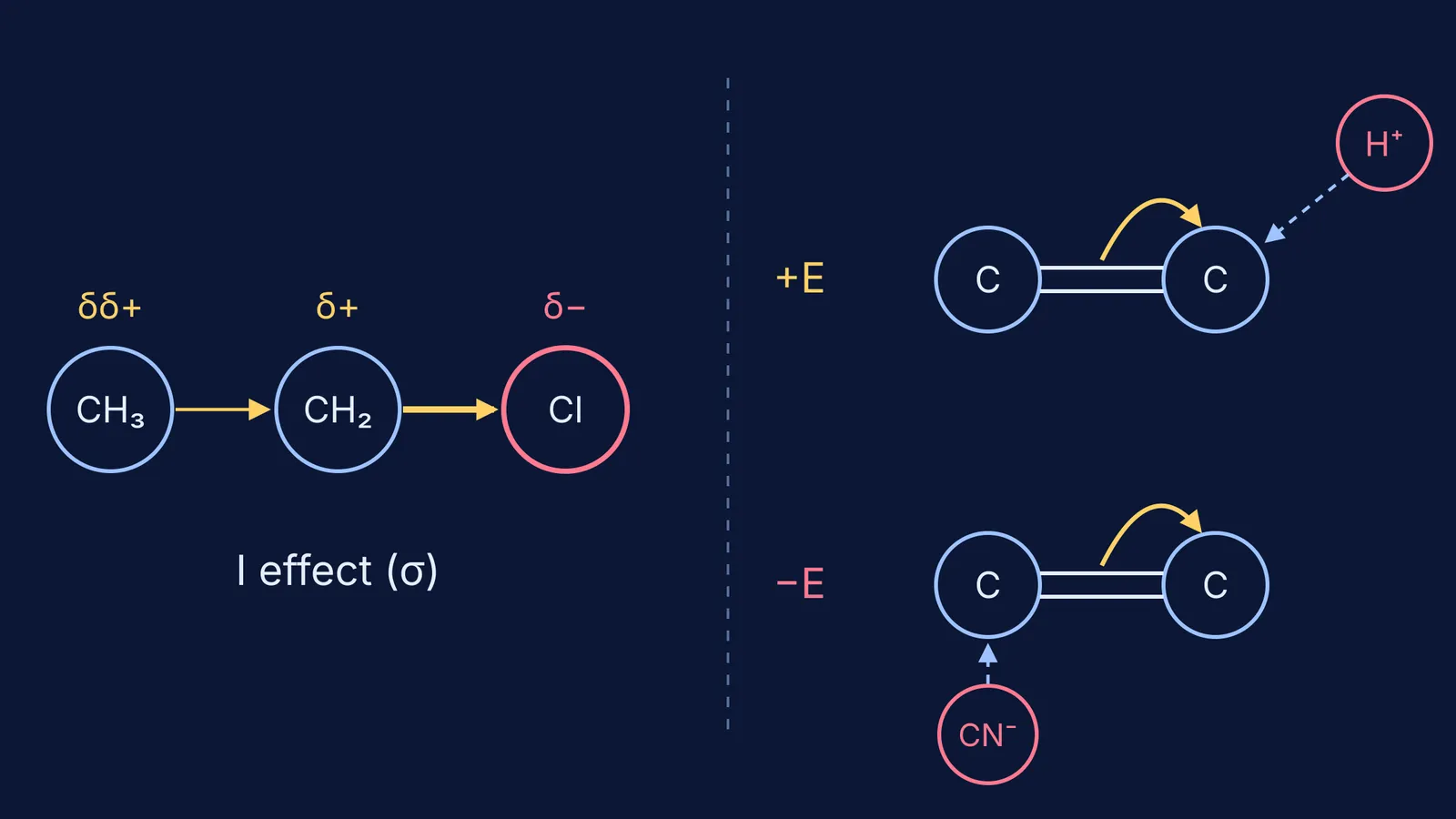
Take chloroethane, CH₃CH₂Cl. Chlorine pulls the C–Cl electrons towards itself, so carbon-1 becomes δ+. Carbon-1 then draws a little density from the C–C bond, leaving a smaller charge, δδ+, on carbon-2. NCERT notes that the effect decreases rapidly as the number of intervening bonds increases and becomes vanishingly small after three bonds (NCERT, section 8.7.5).
The same section lists halogens, –NO₂, –CN, –COOH, –COOR and –OAr as electron-withdrawing groups, and alkyl groups such as methyl and ethyl as electron-donating groups.
That is why the inductive effect turns up in "arrange in order" questions. Electron-withdrawing groups near a –COOH make the acid stronger, as our explainer on why chloroacetic acid is stronger than acetic acid works through. Electron-donating alkyl groups help cations instead: NCERT gives the carbocation stability order as methyl < primary < secondary < tertiary and credits it to inductive and hyperconjugation effects together. If the second half trips you up, see how to count alpha hydrogens for hyperconjugation.
What are the +E and −E effects?
Both are electromeric. The sign tells you where the π electrons go compared with where the reagent attaches (NCERT, section 8.7.8):
+E effect: the π electrons move to the atom to which the reagent gets attached. NCERT's example is H⁺ adding to a C=C bond.
−E effect: the π electrons move to the atom to which the reagent does not get attached. NCERT's example is CN⁻ adding to a C=C bond.
How do you tell which effect a question is asking about?
Run these four checks, in order:
Is an attacking reagent part of the picture? No reagent means it cannot be electromeric.
Which electrons move, σ or π? A shift along a chain of single bonds is inductive.
Is the shift partial (δ) or complete (a full + and −)? Partial is inductive; complete is electromeric.
If electromeric, does the reagent bond to the atom that receives the electrons? Yes means +E; no means −E.
Worked example. HBr adds to propene, CH₃–CH=CH₂. H⁺ approaches the double bond, and the π pair moves to the end carbon, which is where H⁺ attaches. Check 4 says +E. That leaves the positive charge on the middle carbon: a secondary carbocation, which NCERT's stability order ranks above a primary one, because alkyl groups on the charged carbon stabilise it through inductive and hyperconjugation effects. One reaction, both effects: a temporary +E shift starts it, and permanent inductive donation helps decide where the charge sits. Why peroxides change the outcome with HBr is in our piece on the Kharasch peroxide effect.
Where should you practise next?
If the definitions still blur together, the Fermi Concept Library gives each chemistry concept its own lesson and its place in the map, so you can revisit each effect on its own before mixing them. If you know the idea but keep picking the wrong option, work through questions in the Fermi Problem Library, where a step-by-step solver explains the reasoning rather than printing an answer.
Next time the options mix I, R and E effects, ask first: is a reagent attacking a π bond right now?


