

On this page
In short To count alpha hydrogens for hyperconjugation, find the saturated (sp³) carbon atoms directly attached to the carbocation, radical or double bond and count their hydrogens. As early 1937 heat of hydrogenation measurements showed, the higher this alpha hydrogen count, the more stable the structure is due to sigma-bond delocalization.
When you predict the major product of an elimination reaction or trace a carbocation's path, you need to rank the stability of the possible structures. The key to that ranking is hyperconjugation (sometimes called no-bond resonance).
Early measurements of the heat of hydrogenation in 1937 showed that alkenes release less heat—meaning they start out at a lower energy and are more stable—when they have more alkyl groups attached to the double bond 1. The reason is hyperconjugation, and its strength depends entirely on how many alpha hydrogens you can count.
What is an alpha hydrogen?
In organic chemistry, the "alpha" position is the spot directly next to the action. For hyperconjugation, the action is an electron-deficient centre or an unsaturated group.
An alpha carbon is any saturated, sp³-hybridised carbon atom that is directly bonded to an unsaturated or electron-deficient centre 1.
The centre: This is your C=C double bond, your carbocation (C⁺), or your carbon with an unpaired electron (free radical).
The alpha carbon: This is the carbon directly touching the centre.
The alpha hydrogen: These are the hydrogen atoms attached to that alpha carbon.
How do you count alpha hydrogens step by step?
If you are wondering how to count hyperconjugation structures alpha hydrogen numbers dictate, the rule is simple: the number of hyperconjugation structures you can draw for a molecule is exactly equal to its number of alpha hydrogens. Here is the framework for counting them quickly.
Locate the centre. Draw a box around the C=C double bond or the carbon with the positive charge.
Mark the immediate neighbours. Look only at the carbons directly touching your box. Ignore any carbons further down the chain.
Check the hybridisation. Keep only the neighbours that are sp³ hybridised (bonded only with single bonds). These are your alpha carbons.
Count the hydrogens. Add up all the hydrogens attached to those alpha carbons.
Example 1: Carbocations
Compare the ethyl cation (CH₃–CH₂⁺) and the tert-butyl cation ((CH₃)₃C⁺).
For the ethyl cation, the centre is the CH₂⁺. It is attached to one carbon (the CH₃ group). That carbon has 3 hydrogens. So, the ethyl cation has 3 alpha hydrogens.
For the tert-butyl cation, the central C⁺ is attached to three CH₃ groups. Each of those three alpha carbons brings 3 hydrogens, giving a total of 9 alpha hydrogens. Because 9 is greater than 3, the tert-butyl cation is much more stable. If you are staring at a carbocation rearrangement and cannot decide if a hydride shift will happen, the Fermi Problem Library will walk you through the energy of each intermediate step by step.
Example 2: Alkenes
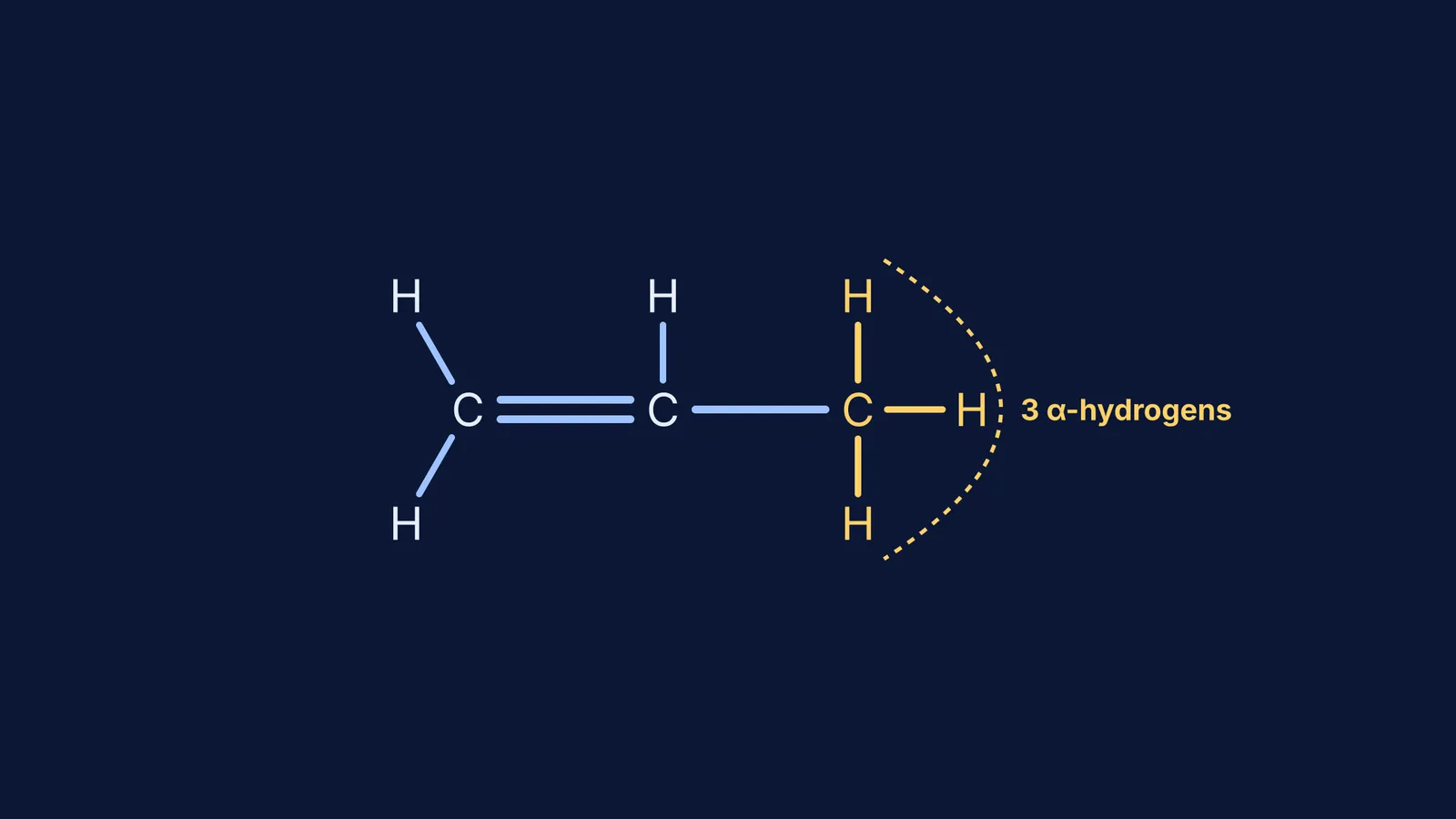
Compare propene (CH₃–CH=CH₂) and ethene (CH₂=CH₂).
In propene, draw a box around the C=C double bond. There is one carbon directly attached to it (the CH₃ group). It holds 3 hydrogens, so propene has 3 alpha hydrogens.
In ethene, there are no carbons attached to the C=C double bond. It has 0 alpha hydrogens. Therefore, propene is more stable than ethene.
Why do alpha hydrogens add stability?
Hyperconjugation is the overlap of electrons. In a carbocation, the positively charged carbon has an empty p-orbital. The electrons in the adjacent C–H single bonds (the sigma bonds on the alpha carbon) can lean over and partially overlap with that empty orbital.
This overlap allows the electrons to spread out over a larger volume, which lowers the overall energy of the molecule. Each alpha hydrogen provides one C–H bond that can overlap. The more alpha hydrogens you have, the more the charge is shared, and the more stable the structure becomes. If you find it hard to picture how orbitals overlap in 3D, the Fermi Concept Library breaks down the geometry of bonding in its chemistry lessons.
How do you predict stability using alpha hydrogens?
Once you can count the alpha hydrogens reliably, you can answer most stability questions in organic chemistry without memorising separate rules for every functional group.
Rank carbocations: Count the alpha hydrogens. A secondary carbocation with 6 alpha hydrogens is always more stable than a primary carbocation with 3.
Rank free radicals: The rule is exactly the same as for carbocations. The unpaired electron sits in a p-orbital and is stabilised by overlapping C–H bonds.
Apply Zaitsev's rule: When an elimination reaction like alcohol dehydration can form more than one alkene, the major product is the one with the most substituted double bond. "More substituted" simply means it has more alpha hydrogens.


