

On this page
When studying organic chemistry for exams like the JEE or NEET, predicting the strength of an acid is a classic problem. It is rarely about memorising long tables of pKa values. Instead, it is about understanding how the atoms attached to the carboxyl group change the stability of the entire molecule. The trend from acetic acid to trichloroacetic acid is one of the clearest and most commonly tested ways to see the inductive effect at work.
What makes an acid strong?
The strength of an acid depends entirely on the stability of its conjugate base. When a carboxylic acid (R-COOH) acts as an acid, it donates a proton (H⁺). This leaves behind a carboxylate anion (R-COO⁻), which carries a negative charge.
If that negative charge is concentrated in one place, the ion is highly unstable and will strongly try to pull the proton back. The acid is weak. But if the rest of the molecule can spread out or delocalise that negative charge, the conjugate base becomes stable. The acid will easily release its proton and stay separated, making it a stronger acid.
How does the negative inductive (-I) effect work?
The inductive effect is the shift of electron density through the sigma (σ) bonds of a molecule. It is caused by differences in electronegativity between atoms.
Chlorine is highly electronegative compared to carbon and hydrogen. When chlorine atoms are attached to the α-carbon (the carbon next to the carboxyl group), they pull electron density towards themselves. This electron-withdrawing pull travels down the carbon-carbon bond and reaches the carboxylate group. By pulling electrons away from the negatively charged oxygen atoms, chlorine helps to disperse the charge, stabilising the R-COO⁻ ion. This is known as the negative inductive effect, or the -I effect.
Why is trichloroacetic acid stronger than acetic acid?
We can see the power of the -I effect by comparing the measured acid dissociation constants (pKa values) of these three acids. Because the pKa scale is logarithmic, a drop of 1 unit means the acid is 10 times stronger. A lower pKa means a stronger acid.
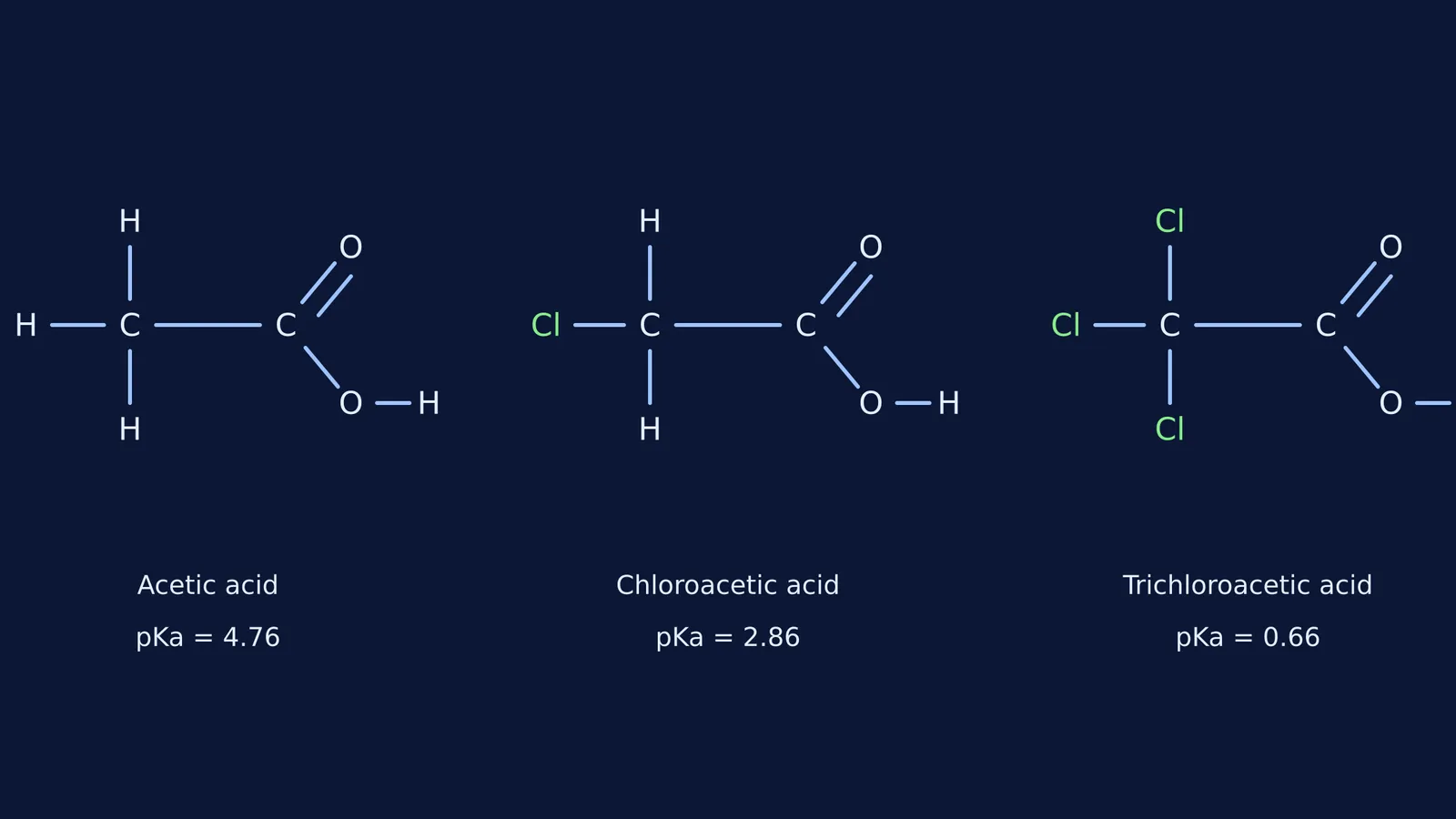
Acetic acid (CH₃COOH): The pKa of acetic acid is 4.76. The methyl (CH₃) group has a slight electron-donating effect (+I effect). It pushes electron density towards the carboxylate group, intensifying the negative charge and destabilising the ion. This makes acetic acid a weak acid.
Chloroacetic acid (CH₂ClCOOH): Replacing one hydrogen atom with a chlorine atom gives a pKa of 2.86. The strong -I effect of the single chlorine atom overcomes the carbon chain's electron-donating nature. It pulls electron density away, stabilising the conjugate base and making chloroacetic acid nearly 100 times stronger than acetic acid.
Trichloroacetic acid (CCl₃COOH): When all three hydrogen atoms on the α-carbon are replaced by chlorine, the pKa drops to 0.66. The combined -I effect of three highly electronegative chlorine atoms creates a significant pull on the electron density. The resulting trichloroacetate anion is heavily stabilised, making trichloroacetic acid over 10,000 times stronger than acetic acid.
Every time you replace a hydrogen with an electron-withdrawing halogen, the acid becomes stronger. If you were to replace the chlorine with fluorine (which is even more electronegative), the acid would become stronger still.
Inductive vs resonance effects
It is worth noting that the inductive effect is only one part of the puzzle. While the inductive effect operates purely through the sigma bonds and fades rapidly with distance, the resonance (or mesomeric) effect operates through pi (π) bonds and can influence an entire molecule over larger distances. However, in the case of aliphatic carboxylic acids like chloroacetic acid, the resonance effect within the carboxylate group is identical across all three molecules. The only difference is the substituents on the α-carbon, making the pure inductive effect the tie-breaker.
How do you understand electronic effects for exams?
The inductive effect is just one of several electronic effects that dictate how molecules behave. To solve advanced reaction mechanisms, you also need to weigh up resonance, the mesomeric effect, and hyperconjugation.
A good way to build this intuition is through the Fermi Concept Library, which maps out every concept in chemistry, each with its own lesson. Instead of just giving you the rules, Fermi's AI tutor works out what you already know and builds a plan for the session. When you are ranking acids, the tutor will not just tell you the right order; it will ask you to draw the conjugate bases, run through the electron-withdrawing groups, and check your reasoning as you go.
If you are struggling to picture how these electron shifts change the overall molecule, interactive tools like the Fermi Simulation Lab can help you visualise the electrostatic potential maps that are otherwise hard to see on a static page.
To learn more about how acidity works across different functional groups, explore our guides on ranking carboxylic acids and the broader electronic effects in organic chemistry.


