

On this page
In early organic chemistry, a long-standing puzzle frustrated researchers: the inconsistent results when adding hydrogen bromide (HBr) to carbon-carbon double bonds. Sometimes the reaction followed the expected textbook rules, but other times it did the exact opposite, yielding mixtures of products that seemed to defy explanation.
What is the Kharasch peroxide effect?
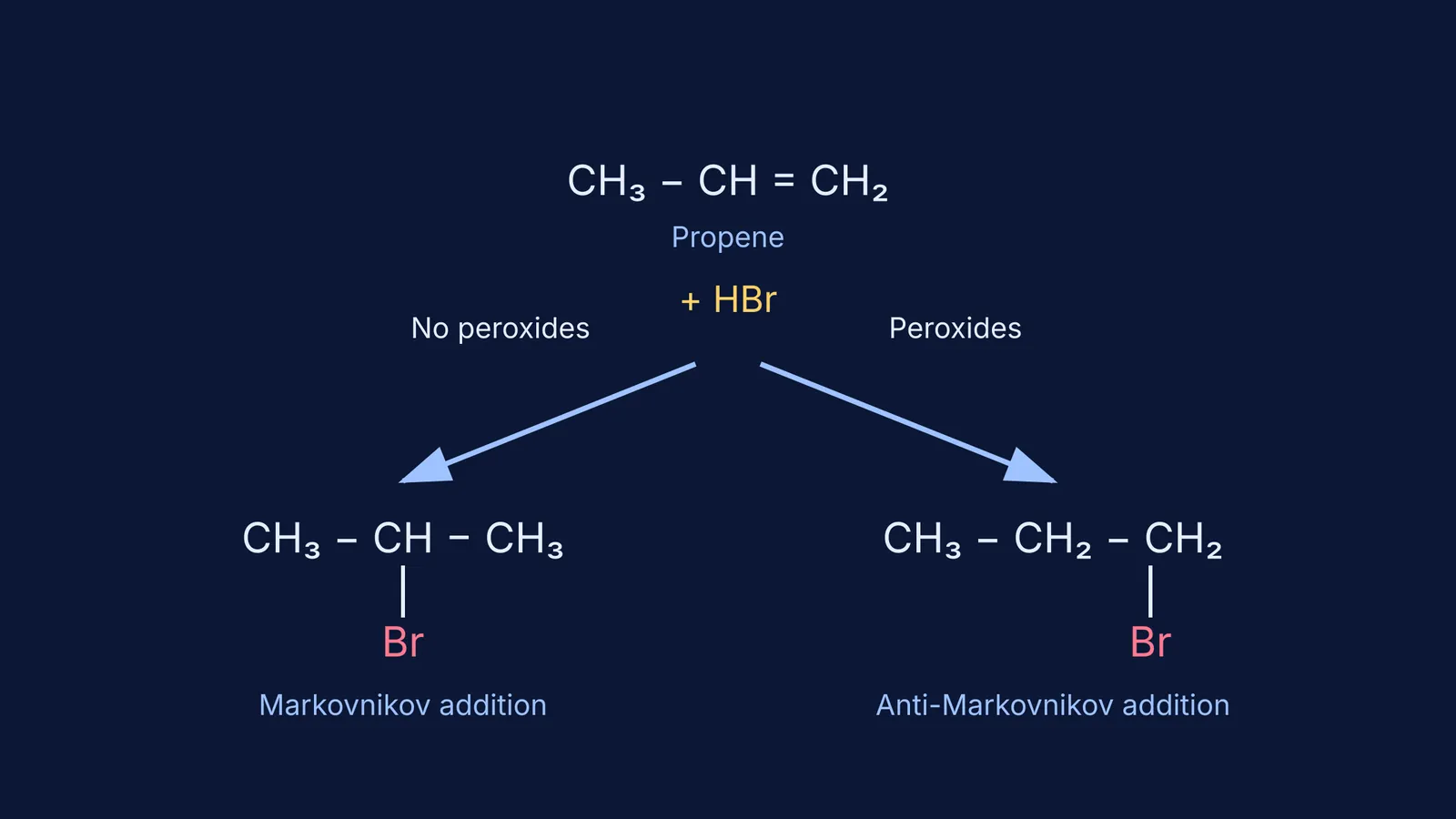
In 1870, the Russian chemist Vladimir Markovnikov proposed his famous rule (Wikipedia). Markovnikov's rule states that when adding an acid to an asymmetric alkene, the hydrogen atom attaches to the carbon that already has more hydrogen atoms, while the halide attaches to the carbon with fewer. For decades, chemists assumed this was a universal law.
However, in 1933, chemist Morris S. Kharasch and his student Frank R. Mayo at the University of Chicago published a landmark paper in the *Journal of the American Chemical Society*. They proved that the erratic results with HBr were not random. Instead, they were caused by trace peroxides formed when alkenes reacted with atmospheric oxygen.
They showed that the presence of peroxides forces HBr to add in the reverse direction—giving the anti-Markovnikov product. This reversal is now known as the Kharasch effect, or the peroxide effect.
Why does anti-Markovnikov addition happen?
Standard Markovnikov addition proceeds through a carbocation intermediate. The hydrogen adds first, forming the most stable positive charge (usually on a secondary or tertiary carbon), and the negative bromide ion attacks it.
But when peroxides are present, the reaction pathway completely changes. The weak oxygen-oxygen (O-O) bond in a peroxide breaks easily under heat or light, creating free radicals. This triggers a free-radical chain reaction:
Initiation: The peroxide radical pulls a hydrogen atom from HBr, leaving behind a highly reactive bromine radical (Br·).
Propagation (Step 1): The bromine radical attacks the alkene's double bond. Crucially, the bromine bonds to the *least* substituted carbon. Why? Because doing so leaves the single unpaired electron on the *more* substituted carbon, forming a much more stable secondary or tertiary carbon radical.
Propagation (Step 2): This stable carbon radical then abstracts a hydrogen atom from another HBr molecule, creating the final anti-Markovnikov product and a new bromine radical to continue the chain.
If you want to see every step of these chains, the Fermi Concept Library contains interactive lessons on every organic mechanism. For a closer look at the initiation, propagation and termination phases, our guide to the free radical chlorination of methane: initiation to termination breaks down a very similar pathway.
Why does the peroxide effect only work for HBr?
The Kharasch peroxide effect is unique to hydrogen bromide. If you attempt the same reaction with hydrogen chloride (HCl) or hydrogen iodide (HI) in the presence of peroxides, the reaction stubbornly reverts to the standard Markovnikov addition.
This happens because of thermodynamics. A radical chain reaction can only sustain itself if both of its propagation steps release energy (meaning they are exothermic).
For HCl: The carbon-radical intermediate must break the H-Cl bond to grab a hydrogen atom. But the H-Cl bond is incredibly strong, making this step heavily endothermic. The chain stalls.
For HI: The iodine radical must attack the double bond to form a C-I bond. However, the energy released by forming the weak C-I bond is not enough to compensate for breaking the pi bond in the alkene. This first step is endothermic, and the iodine radicals simply recombine into iodine gas instead of continuing the chain.
Only HBr sits in the thermodynamic sweet spot where both the attack on the double bond and the abstraction of hydrogen are exothermic. For step-by-step help calculating the exact enthalpy changes in these reactions, the Fermi Problem Library explains the reasoning behind each step instead of just printing the answer.
How do you predict the product in an exam?
When you encounter an alkene addition problem in an exam, the reagent on the reaction arrow determines the entire mechanism:
Just HBr (or HCl, HI): The reaction follows the standard carbocation mechanism. Apply Markovnikov's rule. The halogen goes to the more substituted carbon.
HBr + Peroxide (or heat/light with oxygen): The reaction switches to the free-radical mechanism. The Kharasch peroxide effect applies. The bromine goes to the less substituted carbon.
HCl or HI + Peroxide: Ignore the peroxide. The radical mechanism fails thermodynamically, so standard Markovnikov addition takes over.
By checking the reagent carefully, you can reliably predict which pathway the molecule will take.


