

On this page
You have five structures and one question: which is the strongest acid? Memorising pKa tables does not scale to every compound an exam can invent. A fixed four-step check does. Organic chemistry courses teach it with the mnemonic ARIO: Atom, Resonance, Induction, Orbital (Master Organic Chemistry; LibreTexts, CHEM 231).
Why compare the conjugate base, not the acid?
An acid is strong when giving up H+ is easy, and that is easy when the anion left behind is stable. As James Ashenhurst writes in his guide to the factors that influence acidity, "anything which stabilizes the conjugate base will increase the acidity."
So at every step, draw the anion and ask one question: how well can it hold the negative charge? A lower pKa means a stronger acid.
How do you compare acidity of organic compounds step by step?
Work in order, and stop at the first step that separates your compounds.
Atom bearing the H. Across a row, the more electronegative atom holds charge better, so O–H beats N–H beats C–H. Down a group, size wins: methanethiol (pKa 10.4) is more acidic than methanol (pKa 15.5), because sulfur spreads the charge over a larger atom (LibreTexts, CHEM 231).
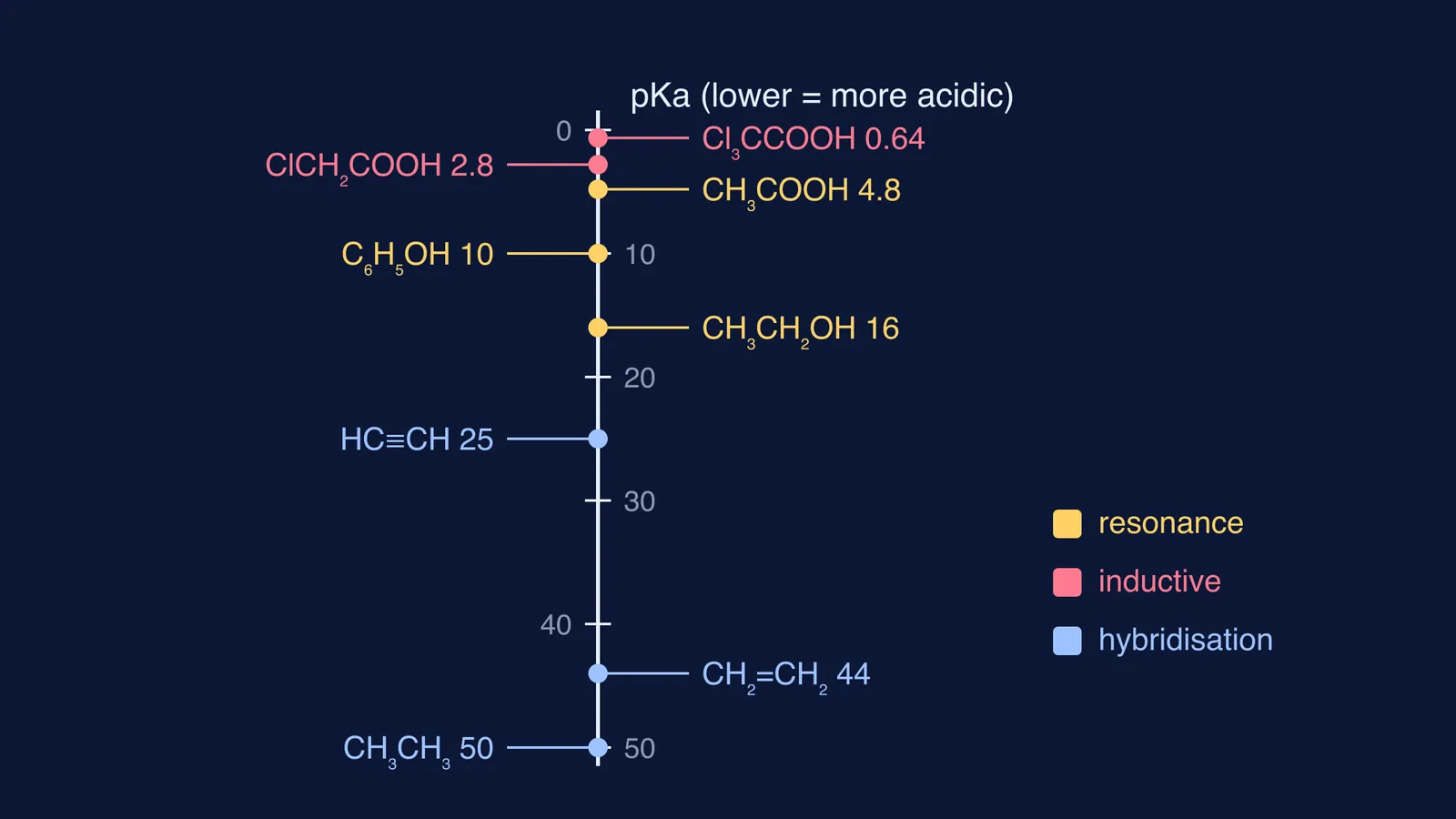
Resonance. A charge shared over several atoms is more stable than one stuck on a single atom. Acetic acid has a pKa of 4.8 while ethanol sits near 16, because acetate shares its charge over two oxygens and ethoxide keeps it on one. Phenol, at a pKa of about 10, sits in between: phenoxide spreads its charge into the benzene ring (LibreTexts, CHEM 231).
Inductive effects. Electronegative atoms nearby pull electron density through sigma bonds and steady the anion. Chloroacetic acid has a pKa of 2.8, dichloroacetic acid 1.3 and trichloroacetic acid 0.64 (LibreTexts, Soderberg/07:_Acid-base_Reactions/7.04:_Structural_Effects_on_Acidity_and_Basicity)). Distance matters: 2-chloropropanoic acid has a pKa of 2.8 but 3-chloropropanoic acid 4.0, a clear case of how the inductive effect fades with distance.
Hybridisation (orbital). An sp orbital has 50% s character, sp2 33.3% and sp3 25%, and more s character holds the charge closer to the nucleus (LibreTexts, CHEM 231). That is why ethyne (pKa 25) is far more acidic than ethene (44) or ethane (50).
The Soderberg text/07:_Acid-base_Reactions/7.04:_Structural_Effects_on_Acidity_and_Basicity) puts the ranking between steps 2 and 3 plainly: "In general, resonance effects are more powerful than inductive effects."
Worked example: which of these five is most acidic?
Rank ethanol, acetic acid, chloroacetic acid, phenol and ethyne.
Step 1, atom: four compounds lose H from oxygen, one (ethyne) from carbon. Ethyne goes last.
Step 2, resonance: among the O–H acids, the carboxylate ions share charge between two equal oxygens, phenoxide spreads it into the ring, and ethoxide cannot spread it at all. So both carboxylic acids come first, then phenol, then ethanol.
Step 3, inductive: acetic and chloroacetic acid tie on resonance. The chlorine pulls electron density from the carboxylate, so chloroacetic acid is stronger.
Step 4, hybridisation: not needed; every pair is already decided.
Answer: ClCH2COOH > CH3COOH > C6H5OH > CH3CH2OH > HC≡CH. Check it against measured values from the LibreTexts CHEM 231 page: pKa 2.8, 4.8, about 10, about 16 and 25. The order matches.
When does the step order break?
The steps are a priority list, not a law:
Atom versus orbital. By step 1, ammonia (N–H) should beat ethyne (C–H). It does not: ammonia's pKa is 36 and ethyne's is 25. LibreTexts calls these competing factors; here the sp carbon's 50% s character wins over nitrogen's electronegativity.
Too many changes at once. Ashenhurst notes that ARIO works well for similar molecules where only one variable changes. When two or more things change, as with ethanol versus HCl, he says you have to rely on known pKa values instead.
The same logic carries over to substituent questions, such as why formic acid is stronger than acetic and benzoic acid.
How should you practise this for JEE and NEET?
In a ranking question, the reason matters as much as the order. Try this ten-minute daily routine:
Take one ranking question from your NCERT exercises or a past paper.
Draw every conjugate base before you rank anything.
Write the step name (atom, resonance, inductive or orbital) beside each comparison you make.
Check your order against a pKa table, and mark any comparison where you used the wrong step.
You can also ask an AI tutor to name the effect at each ranking step and check its reasoning against your own.
If you keep getting the order right for the wrong reason, the Fermi Problem Library has worked problems with a step-by-step solver that explains the reasoning rather than printing an answer. If one step feels shaky, the Fermi Concept Library gives each chemistry concept its own lesson.
Pick five acids tonight, draw their anions, and rank them one step at a time.


