

On this page
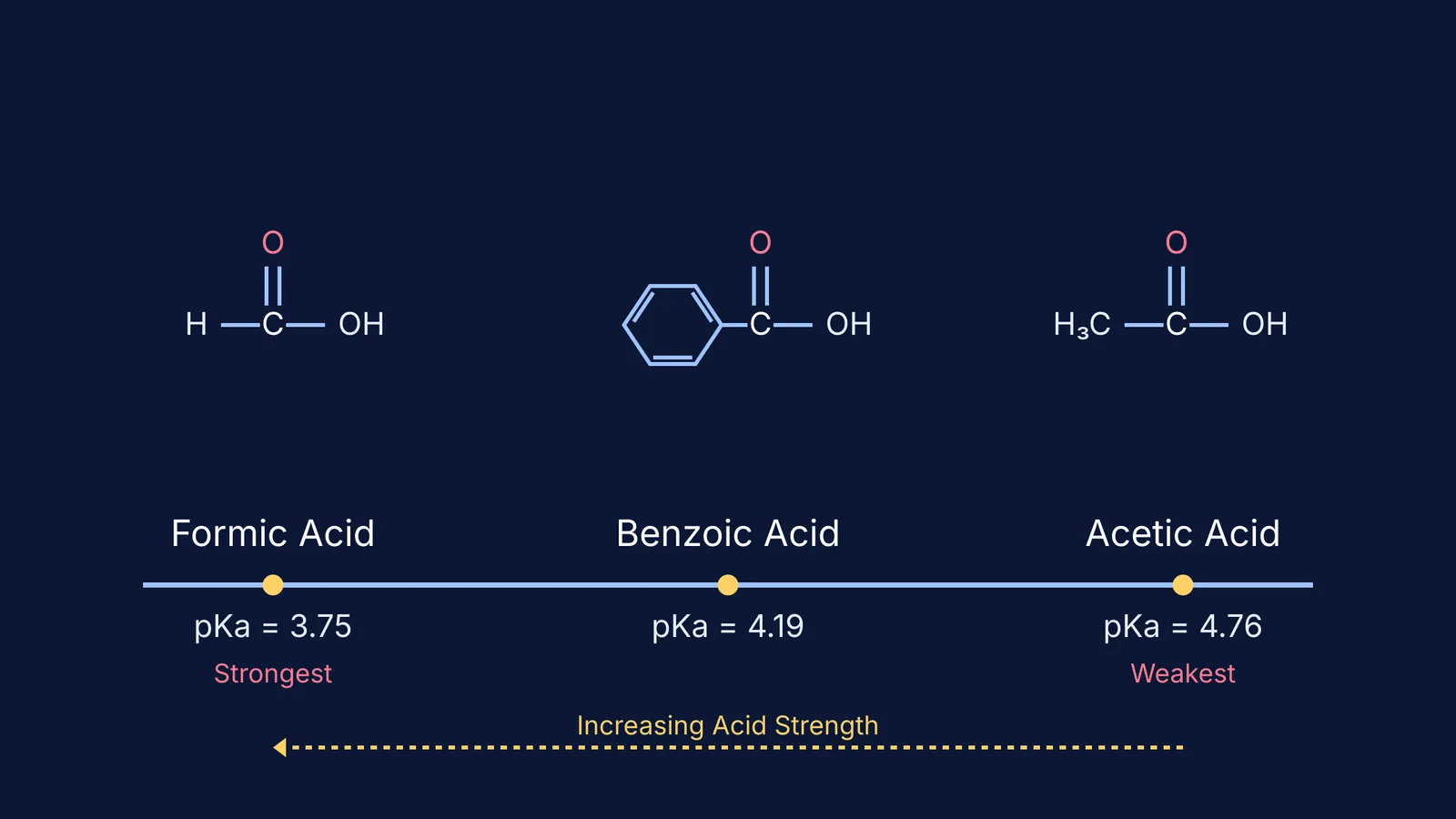
When you study carboxylic acids for board exams or entrance tests like JEE and NEET, one trend appears on almost every past paper: ranking their acidic strength. If you measure the acidity of formic acid, benzoic acid, and acetic acid in water at 25 °C, formic acid is the strongest.
According to data compiled by Chemistry LibreTexts/20%3A_Carboxylic_Acids/20.04%3A_Acidity_of_Carboxylic_Acids), formic acid has a pKa of 3.75, making it approximately ten times more acidic than acetic acid, which has a pKa of 4.76. Benzoic acid sits strictly between them with a pKa of 4.19. Because a lower pKa means a stronger acid, the exact acidity order is formic acid first, benzoic acid second, and acetic acid third.
What is the acidity order of formic, acetic, and benzoic acid?
The absolute acidity order is formic acid > benzoic acid > acetic acid.
To understand why, you have to look at the conjugate base. When a carboxylic acid donates its proton (the H⁺ ion), it leaves behind a negatively charged carboxylate ion. If this negative charge is stable, the acid easily gives up its proton, making it a strong acid. If the negative charge is pushed around or destabilised by nearby groups, the acid holds onto its proton, making it weak.
The differences between formic, benzoic, and acetic acids come down entirely to what is attached to the carboxyl group: a solitary hydrogen atom, a phenyl ring, or a methyl group.
Why is formic acid stronger than acetic acid?
Formic acid (HCOOH) is stronger than acetic acid (CH₃COOH) because of the inductive effect of the methyl group.
In formic acid, the carboxyl group is attached to a simple hydrogen atom. Hydrogen is the standard reference point in organic chemistry; it does not push or pull electrons. When formic acid loses a proton, the resulting formate ion is highly stable.
In acetic acid, the carboxyl group is attached to a methyl group (CH₃). Alkyl groups are electron-donating. The methyl group pushes electron density toward the already negatively charged carboxylate ion through the +I (positive inductive) effect. This extra negative charge destabilises the acetate ion, making acetic acid roughly ten times weaker than formic acid.
Why is benzoic acid stronger than acetic acid?
Benzoic acid (C₆H₅COOH) is stronger than acetic acid due to the electron-withdrawing nature of the sp² hybridised carbons in its phenyl ring.
In acetic acid, the methyl carbon is sp³ hybridised. In benzoic acid, the carbon atom directly attached to the carboxyl group is part of a benzene ring and is sp² hybridised. Because an sp² carbon has more s-character than an sp³ carbon, it is more electronegative.
This means the phenyl ring acts as an electron-withdrawing group via the -I (negative inductive) effect when compared to a methyl group. It pulls electron density away from the carboxylate ion, stabilising the negative charge. Consequently, benzoic acid drops its proton more readily than acetic acid, resulting in a lower pKa of 4.19.
Why is benzoic acid weaker than formic acid?
Although the phenyl ring pulls electrons inductively, benzoic acid remains weaker than formic acid because of the resonance effect.
The benzene ring is rich in pi electrons. While it exerts a mild -I effect, it also exhibits a +R (positive resonance) effect. The pi electron cloud of the phenyl ring can donate electron density into the carboxylate group. This resonance pushes negative charge onto the oxygen atoms, destabilising the conjugate base relative to the neutral formate ion.
Because formic acid has only a solitary hydrogen atom with no +R effect to destabilise the ion, it remains the strongest acid of the three.
If you struggle to weigh competing inductive and resonance effects, the Fermi Concept Library covers every concept in chemistry, with lessons showing exactly how electrons flow in conjugate bases.
A 3-step framework for ranking carboxylic acid strength
When you face a new list of acids in an exam, do not guess. Use this three-step framework to find the correct order:
Look at the reference. Find the simplest acid in the list. Formic acid (hydrogen substituent) is your baseline.
Identify electron-donating groups (EDGs). Any alkyl groups (like methyl in acetic acid) push electrons via the +I effect. They destabilise the conjugate base and decrease acidic strength. Rank these as weaker than the baseline.
Weigh the resonance and inductive balance. Aromatic acids like benzoic acid have a phenyl ring that withdraws electrons inductively (-I) but donates them via resonance (+R). The net result is that they are weaker than formic acid, but stronger than purely aliphatic acids like acetic acid.
You can verify these functional groups in the lab by checking the Ester Test for Alcohol and Carboxylic Acid. When calculating exact values in solutions, The pH of a Mixture of Two Weak Acids Formula helps balance competing equilibria. Furthermore, understanding the impact of adding carbon chains—such as How to Step Up Ethanol to Propanoic Acid: Three Routes Explained—reinforces why longer carbon groups increasingly weaken an acid through compounding +I effects.


