On this page
Have you ever stared at three substituted benzoic acids and guessed the most stable one just by counting the halogens? You are not alone.
Why is acid strength so hard to predict?
When we learn the rules of organic chemistry, we learn about the inductive effect (electrons pulling through σ-bonds) and the resonance or mesomeric effect (electrons sharing through π-bonds). On their own, they make sense. But when they compete—like a chlorine atom pulling electrons away (-I) but also donating a lone pair (+M)—things get messy.
A 2011 study by L. McClary and V. Talanquer in the *International Journal of Science Education* (10.1080/09500693.2010.528463) found that undergraduate chemistry students often fall back on "lexicographic heuristics" when ranking acid strength. Instead of weighing competing electronic effects, students use shortcuts. They look at a single feature—such as the number of oxygen atoms or the sheer presence of a double bond—and rank the molecules based only on that trait.
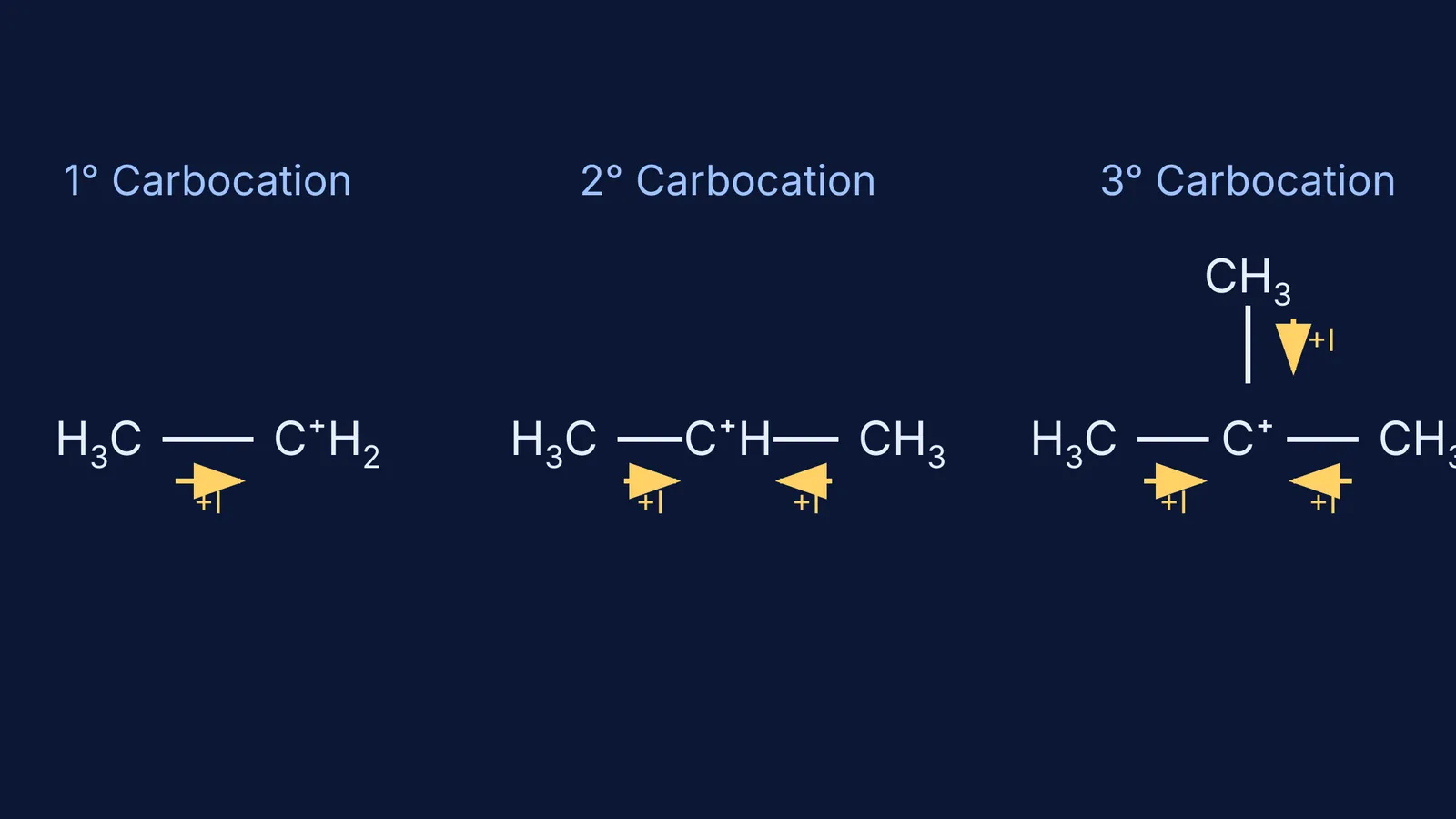
This shortcut works until the exam tests an exception. If you only memorize that "alkyl groups stabilise carbocations," you will get stuck when asked if a resonance-stabilised primary carbocation is more stable than a tertiary one without resonance.
How do you ask AI to name the inductive resonance effect at each ranking step?
To break the habit of guessing, you have to slow down and name the forces at play. Instead of asking for the final answer, you can use a specific prompt with an AI tutor to force a step-by-step breakdown.
Try this exact script the next time you have a ranking question:
"I need to rank these molecules by stability: [paste molecules]."
"Do not give me the final ranking yet."
"Step 1: List each molecule one by one."
"Step 2: Name every electronic effect present (e.g., +I, -I, +M, -M, hyperconjugation)."
"Step 3: Tell me which effect is dominant for each molecule."
"Wait for my reply before we try to rank them."
By splitting the task, you evaluate the structure first. Fermi's AI tutor is built for this. It holds a line of reasoning across a session, notices where a student is stuck, and decides whether to explain, ask or show, rather than just printing the answer.
What happens when the inductive effect and resonance compete?
Once you have the prompt, test it on classic trap questions. Here are three cases where effects compete and shortcuts fail.
The Halogen Exception
Ask the AI to rank the acidity of *p*-fluorobenzoic acid, *p*-chlorobenzoic acid, and benzoic acid.
Halogens are unique because their electron-withdrawing inductive effect (-I) is stronger than their electron-donating resonance effect (+M). This happens because the 2p orbitals of carbon do not overlap well with the larger 3p or 4p orbitals of chlorine and bromine.
By forcing the AI to list the effects, you will explicitly see it state: "Chlorine has a -I and +M effect, but the -I effect dominates." For more on how ring position changes everything, read our guide to the Ortho effect: why ortho benzoic acids are stronger acids.
Distance Decay in the Inductive Effect
Ask the AI to compare the acidity of 2-chlorobutanoic acid and 3-chlorobutanoic acid.
The resonance effect of the carboxylic acid group is identical in both. The difference is pure induction. The inductive effect diminishes rapidly with distance across σ-bonds. The AI will correctly identify that the -I effect in the 2-chloro isomer is much stronger because the halogen is one carbon closer to the acidic hydrogen. You can see this principle applied in our article on The Inductive Effect on the Acid Strength of Chloroacetic Acid.
Hyperconjugation vs Resonance
Ask the AI to rank the stability of the benzyl cation and the *tert*-butyl cation.
This is a classic exam trap. Students often assume that resonance always beats induction and hyperconjugation. While the benzyl cation is stabilised by resonance from the benzene ring, the *tert*-butyl cation can be more stable depending on conditions (such as in the gas phase) due to extreme hyperconjugation from nine α-hydrogens. The AI will help you list the nine hyperconjugative structures versus the four resonance structures, letting you see the mechanics behind the stability.
If you are struggling to remember these rules, you can look up specific effects in the Fermi Concept Library, which catalogues every concept in chemistry. Taking the time to name the effect at each step ensures that when exam day comes, you rely on reasoning, not just a heuristic shortcut. Once you master ranking these effects, you can test how they influence macroscopic properties in a Buffer solution simulation: add acid and base, predict pH.