

On this page
If a question asks you to arrange substituted benzoic acids by acid strength, check the ortho position before anything else.
What is the ortho effect?
The ortho effect is the change in a benzene compound's behaviour when a group sits right next to (1,2 to) the functional group, caused by crowding and bonding interactions on top of ordinary polar effects, as summarised in the Wikipedia entry on the ortho effect. For benzoic acids it shows up as a general pattern: an ortho-substituted acid is usually stronger than its meta and para isomers.
Benzoic acid itself has a pKa of 4.20 at 25 °C, as listed on PubChem. Lower pKa means a stronger acid.
Why are ortho substituted benzoic acids stronger acids?
In benzoic acid, the –COOH group lies flat in the plane of the ring. That lets the ring push electron density into the carboxyl group by resonance, which makes losing H⁺ slightly harder. Put any group at the ortho position and it bumps into –COOH, which twists out of the ring's plane. The overlap is lost, the ring stops donating, and the acid gets stronger. Chemists call this steric inhibition of resonance (Ortho effect, Wikipedia).
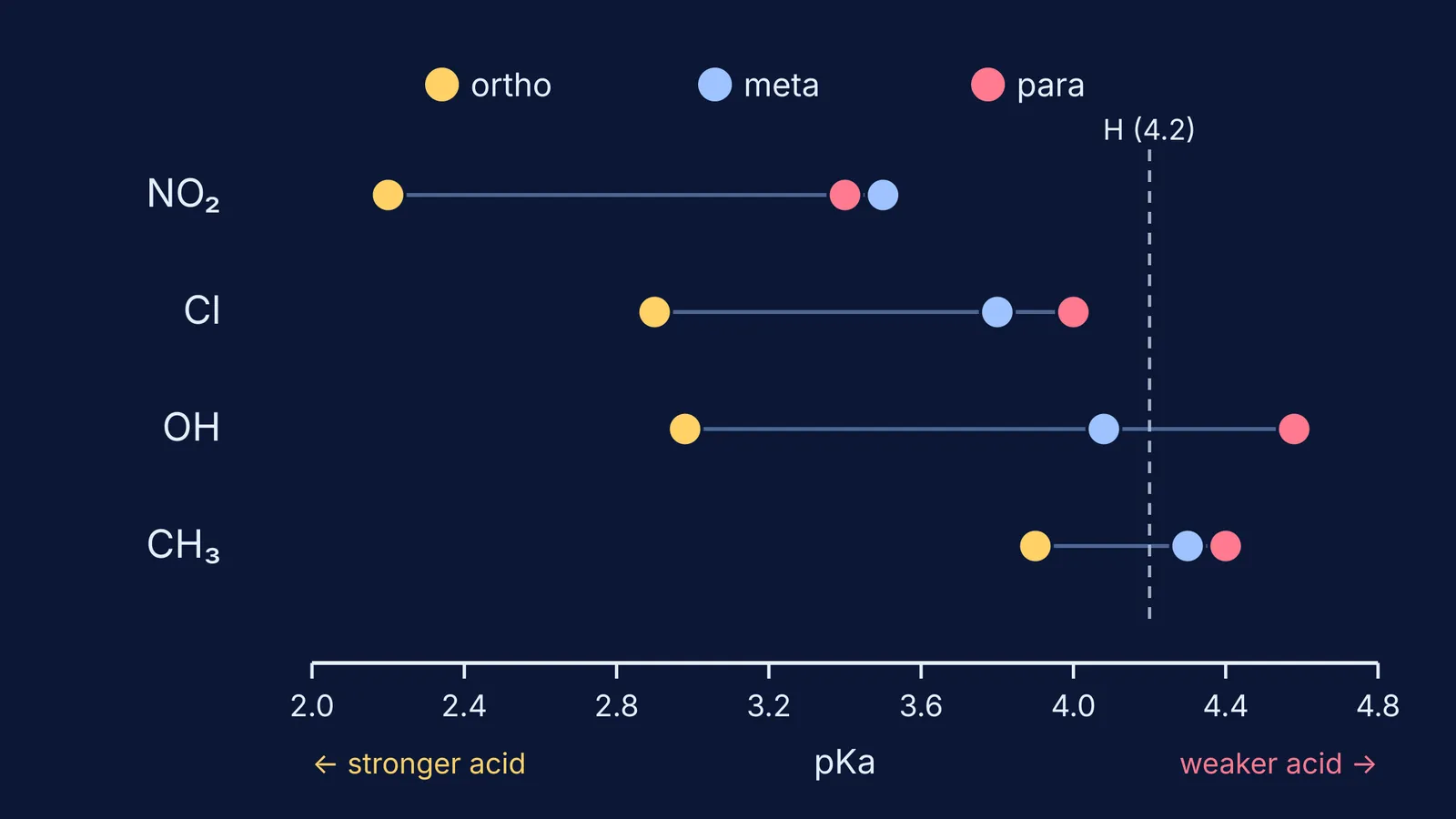
On top of that, an electron-withdrawing ortho group is as close as it can be to –COOH, so its inductive pull is strongest there. The pKa values in the same Wikipedia table show both effects:
CH₃: ortho 3.9, meta 4.3, para 4.4
Cl: ortho 2.9, meta 3.8, para 4.0
NO₂: ortho 2.2, meta 3.5, para 3.4
OH: ortho 2.98, meta 4.08, para 4.58
Methyl donates electrons, yet o-toluic acid is still stronger than benzoic acid: the ortho effect in its clearest form.
Salicylic acid (o-hydroxybenzoic acid) gets an extra push. The usual textbook explanation is that after it loses H⁺, the neighbouring –OH hydrogen-bonds to the carboxylate and stabilises it. Its first pKa is 2.98 at 20 °C, as listed on PubChem. Our post on intramolecular hydrogen bonding in o-nitrophenol shows the same kind of internal bond changing a physical property.
How do you rank substituted benzoic acids?
Use this order of checks:
Ortho first. For the same substituent, the ortho isomer is usually the strongest of the three, and most ortho acids beat benzoic acid. Across different substituents, still compare values: o-toluic acid (3.9) is weaker than p-nitrobenzoic acid (3.4). Among ortho isomers, stronger electron-withdrawing groups win: o-nitro is the strongest of the four above.
Then the substituent type at meta and para. Electron-withdrawing groups (–NO₂, –CN, –Cl) lower pKa; electron-donating groups (–CH₃, –OCH₃) raise it. The para table in OpenStax Organic Chemistry runs from p-nitro (3.41) to p-methoxy (4.46).
For groups that pull by induction but push by resonance (–OH, –OCH₃, halogens), separate meta from para. At meta only the inductive pull acts, so m-hydroxybenzoic acid (4.08 in the Wikipedia table) is stronger than benzoic acid. At para the resonance push wins for –OH, so p-hydroxybenzoic acid (4.58) is weaker.
Check near-ties before you commit. m- and p-nitrobenzoic acids (3.5 and 3.4 in the same table) differ by only about 0.1 pKa unit, with para slightly stronger.
Worked example. Arrange in decreasing acid strength: benzoic acid, p-toluic acid, o-toluic acid, salicylic acid, m-hydroxybenzoic acid, p-hydroxybenzoic acid.
Check 1 puts the two ortho acids first, with salicylic acid ahead because of its hydrogen bond. Checks 2 and 3 put m-hydroxy just above benzoic acid and the two para acids below it. Answer (pKa from the table above): salicylic acid (2.98) > o-toluic acid (3.9) > m-hydroxybenzoic acid (4.08) > benzoic acid (4.2) > p-toluic acid (4.4) > p-hydroxybenzoic acid (4.58).
If you want to revise the inductive and resonance effects behind checks 2 and 3, our guide to inductive, resonance and hyperconjugation effects covers them, and the Fermi Concept Library gives each concept its own lesson and its place in the map.
Why is o-toluidine a weaker base than aniline?
In anilines, the ortho effect runs the other way: it usually makes the compound a weaker base. Compare the pKa of each conjugate acid; a higher value means a stronger base. PubChem lists aniline at 4.6 (PubChem), o-toluidine at 4.44 (PubChem), m-toluidine at 4.69 (PubChem) and p-toluidine at 5.10 (PubChem), all at 25 °C.
So the order is p-toluidine > m-toluidine > aniline > o-toluidine. The reason is steric inhibition of protonation: when –NH₂ picks up H⁺, nitrogen changes from roughly flat (sp²) to tetrahedral (sp³), and the extra hydrogen crowds the ortho group. That destabilises the anilinium ion, so the base takes up a proton less readily (Ortho effect, Wikipedia). For wider amine basicity orders, see our post on amines and diazonium salts.
Which exceptions trip students up?
All values here are from the Wikipedia ortho effect article.
o-Methoxybenzoic acid (4.1) is no stronger than its meta isomer (4.1), so the ortho rule is a tendency, not a law.
"Ortho anilines are weaker bases" is not absolute. The listed pKb values (lower means more basic) put o-aminophenol (9.28) slightly more basic than aniline (9.38), with p-aminophenol (8.50) the most basic and m-aminophenol (9.80) the least.
When a ranking goes wrong, find which of the four checks you skipped. The Fermi Problem Library has worked problems with a step-by-step solver that explains the reasoning rather than printing an answer.


