On this page
Most carbocations you meet in Class 12 get some help. Alkyl groups push in electron density, and a neighbouring π bond can spread the charge by resonance. Vinyl and phenyl cations get almost none of that help. Here is why, plus a ranking drill.
What makes a vinyl cation different?
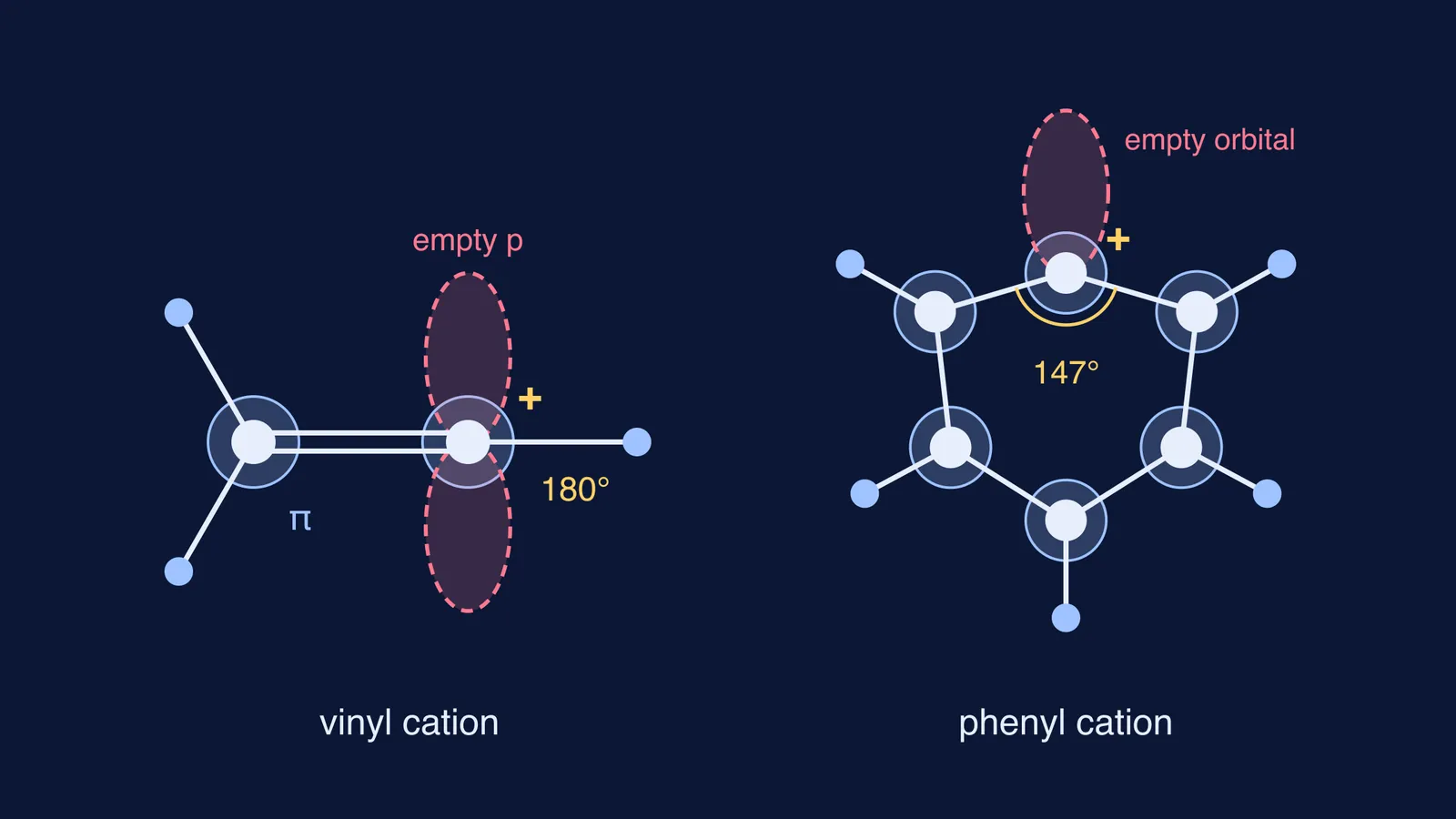
In a vinyl cation the positive charge sits on a carbon that is part of a C=C double bond. That carbon has only two groups attached, so it becomes sp hybridised and linear. Crystal data back this up: Müller, Juhasz and Reed published the first X-ray structure of a vinyl cation in 2004, and the bond angle at the charged carbon came out near 180°, as summarised in this overview of vinyl cations.
There are two problems here.
Wrong hybridisation. An sp orbital has 50% s character, compared with 33% for sp2 and 25% for sp3, according to LibreTexts on hybrid orbitals. More s character holds electrons closer to the nucleus, which makes an sp carbon more electronegative (why sp carbon is more electronegative than sp3 carbon). An electronegative carbon is a bad place to put a positive charge.
The empty orbital points the wrong way. The vacant p orbital lies perpendicular to the π bond, as the vinyl cation overview explains. Orbitals at right angles have zero overlap, so the C=C π electrons can't move in to share the charge.
Why can't the benzene ring stabilise a phenyl cation?
Benzene is full of π electrons, so why don't they help? Geometry again. When a ring carbon loses its halide, the empty orbital is left in the plane of the ring. The six π orbitals stick out above and below that plane. A 2021 study of the gas-phase phenyl cation by Wiersma and colleagues in Physical Chemistry Chemical Physics (open preprint) describes this as a vacant, non-bonding σ orbital that pushes the charged carbon towards sp hybridisation.
The ring can't let that carbon go linear. In the singlet ground state, the structure shown in the paper has the angle at the charged carbon opened to 147°, up from the normal 120°, which distorts the hexagon (Wiersma et al., Figure 1). The result is a strained ring with the charge on an sp-like carbon that the π cloud can't reach.
Why don't vinyl and aryl halides undergo SN1?
SN1 has one slow step: the C–X bond breaks on its own to give a carbocation. If that cation is very high in energy, this step is far too slow to compete. The LibreTexts chapter on electrophiles:_Organic_Chemistry_with_a_Biological_Emphasis_(Soderberg)/08:_Nucleophilic_Substitution_Reactions/8.03:_Electrophiles) puts it plainly: an SN1 route is unlikely because a vinylic carbocation is inherently unstable. The same chapter adds a second reason. Bonds to sp2 carbons are shorter and stronger than bonds to sp3 carbons, so the leaving group is harder to remove in the first place.
In aryl halides, a lone pair on the halogen also takes part in resonance with the ring. This gives the C–X bond partial double-bond character, which is why haloarenes need harsh conditions or activating groups before nucleophilic substitution happens (why haloarenes resist nucleophilic substitution).
Compare this with benzyl chloride. Its CH2 carbon is sp3, and the cation it forms has its empty p orbital parallel to the ring's π orbitals, so the charge spreads across the ring (why allylic and benzylic halides react fast by SN1). A benzyl cation and a phenyl cation have the same ring, but their empty orbitals point in different directions, and that is the key difference.
How do you rank carbocation stability in exam questions?
Use this three-question check on any cation.
Can the empty orbital line up with a π bond or lone pair? If yes (allyl, benzyl), it moves up the order.
How many alkyl groups are attached? For simple alkyl cations the order is tertiary > secondary > primary > methyl (LibreTexts:_Organic_Chemistry_with_a_Biological_Emphasis_(Soderberg)/08:_Nucleophilic_Substitution_Reactions/8.03:_Electrophiles)).
Is the positive carbon part of a double bond or an aromatic ring? If yes (vinyl, phenyl), it goes below ordinary alkyl cations such as ethyl, since vinyl cations are inherently less stable to begin with.
Try it. Rank these from most to least stable: ethyl, phenyl, benzyl, isopropyl. Cover the answer first.
Answer: benzyl > isopropyl > ethyl > phenyl.
Why: benzyl passes question 1; the alkyl cations follow question 2; phenyl fails question 3.
Now apply it to SN1. Which of these can react by SN1 in a polar protic solvent: chlorobenzene, vinyl chloride, tert-butyl chloride, allyl chloride? Tert-butyl and allyl chloride can, because they give a tertiary and a resonance-stabilised cation. Chlorobenzene and vinyl chloride would have to form phenyl and vinyl cations, so they don't.
If you keep mixing these up, the Fermi Concept Library gives each concept in chemistry its own lesson and its place in the map. For more practice, the Fermi Problem Library has worked problems with a step-by-step solver that explains the reasoning rather than printing an answer.