

On this page
You meet this idea in Class 11 organic chemistry and again in JEE Main and NEET-UG questions: an sp carbon is more electronegative than an sp³ carbon, even though both are just carbon. The reason is the orbital carbon bonds with, and it explains a classic acidity order.
What does s character mean for sp, sp² and sp³ carbon?
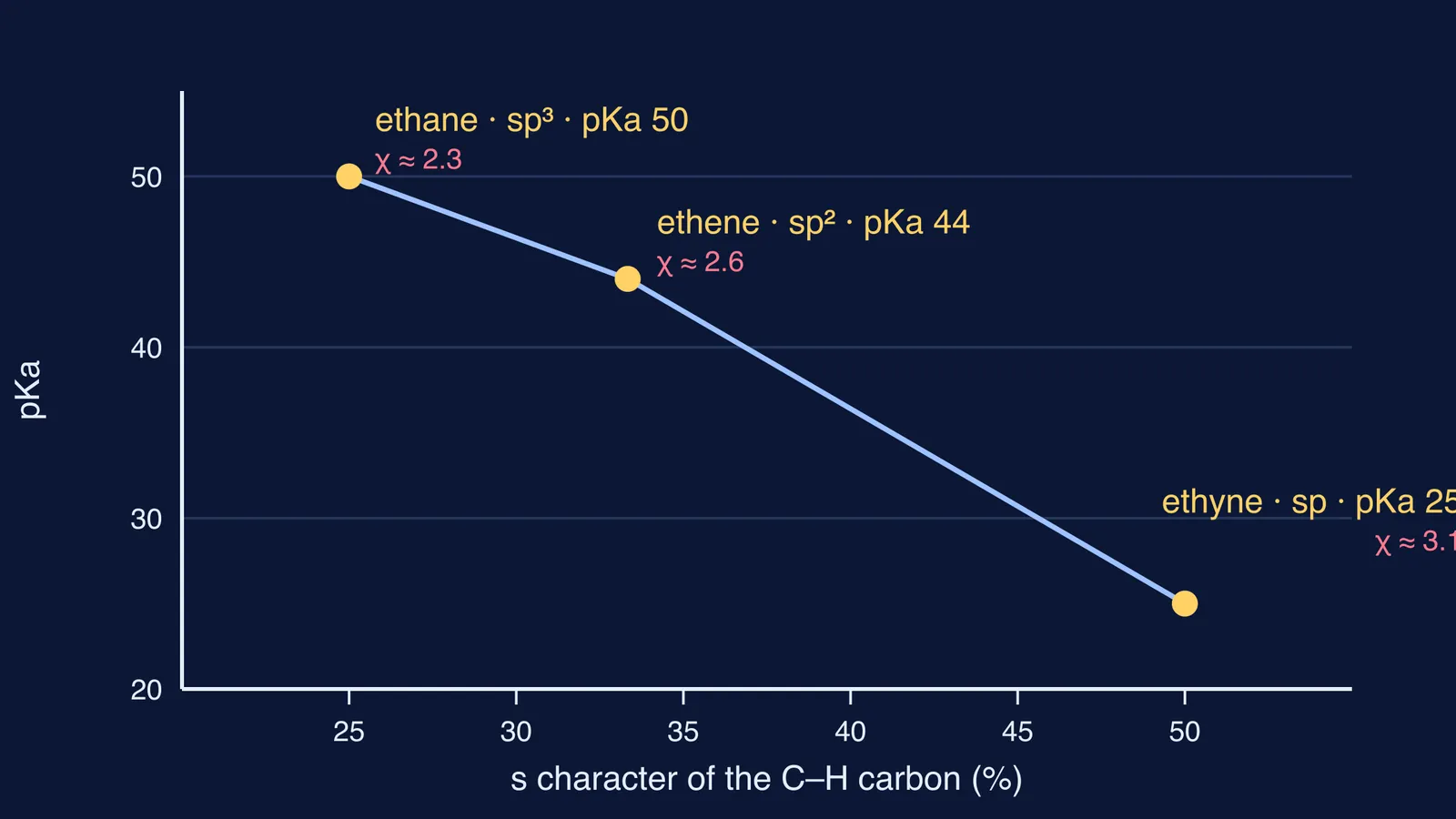
When carbon mixes its 2s orbital with its 2p orbitals, the share of s in each hybrid depends on how many p orbitals join in. An sp hybrid orbital is 50% s, an sp² hybrid is 33% s, and an sp³ hybrid is 25% s (LibreTexts, Alkyne Acidity).
sp³ (ethane): one s plus three p, so 25% s
sp² (ethene): one s plus two p, so 33% s
sp (ethyne): one s plus one p, so 50% s
Why is sp carbon more electronegative than sp³?
Electrons in s orbitals are held more tightly than electrons in p orbitals, so an atom bonding through a hybrid with more s character is more electronegative (Wikipedia, Electronegativity). Put simply, the greater the s character of an orbital, the closer its electrons are to the nucleus (LibreTexts).
On the Pauling scale, carbon's electronegativity is about 2.3 when sp³, 2.6 when sp² and 3.1 when sp, against 2.5 for carbon in general; the Wikipedia article takes these values from Ian Fleming's 2009 book Molecular Orbitals and Organic Chemical Reactions (Wikipedia, Electronegativity).
Why is ethyne more acidic than ethene and ethane?
Acidity is decided by the anion left behind. When a C–H bond loses H⁺, the bonding pair stays on carbon, in the hybrid orbital that made the bond. In the acetylide ion, HC≡C⁻, that pair sits in an sp orbital with 50% s character, close to the nucleus and so more stable; in the ethyl anion it sits in an sp³ orbital with only 25% s character (LibreTexts). A more stable conjugate base means a stronger acid.
The measured values follow the same order (LibreTexts):
ethane, CH₃CH₃: pKa about 50
ethene, CH₂=CH₂: pKa about 44
ethyne, HC≡CH: pKa about 25
pKa is a logarithmic scale, so each unit is a factor of 10. Ethyne's pKa is 19 units below ethene's, which on these figures makes its C–H roughly 10¹⁹ times more acidic. Ethyne is still a very weak acid: water, at pKa 14, is far stronger (LibreTexts).
Worked example: which base can deprotonate ethyne?
The rule: an acid–base equilibrium favours the side with the weaker acid. So a base can take H⁺ from ethyne only if its own conjugate acid has a pKa higher than 25.
Hydroxide, OH⁻. Its conjugate acid is water, pKa 14 (LibreTexts). Water is the stronger acid, so the equilibrium lies on the ethyne side and NaOH removes hardly any of ethyne's protons.
Amide, NH₂⁻, from sodium amide. Its conjugate acid is ammonia, with a pKa of 32.5 measured at −33 °C (Wikipedia, Ammonia). Ammonia is the weaker acid, so the reaction runs forward, which is why NaNH₂ is the usual base for making acetylide anions (LibreTexts).
Amide and ethene. Now ammonia (32.5) is a stronger acid than ethene (44), so the equilibrium lies on the ethene side and NaNH₂ does not deprotonate ethene appreciably.
What mistakes do students make with this?
Calling every alkyne acidic. But-2-yne, CH₃C≡CCH₃, has no hydrogen on either sp carbon, so it has no acetylenic hydrogen to lose.
Arguing from how easily the bond breaks. The order is explained by where the lone pair sits in the anion, so write your answer about the conjugate base.
Flipping the direction. More s character means higher electronegativity and higher acidity, which means a lower pKa.
Thinking it only applies to carbon. The same logic explains why a lone pair on sp nitrogen is held too tightly to be very basic; see why sp³ amines are more basic than imines and nitriles.
How should you write this in an exam answer?
Name the hybridisation of the carbon that loses H⁺, state its s character, then link it to the stability of the conjugate base. For example: “Ethyne's carbon is sp, with 50% s character, so the lone pair of the acetylide ion is held close to the nucleus and is stabilised; ethane's carbon is sp³, with 25% s character, so its anion is less stable. Hence ethyne is the stronger acid.”
If the shapes themselves are still fuzzy, start with sp, sp² and sp³ shapes and bond angles in 3D, then see how the same s-character idea predicts bond angles in Bent's rule and how to use it.
To place hybridisation in the wider picture of bonding, the Fermi Concept Library gives each chemistry concept its own lesson and its place in the map. To practise the base-choice reasoning, the Fermi Problem Library has worked problems with a step-by-step solver that explains the reasoning rather than printing an answer.


