On this page
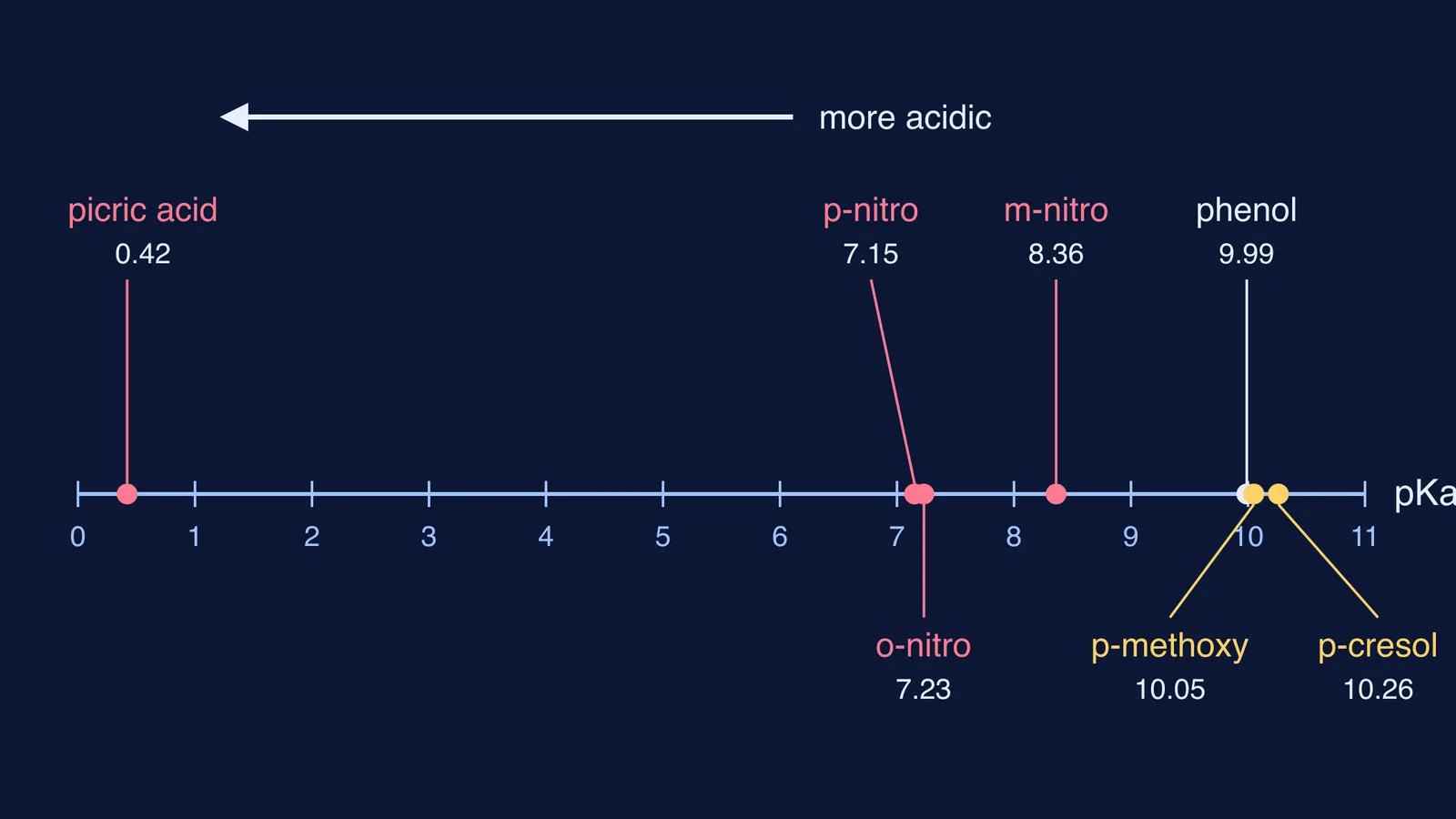
Phenol is a weak acid, but a much stronger one than an alcohol, because once it loses H⁺ the negative charge on the phenoxide oxygen can spread into the benzene ring by resonance. Phenol's pKa is 9.99 at 25 °C, the CRC Handbook value listed on PubChem's phenol record. A lower pKa means a stronger acid, and each pKa unit is a tenfold change in the acid constant Ka.
What decides how acidic a substituted phenol is?
One test settles it: does the substituent stabilise or destabilise the phenoxide ion?
Electron-withdrawing groups (-I, -R), such as -NO₂, spread the negative charge out. The phenoxide is stabilised, so acidity rises.
Electron-donating groups, such as -CH₃ (+I and hyperconjugation) and -OCH₃ at para (+R), push more electron density towards an ion that already carries a negative charge. The phenoxide is destabilised, so acidity falls.
If the -I and +R labels feel shaky, start with our explainer on inductive, resonance and other electronic effects.
Why is p-nitrophenol more acidic than m-nitrophenol?
The pKa of 4-nitrophenol is 7.15 at 25 °C, from the IUPAC compilation by Serjeant and Dempsey cited on PubChem's 4-nitrophenol record. The pKa of 3-nitrophenol is 8.36 in the same compilation, as listed on PubChem's 3-nitrophenol record. That gap of 1.21 pKa units means the para isomer's Ka is about 16 times larger.
The reason is resonance. With the nitro group para (or ortho) to the oxygen, the ring can carry the negative charge onto the nitro-bearing carbon and on to the nitro oxygens, so nitro acts through both -I and -R. At meta, no resonance structure puts the charge there, so only the distance-weakened -I effect helps. As one LibreTexts chapter on substituent effects/16:_Reactions_of_Substituted_Benzenes/16.05:_The_Effect_of_Substituents_on_pKa) puts it, the nitro group's influence is over ten times stronger para than meta, even though meta is closer to the hydroxyl group.
m-Nitrophenol is still more acidic than phenol (8.36 against 9.99): the -I effect is real, just weaker.
Ortho sits just behind para: the pKa of 2-nitrophenol is 7.23 at 25 °C, from the same IUPAC data on PubChem's 2-nitrophenol record. Textbooks usually credit a hydrogen bond between the OH and the neighbouring nitro group, which holds the proton slightly more tightly.
Why are p-cresol and p-methoxyphenol weaker acids than phenol?
The pKa of p-cresol (4-methylphenol) is 10.26, from Pearce and Simkins (1968) as listed on PubChem's p-cresol record. The methyl group donates electron density through +I and hyperconjugation, which makes the phenoxide less stable than in phenol itself.
Methoxy is the trickier case. Its oxygen is electronegative, so it has a -I effect, but its lone pair donates into the ring by +R, and at the para position +R wins. PubChem's 4-methoxyphenol record lists a pKa of 10.05 at 23 °C (Slater and colleagues, 1994), while a LibreTexts chapter on phenols/07%3A_Acid-base_Reactions/7.05%3A_Acid-base_Properties_of_Phenols) gives 10.6. Both are above phenol's.
Position matters: the +R push works from ortho and para, so do not assume every methoxyphenol is weaker than phenol. And because p-cresol and p-methoxyphenol are close and the values vary by source, do not memorise an order between those two.
Why is picric acid so strong?
Picric acid (2,4,6-trinitrophenol) has a pKa of 0.42 at 24 °C, according to the CRC Handbook value on PubChem's picric acid record. That makes its Ka roughly 3.7 billion times larger than phenol's.
All three nitro groups sit where resonance can deliver the negative charge onto them: two ortho and one para. The LibreTexts substituent chapter linked above notes that ortho and para nitro effects add up, so the phenoxide is very stable. For how they get there, see our post on nitration of phenol, nitrophenols and picric acid.
How do you rank substituted phenols in an exam?
Check in this order:
Start from phenol, pKa close to 10.
Label each substituent: does it withdraw electrons or donate them?
Check its position. Ortho and para let resonance act; meta leaves only the inductive effect.
Count the withdrawing groups at ortho and para. More of them means a stronger acid.
Rank: withdrawing at ortho or para, then withdrawing at meta, then phenol, then donating groups.
Worked example. Rank phenol, p-cresol, m-nitrophenol, p-nitrophenol and picric acid, strongest acid first.
Picric acid: three nitro groups at ortho and para, first.
p-Nitrophenol: one nitro group, -I and -R, second.
m-Nitrophenol: one nitro group, -I only, third.
Phenol: the reference.
p-Cresol: electron-donating methyl, last.
Answer: picric acid > p-nitrophenol > m-nitrophenol > phenol > p-cresol. The measured pKa values from the PubChem records above (0.42, 7.15, 8.36, 9.99, 10.26) confirm it.
Our step-by-step method for comparing acidity applies the same conjugate-base test to carboxylic acids and alcohols. For more sets to rank, the Fermi Problem Library has worked problems with a step-by-step solver that explains the reasoning rather than printing an answer. If the gap is the idea of -I versus -R itself, the Fermi Concept Library gives each concept its own lesson.
Try the five-step check on p-cresol and the three nitrophenols tonight, saying each reason out loud.