On this page
N2+ and N2- have the same bond order, so how can one be more stable? Bond order is only the first test. When two species tie, you look at where the electrons sit. Below we work through both molecular orbital (MO) diagrams, then give you a four-step method for O2+, O2- and similar pairs.
Why do N2+ and N2- have the same bond order?
Start by counting. A nitrogen atom has 7 electrons, so N2 has 14, N2+ has 13 and N2- has 15.
Bond order is one half of the difference between the number of electrons in bonding orbitals (Nb) and antibonding orbitals (Na): bond order = ½(Nb − Na), as defined in NCERT Class 11 Chemistry, Chapter 4. The same chapter gives the orbital order for B2, C2 and N2, in which σ2p sits above the two π2p orbitals.
Fill the valence orbitals in that order (the 1s electrons cancel out):
N2, 10 valence electrons: σ2s² σ*2s² π2p⁴ σ2p². Nb = 8, Na = 2, bond order 3.
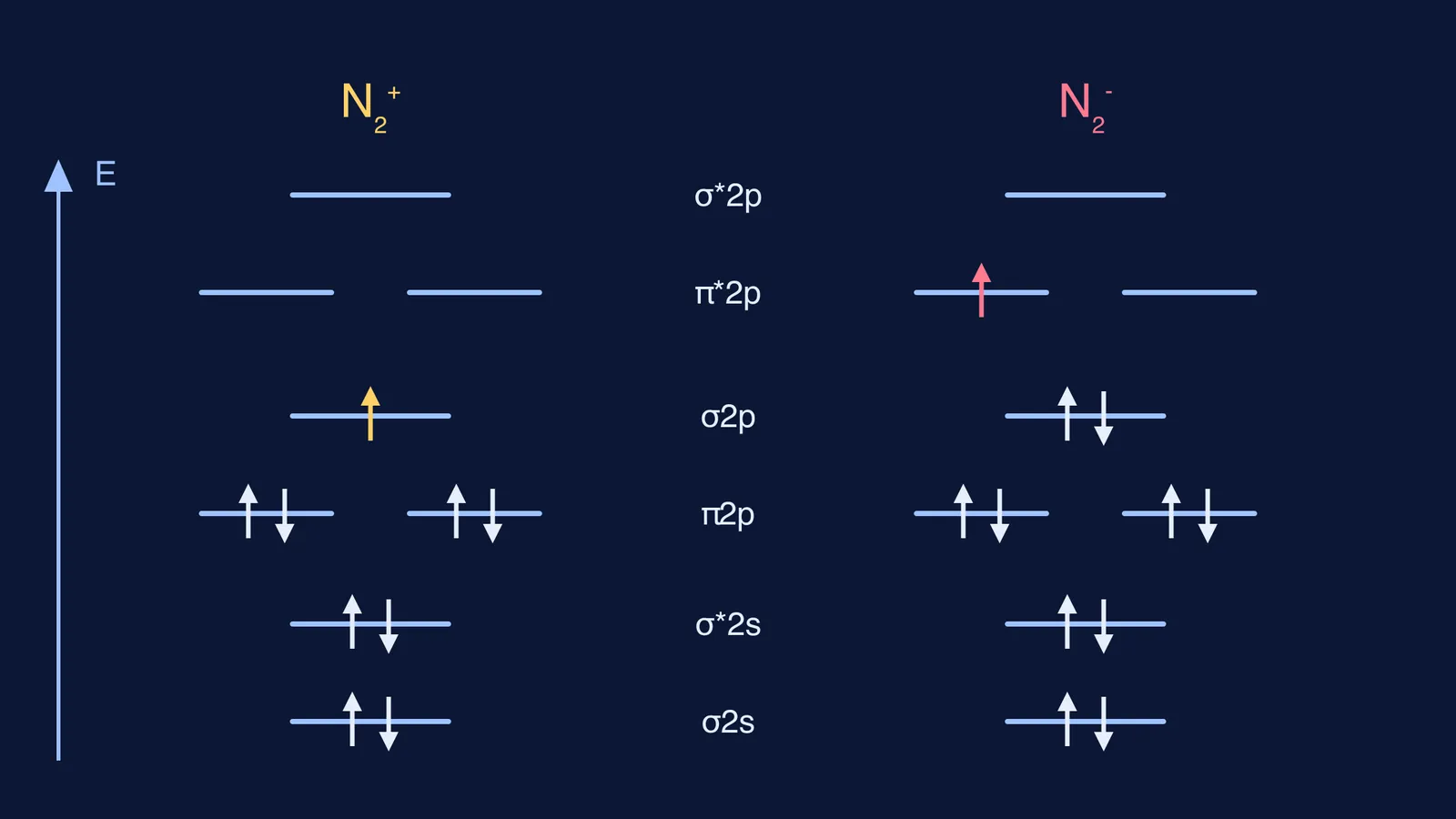
N2+, 9 valence electrons: σ2s² σ*2s² π2p⁴ σ2p¹. Nb = 7, Na = 2, bond order 2.5.
N2-, 11 valence electrons: σ2s² σ*2s² π2p⁴ σ2p² π*2p¹. Nb = 8, Na = 3, bond order 2.5.
N2+ loses a bonding electron; N2- gains an antibonding one. Each costs half a bond.
Which is more stable, N2+ or N2-?
N2+ is more stable. The tie-breaker is the antibonding count: N2- has three antibonding electrons, N2+ has two.
The NCERT chapter explains why: electrons in an antibonding orbital destabilise the molecule, because the repulsion between electrons in that orbital is more than their attraction to the nuclei. N2- carries one more of these electrons.
The measurements agree:
N2+ is a well-characterised ion. The NIST Chemistry WebBook lists its ground-state bond length as 1.11642 Å (NIST, nitrogen cation), only a little longer than the 110 pm (1.10 Å) that NCERT gives for N2.
Free N2- does not last. A 2022 paper in The Journal of Physical Chemistry Letters describes gas-phase N2- as a temporary anion that "only undergoes autodetachment": it throws off the extra electron and becomes N2 again (Gyamfi and Jagau, 2022).
How do you compare O2+ and O2- quickly?
Use the same four steps for any pair of second-period diatomic ions:
Count total electrons. Add one for each minus charge, take away one for each plus charge.
Pick the orbital order. For B2, C2, N2 and their ions, σ2p sits above π2p; for O2 and F2, σ2p sits below π2p (NCERT, Chapter 4).
Fill the orbitals, count Nb and Na, and work out ½(Nb − Na). The higher bond order wins.
If the bond orders tie, the species with fewer antibonding electrons is more stable.
Worked example: O2 has 16 electrons, so O2+ has 15 and O2- has 17. Using the O2 order, the valence filling is σ2s² σ*2s² σ2p² π2p⁴, then the π*2p orbitals.
O2+ has one π* electron: Nb = 8, Na = 3, bond order 2.5.
O2- has three π* electrons: Nb = 8, Na = 5, bond order 1.5.
O2+ wins at step 3, and NIST bond lengths follow the bond orders: 1.1164 Å for O2+ (NIST, O2+), 1.20752 Å for O2 (NIST, O2) and 1.35 Å for O2- (NIST, O2-).
Two checks. First, N2+ and O2+ both have bond order 2.5, and NIST gives them almost the same bond length: 1.11642 Å and 1.1164 Å. Second, O2- is a real, bound ion, unlike N2-: NIST lists a measured electron affinity of 0.448 eV for O2 (NIST, O2 ion energetics), so O2 releases energy when it gains an electron. That is the superoxide ion, covered in oxidation numbers of oxygen in OF2, H2O2 and KO2.
Which other pairs tie on bond order?
Try these before reading the answers:
H2+ and H2-: both 0.5. H2+ has no antibonding electrons; H2- has one. The method picks H2+.
Li2+ and Li2-: both 0.5. Li2+ wins on the tie-breaker.
C2+ and C2-: not a tie. C2+ has bond order 1.5 and C2- has 2.5, because the extra electron goes into bonding σ2p. Here the anion wins, so never assume the cation always does.
Where do students lose marks on these questions?
Stopping at "same bond order, same stability".
Adding an electron for a plus charge, or removing one for a minus charge.
Using the O2 order for N2 ions. The bond order of N2+ is unchanged, but the electron leaves σ2p, not π2p. The same order explains why B2 is paramagnetic and which orbital is the HOMO in Fukui's frontier orbitals.
If you keep slipping on the order of orbitals, work a few of these pairs in the Fermi Problem Library, where the step-by-step solver explains the reasoning rather than printing an answer. For the theory behind σ and π orbitals, the Fermi Concept Library has a lesson on each concept and shows where it fits in the map.
Next time you see a tie in bond order, count the antibonding electrons before you answer.