

On this page
In 1952, Kenichi Fukui and two Kyoto University colleagues, Teijiro Yonezawa and Haruo Shingu, published a short paper in The Journal of Chemical Physics with a surprising claim (Fukui, Yonezawa and Shingu, 1952). To predict where a molecule reacts, you do not need all of its electrons. You mostly need the ones at the top.
That idea became frontier orbital theory, the reason chemistry textbooks talk about HOMO and LUMO.
What is frontier orbital theory?
Frontier orbital theory says that a chemical reaction is steered mainly by two orbitals: the highest occupied molecular orbital (HOMO) of one reactant and the lowest unoccupied molecular orbital (LUMO) of the other (Fukui's Nobel lecture, 1981).
Picture a molecule's orbitals as a stack of energy levels, filled with electron pairs from the bottom up. The HOMO is the top filled level, holding the electrons easiest to give away. The LUMO is the lowest empty level, the cheapest place for incoming electrons. The Nobel Committee's 1981 press release describes them as the orbits of "the most loosely bound electrons" and the "most easily accessible" unoccupied orbits, which Fukui called "frontier orbitals".
When two molecules meet, electrons flow from the HOMO of one into the LUMO of the other. The closer those two levels are in energy, and the better their shapes overlap, the stronger the interaction.
How did Fukui discover that the HOMO controls reactivity?
Fukui began as an experimental chemist. He graduated from Kyoto Imperial University in 1941 and became a professor there in 1951, according to his Nobel autobiography.
His puzzle was naphthalene, two fused benzene rings. Nitration puts the nitro group mainly on the alpha carbon, next to the ring junction, which electron density could not explain, since electrophiles and nucleophiles attacked the same spot, he recalled in his Nobel lecture. So he tried what he called a "slightly unusual" approach: he calculated the distribution of only the electrons in the highest-energy π orbital. The result gave "an almost perfect agreement" with where electrophiles actually attack.
The 1952 paper tested this on fifteen condensed aromatic hydrocarbons and concluded that electrons in the highest occupied orbital, which it named "frontier electrons", are decisive in chemical activation (Crossref record with abstract). His group later found that the lowest vacant orbital plays the same part when a nucleophile attacks, and that both orbitals matter for radicals. These two orbitals were then abbreviated HOMO and LUMO, as the lecture explains.
How do HOMO and LUMO explain the Diels–Alder reaction?
The Diels–Alder reaction joins a diene, such as butadiene, with a dienophile, such as ethene, to make a six-membered ring; here is how Diels and Alder found this ring-closing reaction. In 1964, Fukui pointed out that the symmetries of the HOMO and LUMO of dienes and dienophiles are "extremely favourable" for a concerted cyclic interaction, so both new bonds can form together (Nobel lecture).
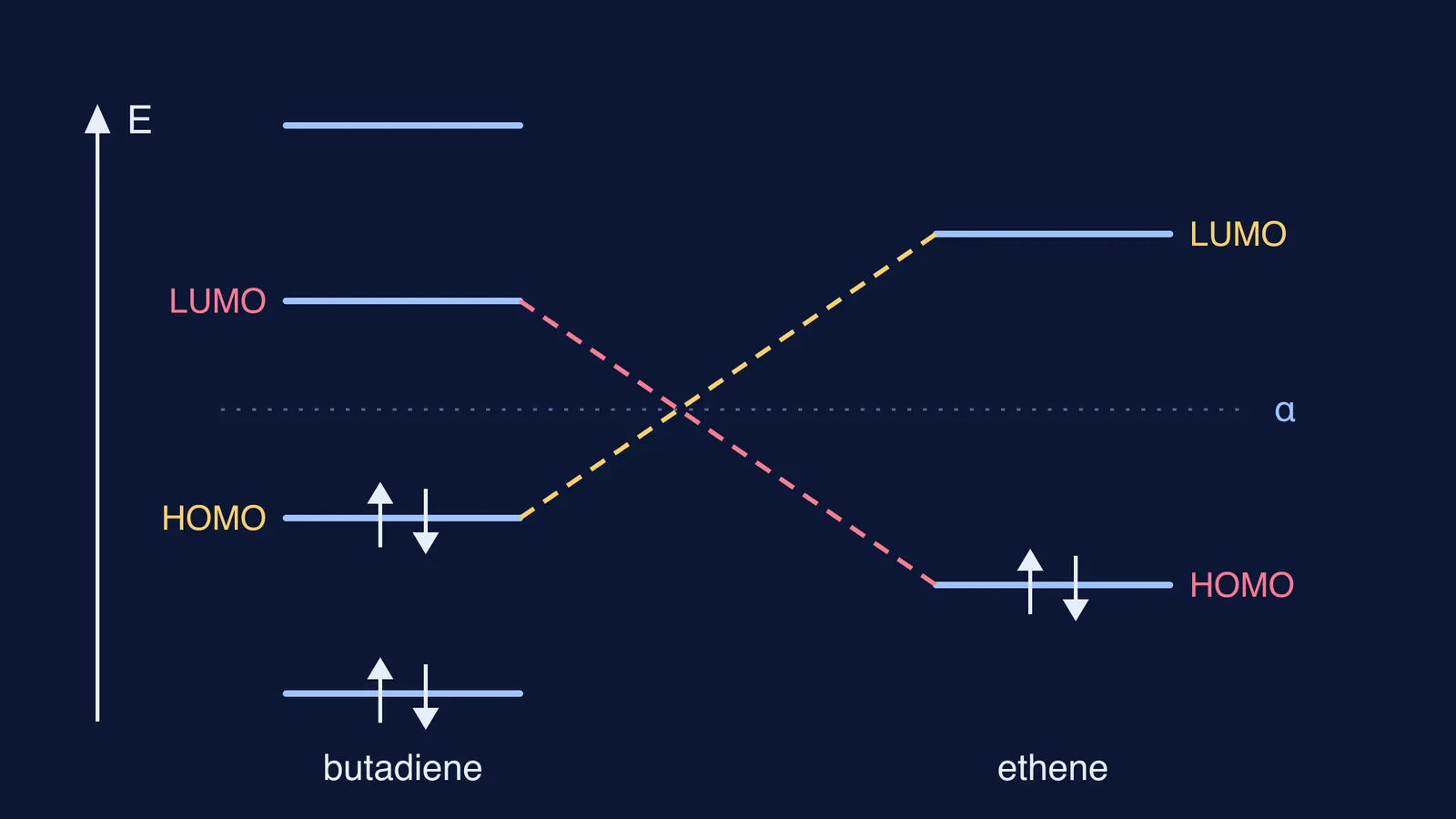
You can run the same check yourself with simple Hückel theory, the method of Erich Hückel, whose 4n + 2 rule for aromatic rings you may already know. In Hückel theory, the butadiene π levels are α + 1.618β, α + 0.618β, α − 0.618β and α − 1.618β, where α and β are negative energies (LibreTexts, Hückel treatment of butadiene/10%3A_Bonding_in_Polyatomic_Molecules/10.06%3A_Butadiene_is_Stabilized_by_a_Delocalization_Energy)). Ethene has one π level at α + β and one π* level at α − β.
A four-step frontier orbital check:
Fill the levels. Butadiene has four π electrons, so its HOMO is α + 0.618β and its LUMO is α − 0.618β. Ethene has two: its HOMO is α + β and its LUMO is α − β.
Pair HOMO with LUMO across the molecules. A common slip is pairing HOMO with HOMO: two filled orbitals give no net bonding.
Compare the gaps. Butadiene HOMO to ethene LUMO is 1.618|β|. Ethene HOMO to butadiene LUMO is also 1.618|β|. When one gap is clearly smaller, that pairing does most of the work.
Check the end lobes. The butadiene HOMO has opposite signs on its two end carbons, and so does the ethene LUMO. Line them up and same sign meets same sign at both ends, so both bonds can start forming at once.
Step 4 is the same in-phase overlap you use for bonding and antibonding molecular orbitals, now applied between two molecules instead of two atoms.
Why did Fukui share the 1981 Nobel Prize with Hoffmann?
The 1981 press release says Fukui's frontier orbital theory "attracted only little attention at first". In the mid-1960s, Fukui and Roald Hoffmann, working independently, showed that frontier orbital symmetry could explain reactions that had been hard to understand; Hoffmann's version, built with Robert Woodward, is called conservation of orbital symmetry.
The 1981 Nobel Prize in Chemistry went jointly to Fukui and Hoffmann "for their theories, developed independently, concerning the course of chemical reactions". Fukui died on 9 January 1998 (Nobel autobiography).
If orbital shapes still feel abstract, the Fermi Concept Library gives each chemistry concept its own lesson and its place in the map, so you can revisit molecular orbitals before tackling reactions.
Next time you see a reaction arrow, look for the frontier: one HOMO, one LUMO, and the overlap between them.


