

On this page
Molecular orbitals come in pairs, one bonding and one antibonding. To tell them apart, check what you can show in an exam answer: where the electrons sit, the energy, and the label. This guide follows the NCERT Class 11 chapter on chemical bonding.
What is the difference between bonding and antibonding orbitals?
When two atomic orbitals combine, two molecular orbitals form: one bonding molecular orbital and one antibonding molecular orbital (NCERT, section 4.7).
The bonding orbital (σ = ψA + ψB) forms by adding the atomic wave functions, and the antibonding orbital (σ* = ψA − ψB) forms by subtracting them (NCERT, section 4.7.1).
Overlap: bonding comes from constructive interference, where the electron waves reinforce each other. Antibonding comes from destructive interference, where they cancel.
Electron density: bonding concentrates it between the nuclei. Antibonding pushes most of it out of that region and leaves a nodal plane of zero density between the nuclei.
Energy: bonding is lower than either parent atomic orbital. Antibonding is higher.
Effect: electrons in a bonding orbital hold the nuclei together. Electrons in an antibonding orbital destabilise the molecule.
Label: bonding orbitals have no star (σ1s, π2px). Antibonding orbitals carry an asterisk (σ*1s, π*2px).
Why does constructive overlap hold atoms together?
NCERT explains that in a bonding orbital the electron density lies between the nuclei, so the repulsion between the nuclei is very small, while an antibonding orbital has a nodal plane between the nuclei, so the repulsion between them is high (NCERT, section 4.7.1).
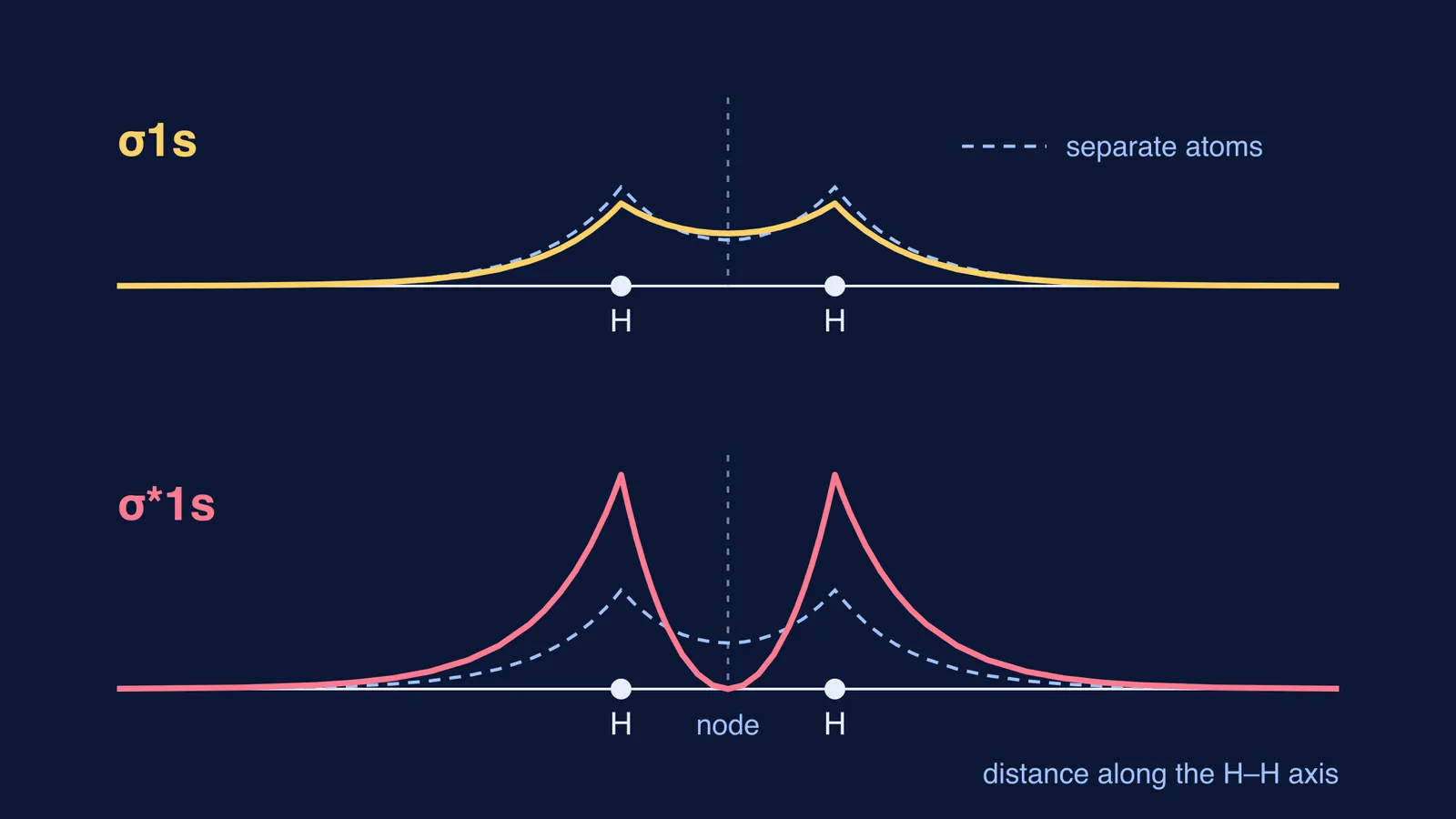
The diagram at the top shows this for hydrogen. In σ1s, the density at the midpoint rises above what two separate atoms would give. In σ*1s, it falls to zero there: that is the node.
Nodes in molecular orbitals come from destructive interference, and generally, the more nodes an orbital has, the higher its energy (LibreTexts inorganic chemistry notes).
Is an antibonding orbital higher in energy than the atomic orbitals?
Yes. NCERT states that a bonding orbital always has lower energy than either atomic orbital that formed it, while the antibonding orbital's energy is raised above them (NCERT, section 4.7.1). The reason given is that the mutual repulsion of the electrons in the antibonding orbital is more than their attraction to the nuclei, so the energy goes up overall.
By how much? NCERT keeps it simple and says the two molecular orbitals together have the same total energy as the two atomic orbitals. More detailed treatments find that the antibonding orbital is raised in energy more than the bonding orbital is lowered (LibreTexts). Write the NCERT version in board answers; the second idea helps explain why filling both orbitals of a pair gives no net bond.
What does the asterisk mean in σ* and π*?
The asterisk marks an antibonding orbital. The Greek letter tells you the shape: σ orbitals are symmetrical around the bond axis and π orbitals are not (NCERT, section 4.7.3). So σ*2pz is antibonding and symmetrical about the axis. A π2px bonding orbital has its electron density above and below the axis, while π*2px has a node between the nuclei.
The 2s and 2p orbitals of two second-period atoms give eight molecular orbitals: four bonding (σ2s, σ2pz, π2px, π2py) and four antibonding (σ*2s, σ*2pz, π*2px, π*2py) (NCERT, section 4.7.4). For when atomic orbitals may combine at all, see the conditions for a linear combination of atomic orbitals.
How do you use bonding and antibonding electrons in a problem?
Bond order is half the difference between the number of electrons in bonding orbitals (Nb) and in antibonding orbitals (Na), so bond order = ½(Nb − Na) (NCERT, section 4.7.5). Unstarred orbitals count towards Nb, starred ones towards Na.
H2: two electrons, both in σ1s. Bond order = ½(2 − 0) = 1. NCERT gives its bond dissociation energy as 438 kJ mol⁻¹ and its bond length as 74 pm (NCERT, section 4.8).
He2: four electrons fill σ1s and σ*1s. Bond order = ½(2 − 2) = 0, so NCERT concludes the molecule is unstable and does not exist (NCERT, section 4.8). See why the He2 molecule has bond order zero.
O2: ten bonding and six antibonding electrons give ½(10 − 6) = 2, a double bond. Two of those antibonding electrons sit unpaired in π*2px and π*2py, so O2 is paramagnetic, which matches experiment (NCERT, section 4.8).
Two slips to avoid:
Thinking antibonding orbitals stay empty. They hold electrons whenever there are enough to fill them, as in He2 and O2.
Putting a node between the nuclei in a π bonding orbital. The node between the nuclei belongs to π*.
If σ and π shapes still feel abstract, the Fermi Concept Library gives every chemistry concept its own lesson and its place in the map, so you can see what molecular orbital theory builds on. To test yourself, the Fermi Problem Library has worked problems with a step-by-step solver that explains the reasoning rather than printing an answer. Next, compare the two big models in valence bond vs molecular orbital theory.


