

On this page
Why does the He2 molecule have a bond order of zero?
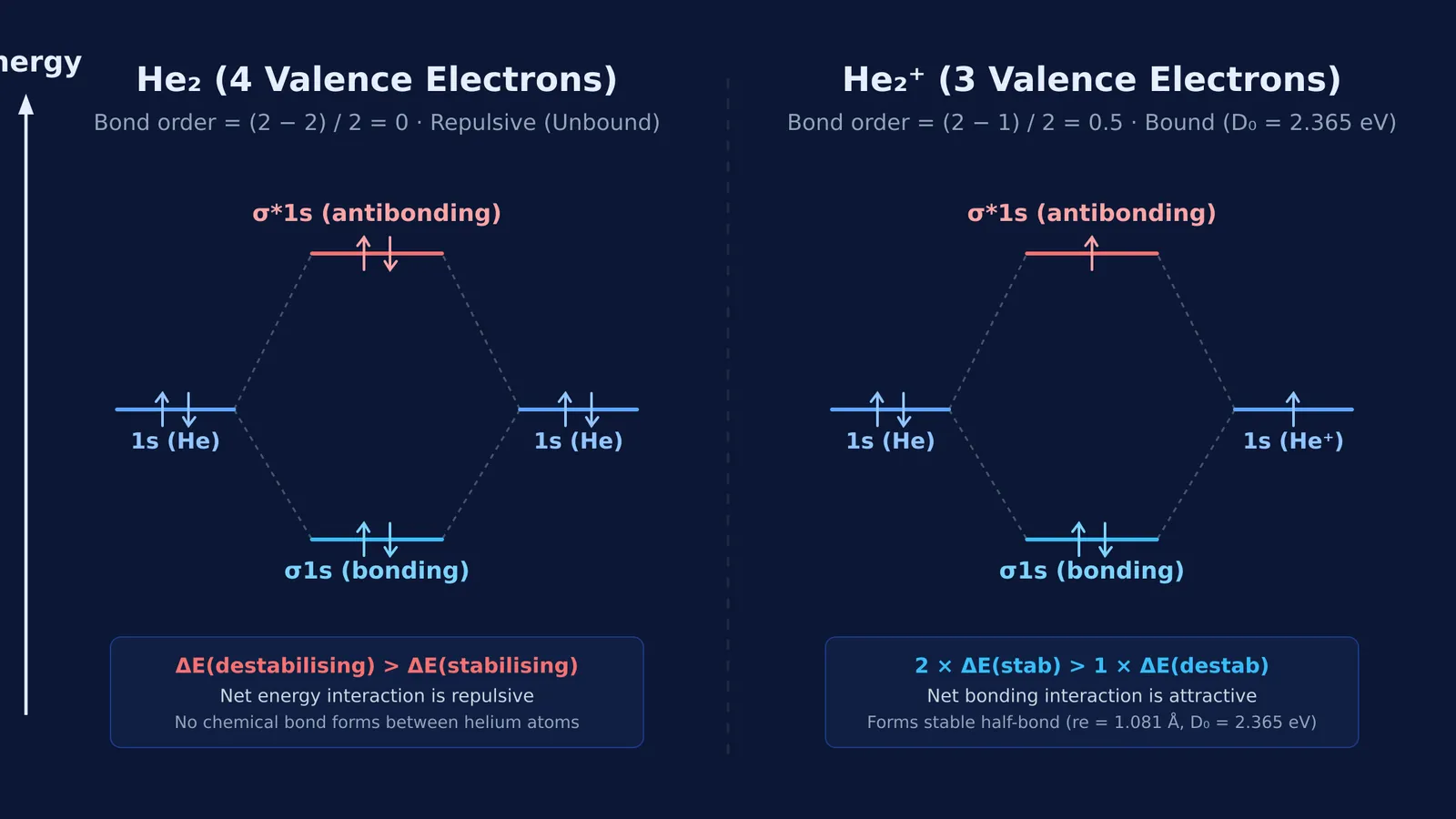
Helium is the simplest element that illustrates why closed-shell noble gases resist forming homonuclear diatomic molecules. An isolated helium atom has the ground-state electron configuration 1s². When two neutral helium atoms approach each other, their 1s atomic orbitals combine under molecular orbital theory into two distinct molecular orbitals: a lower-energy bonding σ1s orbital and a higher-energy antibonding σ*1s orbital.
Following the Aufbau principle and Pauli exclusion principle, the four total electrons fill these orbitals: two pair with opposite spins in the bonding σ1s orbital, and two pair in the antibonding σ*1s orbital. This produces the molecular electron configuration (σ1s)² (σ*1s)².
According to the IUPAC Gold Book definition, bond order measures the net degree of bonding between two atomic centres. In molecular orbital theory, it is calculated as half the difference between the number of bonding electrons (N_b) and antibonding electrons (N_a):
Bond order = (N_b − N_a) / 2 = (2 − 2) / 2 = 0
A bond order of zero indicates that no net covalent bond exists. In dihydrogen (H₂), two electrons occupy only the bonding orbital to create a stable single bond, as explored in sigma and pi orbital overlap. Dihelium instead has equal bonding and antibonding electrons. Robert S. Mulliken developed this framework, receiving the 1966 Nobel Prize in Chemistry (Mulliken, 1967). For visualising how atomic wavefunctions combine, the Fermi Simulation Lab provides interactive simulations for ideas that are easier to see than to read.
Why is the antibonding orbital more destabilising than the bonding orbital?
A common misconception is that a bond order of zero means the helium atoms experience no force. In reality, the interaction between two closed-shell helium atoms at standard bonding distances is actively repulsive.
In the linear combination of atomic orbitals (LCAO) approximation, the spatial overlap integral (S) between the two atomic wavefunctions is strictly positive (S > 0). Because the atomic wavefunctions overlap in space, the resulting energy shifts are asymmetrical:
The energy decrease of the bonding orbital relative to isolated atoms is ΔE_stab = (αS − β) / (1 + S).
The energy increase of the antibonding orbital relative to isolated atoms is ΔE_destab = (αS − β) / (1 − S).
Because (1 − S) is smaller than (1 + S), the destabilisation energy |ΔE_destab| strictly exceeds the stabilisation energy |ΔE_stab|. The antibonding orbital has a nodal plane between the nuclei where electron density drops to zero. This unshields the positively charged helium nuclei, causing mutual repulsion and making the total energy of (σ1s)² (σ*1s)² higher than that of two isolated atoms.
Why can the dihelium cation He2+ exist when He2 cannot?
Removing one electron from the system produces the dihelium molecular cation, He2+. With three electrons, its ground-state molecular orbital configuration is (σ1s)² (σ*1s)¹.
Calculating its bond order yields:
Bond order = (N_b − N_a) / 2 = (2 − 1) / 2 = 0.5
Because the dihelium cation retains two bonding electrons and only one destabilising antibonding electron, net bonding outweighs the antibonding penalty. Spectroscopic constants compiled by Huber and Herzberg in the NIST Chemistry WebBook confirm that the ground state of He2+ (X ²Σ_u⁺) has a measured equilibrium bond length of 1.081 Å (108.1 pm), a harmonic vibrational frequency of 1698.5 cm⁻¹, and a bond dissociation energy of 2.365 eV (approximately 228.2 kJ/mol).
This demonstrates that stable chemical bonds do not require full electron pairs. Much like the odd-electron molecules examined among octet rule exceptions, a fractional bond order of 0.5 is sufficient to produce an experimentally stable molecular ion in electric discharges and mass spectrometers.
Does neutral dihelium ever form in the real world?
While chemical molecular orbital theory confirms that no covalent bond can form, neutral helium atoms experience very faint London dispersion attraction under extreme cryogenic conditions.
In *Physical Review Letters*, researchers detected the helium-4 dimer using transmission grating diffraction (Grisenti et al., 2000). They found that the He2 dimer exists as a fragile quantum halo state with a tiny binding energy of 1.1 mK (approximately 10⁻⁷ eV) and a gigantic mean bond length of 52 ± 4 Å (5,200 pm). Because this distance is forty times larger than standard chemical bonds, the dimer breaks under minimal thermal agitation. In chemistry exams, He2 does not exist because it lacks a covalent bond.
A four-step framework for diatomic stability in JEE and NEET
When solving diatomic problems, use this four-step routine:
Count total electrons: Sum valence electrons and adjust for ionic charge.
Fill molecular orbitals: For 1s diatomics, fill σ1s before σ*1s. For species with 14 or fewer electrons, π2p fills before σ2p.
Calculate bond order: Apply (N_b − N_a) / 2. A bond order of zero means no chemical bond can form; a positive value indicates stability.
Predict properties: Higher bond orders mean greater bond energy and shorter bonds. Unpaired electrons give paramagnetism; paired electrons give diamagnetism.
Applying this sequence to the 1s diatomic series confirms its predictive power:
H2⁺ (1 electron): (σ1s)¹, bond order = 0.5, stable and paramagnetic.
H2 (2 electrons): (σ1s)², bond order = 1.0, stable and diamagnetic.
He2⁺ (3 electrons): (σ1s)² (σ*1s)¹, bond order = 0.5, stable and paramagnetic.
He2 (4 electrons): (σ1s)² (σ*1s)², bond order = 0, unstable and does not exist.
For worked problems on molecular orbital diagrams, bond order calculations, and ion stability, the Fermi Problem Library provides worked problems with a step-by-step solver that explains the reasoning rather than printing an answer. To explore chemical bonding across the broader curriculum, the Fermi Concept Library covers every concept in chemistry, each with its own lesson and its place in the map.


