

On this page
If you draw the Lewis structure of oxygen gas (O₂), you end up with a neat double bond and all electrons paired up. But if you pour liquid oxygen between the poles of a strong magnet, it sticks.
This magnetic attraction, discovered by Michael Faraday in 1847, happens because oxygen actually has two unpaired electrons. It was a puzzle that valence bond theory struggled to explain—until molecular orbital theory offered a radically different picture of how atoms share electrons.
What are the limits of overlapping orbitals?
Valence bond theory, formulated by Walter Heitler and Fritz London in 1927, views a molecule as a collection of separate atoms that happen to overlap. A covalent bond forms when a half-filled orbital from one atom overlaps with a half-filled orbital from another. When these two atomic orbitals merge in space, the two electrons pair up with opposite spins, locking the atoms together.
In this picture, electrons are strictly localised. They sit in the region of space directly between the two bonded nuclei, or they remain on a single atom as a lone pair. It is an excellent theory for visualising molecular shapes and understanding directional bonds. This straightforward, visual nature is why we still use it to teach sp³ hybridisation in carbon, basic molecular geometry, and electron dot structures.
But valence bond theory struggles with molecules where electrons are not confined to a single bond. To explain delocalised electrons, such as the alternating double bonds in a benzene ring, it has to rely on resonance. This involves imagining the molecule rapidly flipping between several different structures, or existing as an average of structures that do not actually exist on their own.
How are electrons spread across the molecule?
In 1928, Robert Mulliken proposed a different approach. Instead of keeping atomic orbitals separate and just overlapping their edges, molecular orbital theory assumes that the original atomic orbitals cease to exist once a molecule forms.
Through a mathematical method called the linear combination of atomic orbitals, the atomic orbitals merge to form completely new molecular orbitals. Instead of belonging to just two atoms, these new orbitals spread out over the entire molecule. The electrons inside them are delocalised, free to move anywhere within the boundaries of the new molecular orbital.
When two atomic orbitals combine, they form two distinct molecular orbitals:
Bonding orbitals: These have lower energy than the original atomic orbitals. Electrons here spend most of their time in the region between the nuclei. Their negative charge pulls the positively charged nuclei together, holding the molecule in a stable state.
Antibonding orbitals: These have higher energy than the original atomic orbitals and feature a node—a region of zero electron density—between the nuclei. Electrons in these orbitals spend their time away from the internuclear region, effectively pulling the atoms apart and weakening the bond.
If you want to explore the mathematical rules governing these orbitals further, the Fermi Concept Library covers every concept in physics, chemistry, biology, mathematics and computing.
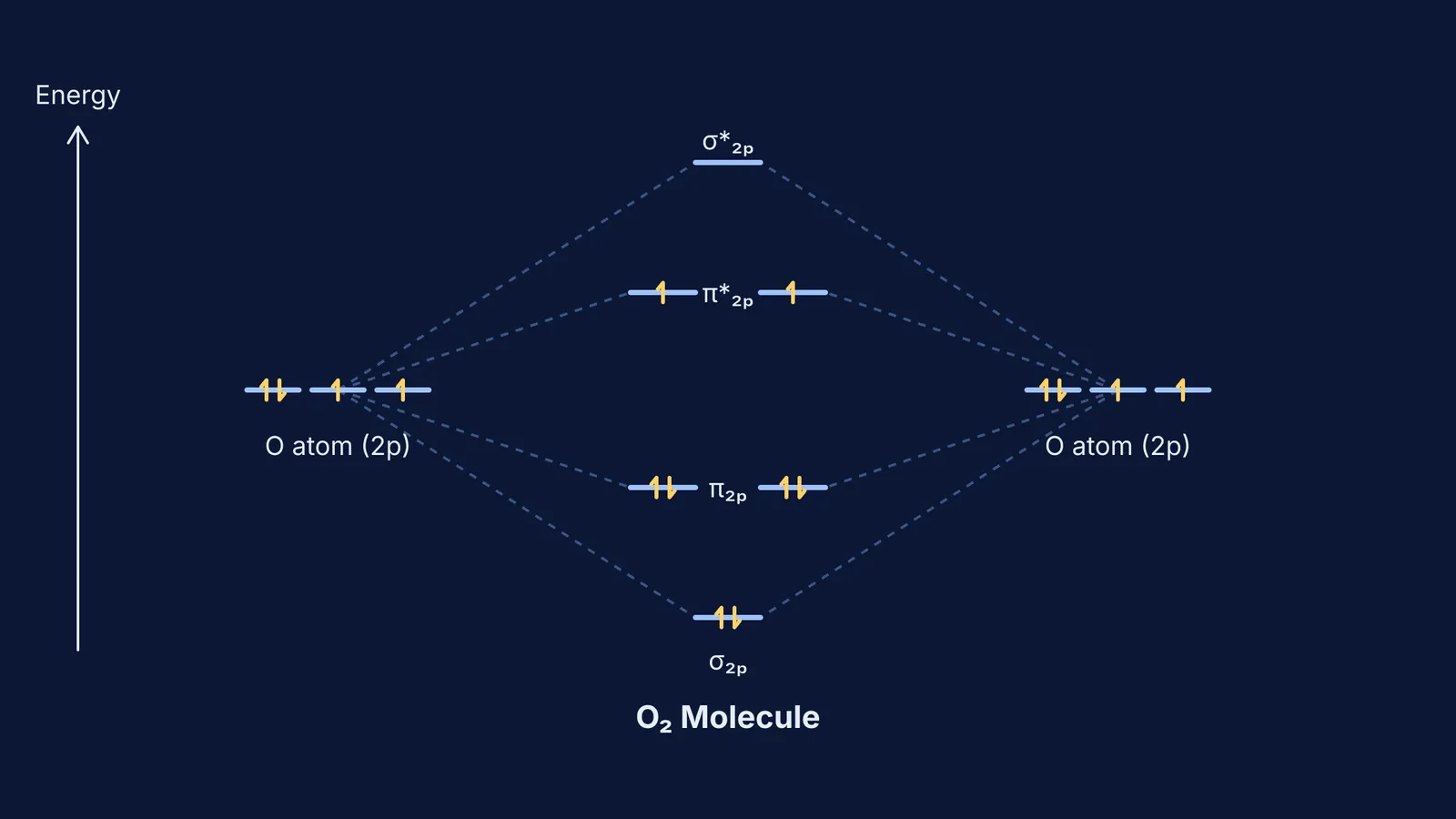
What is the molecular orbital diagram of O₂?
Molecular orbital theory perfectly explains why oxygen is attracted to magnets, a property known as paramagnetism.
An oxygen atom has four valence electrons in its 2p subshell, making a total of eight 2p electrons for the O₂ molecule. When we build the molecule, we fill the available molecular orbitals from the lowest energy up. The first six electrons fill the lower-energy bonding σ₂ₚ and π₂ₚ orbitals, holding the two oxygen atoms together in a strong bond.
This leaves two remaining electrons to place. The next available orbitals are two degenerate π*₂ₚ antibonding orbitals. Degenerate means they sit at the exact same energy level. According to Hund's rule, electrons prefer to occupy degenerate orbitals singly, with parallel spins, before they are forced to pair up in the same orbital. Therefore, the last two electrons go into separate π*₂ₚ orbitals, leaving them completely unpaired.
Those two unpaired electrons give the oxygen molecule its magnetic moment. While valence bond theory incorrectly predicted that all electrons were safely paired up in a standard double bond, molecular orbital theory revealed the hidden unpaired electrons that perfectly matched Faraday's 1847 experimental observations.
Which theory should you use?
You do not have to choose just one, as both theories are standard tools in modern chemistry. Chemists use valence bond theory for a quick, intuitive understanding of molecular geometry, steric hindrance, and single bonds in simple organic molecules. It provides a fast way to draw a molecule on a chalkboard and predict its basic shape.
They switch to molecular orbital theory for complex calculations, interpreting spectroscopy data, and understanding highly delocalised systems like aromatic rings, conjugated polymers, or transition metal complexes. Molecular orbital theory provides the rigorous, system-wide mathematical framework needed for advanced physics and chemistry.
If you get stuck trying to decide which model to apply to a homework question, the Fermi Problem Library features worked problems with a step-by-step solver that explains the reasoning rather than printing an answer.


