

On this page
Molecular Orbital Theory (MOT) moves beyond the idea that electrons are shared strictly between two atoms in a localised bond. Instead, it treats electrons as waves that spread out over the entire molecule. This approach explains phenomena that simpler models cannot, such as why liquid oxygen is paramagnetic and how molecules with odd numbers of electrons remain stable.
What is the Linear Combination of Atomic Orbitals (LCAO)?
The mathematical backbone of MOT is the Linear Combination of Atomic Orbitals (LCAO). Because electrons behave like waves, their wave functions can interfere constructively (adding together) or destructively (cancelling each other out). A 2014 study in Procedia - Social and Behavioral Sciences noted that the abstract, quantum-mechanical nature of MO theory makes it one of the hardest topics for chemistry students to visualise when transitioning from classical Lewis structures.
According to OpenStax Chemistry 2e, this mathematical combination always obeys the conservation of orbitals: combining two atomic orbitals always creates exactly two molecular orbitals. To make sense of it, you only need to remember that atomic orbitals cannot simply mix at random; they follow strict physical rules based on energy and shape.
What are the conditions for linear combination of atomic orbitals?
For atomic orbitals to effectively combine into molecular orbitals, they must meet three strict criteria:
Comparable Energy Levels: Atomic orbitals will only combine effectively if their energies are the same or very similar. When you combine two hydrogen atoms, the 1s orbital of the first atom is at the exact same energy level as the 1s orbital of the second atom, forming stable molecular orbitals. However, a 1s orbital cannot effectively combine with a 2p orbital because the energy gap between them is simply too large. When energies are very close, such as the 2s and 2p orbitals in elements like nitrogen, a phenomenon called s-p mixing can occur, which alters the standard energy level order.
Proper Symmetry: Orbitals must have matching spatial symmetry relative to the internuclear axis (the imaginary line connecting the two nuclei). Without matching symmetry, the wave functions will cancel each other out rather than forming a bond.
Maximum Spatial Overlap: The atoms must be physically close enough for their electron clouds to overlap to a significant extent. The greater the overlap, the stronger and more stable the resulting molecular orbital.
Why do atomic orbitals need proper symmetry to overlap?
Symmetry dictates whether the wave functions will actually interact in a productive way. If we assume the z-axis is the internuclear axis, a 2p_z orbital from one atom can overlap head-on with a 2p_z orbital from another atom to form a strong sigma (σ) bond.
However, a 2p_z orbital cannot combine with a 2p_x or 2p_y orbital. Because they are completely perpendicular to each other, the positive phase of one orbital will exactly cancel out the negative phase of the other, resulting in a net overlap of zero. No bond is formed.
How do bonding and antibonding orbitals differ?
When the conditions for LCAO are met, the orbitals interact in two distinct ways:
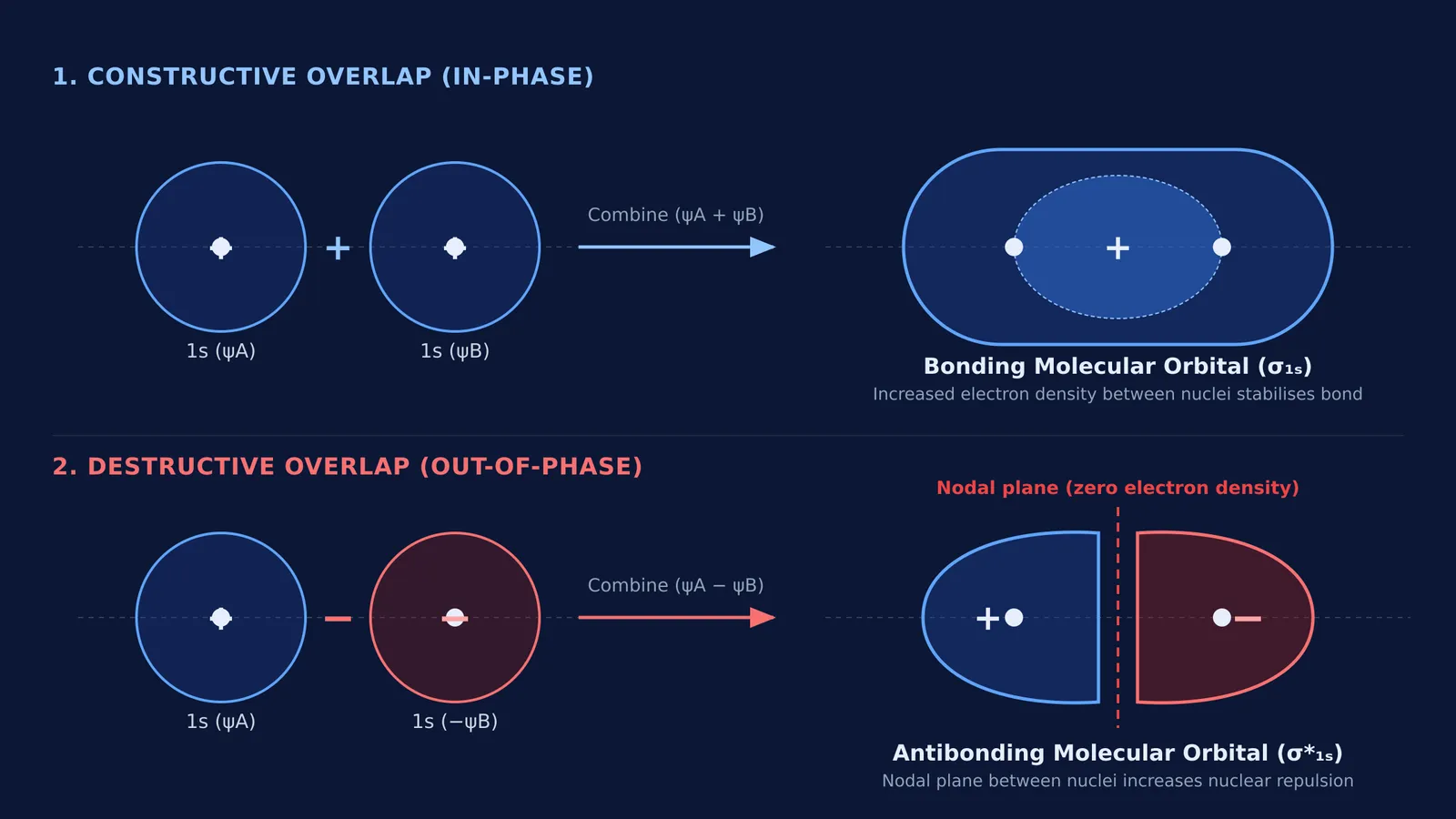
Constructive overlap: When lobes of the same phase mix, they create a bonding molecular orbital. This concentrates electron density between the two nuclei, shielding their positive charges from each other and holding the molecule together like a glue. Electrons in these orbitals stabilise the molecule.
Destructive overlap: When lobes of opposite phases mix, they create an antibonding molecular orbital (usually marked with an asterisk, like σ*). This creates a node—a region of zero electron density—between the nuclei. The positive nuclei are exposed to each other and repel, actively pushing the atoms apart. Electrons in these orbitals destabilise the molecule.
How can students master MO theory without memorisation?
Because MOT is highly theoretical, students often try to survive exams by memorising the energy level ladders without understanding what they mean. A 2021 study in Education Sciences found that combining digital learning environments with concept mapping helps students process and structure these complex orbital diagrams.
Instead of memorising, use this simple checklist whenever you face an MO diagram:
Count the inputs and outputs: Did you put in two atomic orbitals and get exactly two molecular orbitals out? If you start with six 2p orbitals (three from each atom), you must end up with six molecular orbitals.
Check the symmetry: Are you only mixing s with s, or p_z with p_z along the internuclear axis?
Fill from the bottom up: Apply the Aufbau principle, the Pauli exclusion principle, and Hund's rule exactly as you would for single atoms, starting with the lowest-energy bonding orbital and working your way up.
If you want to explore how these rules apply to specific diatomic molecules like O₂ and N₂, the Fermi Concept Library holds a dedicated lesson for every concept in chemistry. You can also explore Molecular orbital theory: bond order and magnetism of O2 and N2 to see the theory in action.


