

On this page
Benzene's extreme stability had puzzled chemists since August Kekulé and the ring structure that explained benzene in 1865. Although Kekulé correctly placed alternating single and double bonds in a hexagon, the molecule resisted the typical addition reactions that other alkenes readily undergo. Instead of breaking its double bonds, benzene preferred substitution reactions that left the ring intact. For decades, classical chemistry struggled to explain why this six-membered ring was so remarkably inert. The answer finally came not from a traditional chemist, but from a physicist applying the newly developed tools of quantum mechanics to molecular structures.
What did Erich Hückel discover in 1931?
In his landmark 1931 paper *Quantentheoretische Beiträge zum Benzolproblem*, published in the journal *Zeitschrift für Physik*, the German physicist and physical chemist Erich Hückel applied Molecular Orbital Theory to the pi electrons of benzene. Unlike earlier approaches that tried to pin down electrons between specific carbon atoms, Hückel treated the electrons as waves spread out over the entire ring.
He calculated the energy levels for these delocalised electrons and found a striking mathematical pattern. For flat, monocyclic systems, the lowest energy level is always a single orbital. Above it, subsequent energy levels appear in degenerate pairs—two orbitals sitting at the exact same energy level.
To achieve maximum stability, a molecule must fill all of its bonding orbitals without leaving any unpaired electrons, creating a "closed-shell" configuration. This is conceptually similar to how noble gases achieve stability by filling their atomic electron shells. Because an orbital holds two electrons, the single lowest level requires two electrons. Each pair of degenerate levels above it requires four electrons. Therefore, perfectly filling these energy levels requires 2, 6, 10, or 14 pi electrons.
How did the 4n+2 rule get its name?
Despite its profound implications, Hückel's quantum mechanical proof was largely ignored by the organic chemistry community for years. The calculations were dense, and organic chemists at the time were largely unfamiliar with the complex language of quantum physics.
The breakthrough that popularised his work came in 1951 when the chemists William von Eggers Doering and Francis L. Detert synthesized tropone (cycloheptatrienylium oxide) and published their findings in the *Journal of the American Chemical Society*. Tropone was a fascinating molecule because it contained a seven-membered ring with three double bonds and a carbonyl group, yet it was exceptionally stable and highly polar.
In explaining this unusual stability, Doering pointed out that if the oxygen atom pulled an electron away from the ring, it left behind a seven-membered ring with exactly six pi electrons. He distilled Hückel's complex orbital symmetry arguments into the simple arithmetic expression 4n + 2, where n is any integer starting from zero. By showing that a seven-membered ring could also be aromatic, Doering definitively proved that aromaticity was a property of electron count, not just six-membered rings. This sparked a global race to synthesise entirely new classes of non-benzenoid aromatic compounds.
How does the Frost circle show the rule?
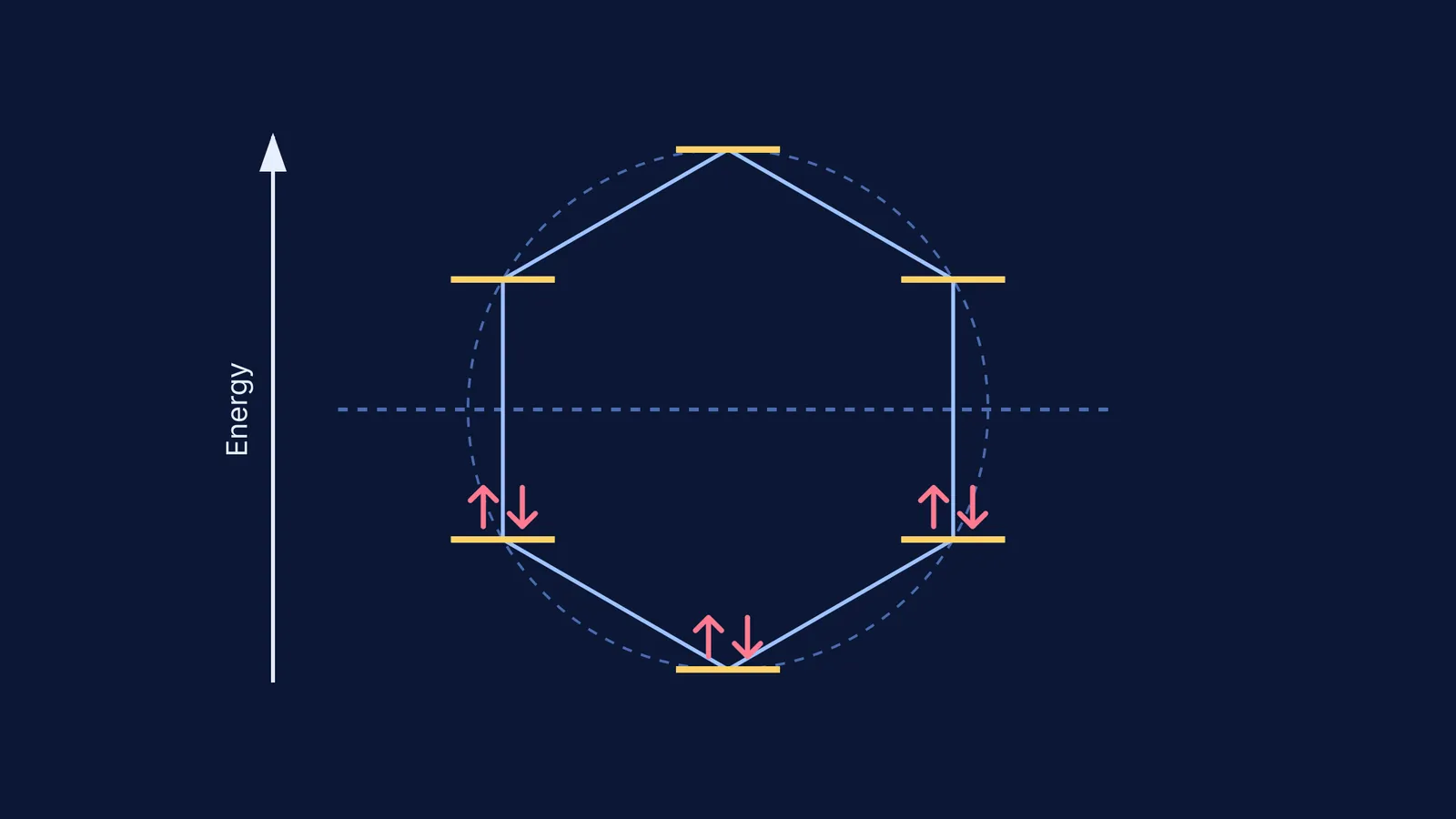
You can see Hückel's math in action without solving any wave equations by using a visual tool called a Frost-Musulin diagram. If you inscribe a regular polygon (representing the molecular ring) inside a circle with one vertex pointing straight down, the height of each vertex exactly matches the energy levels of the pi orbitals.
For a six-membered ring like benzene, the bottom vertex sits at the lowest energy level, which holds two electrons. The two vertices above it sit below the circle's horizontal midline (the non-bonding energy level). Because they are below the midline, they are bonding orbitals. These two degenerate orbitals hold four electrons in total. Filling these three bonding orbitals takes exactly six electrons. In Doering's shorthand, this is the 4n+2 rule for n = 1.
If a ring has four or eight pi electrons, the Frost circle shows that the highest energy electrons will end up sitting unpaired in degenerate orbitals. This violates the closed-shell requirement and creates a highly unstable, antiaromatic compound.
Why is Hückel's rule important?
Today, the 4n+2 rule is a foundational concept in organic chemistry and a non-negotiable part of the JEE and NEET syllabuses. It allows chemists to predict the stability, reactivity, and physical properties of countless molecules before they are even synthesised in a lab.
Aromaticity is not just an academic curiosity; it is a structural pillar of the natural world. The 4n+2 rule governs the planar stability of the DNA bases that carry genetic information, the amino acids that build proteins, and pharmaceutical drugs that rely on flat aromatic rings to bind to cellular receptors.
Understanding this rule is about seeing how the strict mathematical laws of quantum physics scale up to dictate the chemical behaviour of life's essential molecules. If you find drawing the orbitals or deciding which electrons participate in the pi system tricky, Fermi's AI tutor can help you build a plan. The tutor will walk through the molecular configurations with you on the screen, letting you practice until the pattern clicks.


