On this page
Same formula pattern, different products. This classic 'give reasons' question in p-block chemistry comes down to two ideas: which atom in the bond is positive, and whether the central atom has room for one more group.
What are the hydrolysis products of NCl₃ and PCl₃?
Nitrogen trichloride reacts with water to give ammonia and hypochlorous acid: NCl₃ + 3H₂O → NH₃ + 3HOCl (Wikipedia, Nitrogen trichloride).
Phosphorus trichloride reacts vigorously with water to give phosphorous acid and hydrochloric acid: PCl₃ + 3H₂O → H₃PO₃ + 3HCl (Wikipedia, Phosphorus trichloride). That same page notes that PCl₃ smells of HCl because moisture in the air hydrolyses it so quickly.
Both balance with one central atom, 3 Cl, 6 H and 3 O on each side. What differs is where each chlorine ends up.
Why does NCl₃ give NH₃ and HOCl?
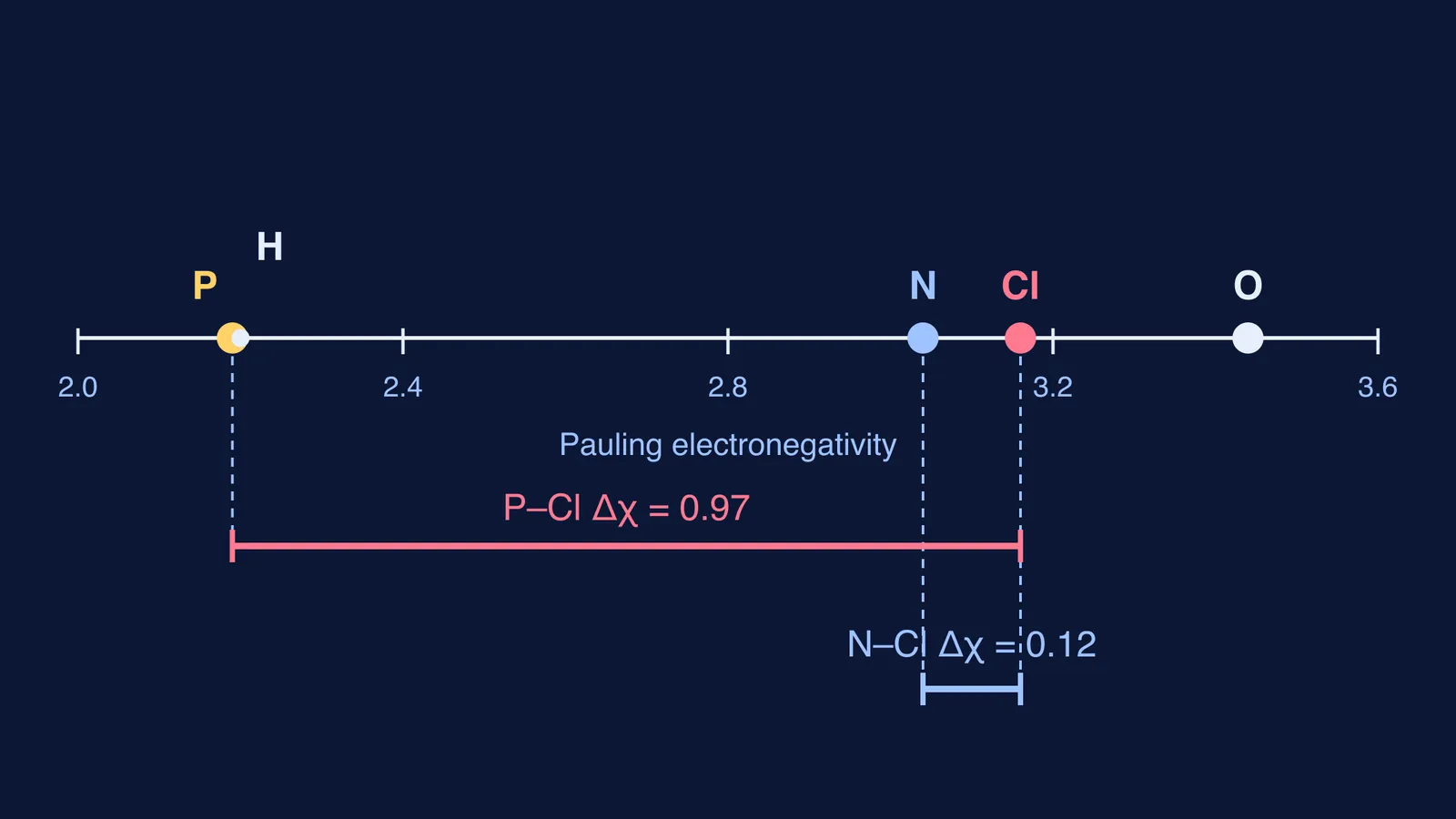
Start with electronegativity. On the Pauling scale, nitrogen is 3.04, chlorine 3.16 and phosphorus 2.19 (Wikipedia data page)). The N–Cl difference is only 0.12, so the N–Cl bond is only weakly polar, and the chlorine carries very little negative charge.
Now look at nitrogen. It is in period 2, so it has only 2s and 2p orbitals and no vacant d orbitals. Its octet is full: three bonds and one lone pair. Water's oxygen has nowhere to attach on nitrogen.
So the reaction goes the other way. Nitrogen's lone pair takes a hydrogen from water, and the leftover OH ends up bonded to chlorine. Each N–Cl bond becomes an N–H bond, and each chlorine leaves as HOCl. Three rounds give NH₃ + 3HOCl.
Why does PCl₃ give H₃PO₃ and HCl?
The P–Cl difference is 3.16 − 2.19 = 0.97 on the same scale, so phosphorus is clearly δ+ and chlorine clearly δ−. Phosphorus is in period 3: it is bigger, and the textbook explanation is that it has vacant 3d orbitals to accept a lone pair.
So water's oxygen attacks phosphorus, a chloride ion leaves and picks up a hydrogen as HCl, and the P–Cl bond becomes P–OH. After three rounds you have P(OH)₃.
P(OH)₃ is not the form you find in the bottle. It is an extremely minor tautomer of HP(O)(OH)₂, which is why phosphorous acid is diprotic, not triprotic: the hydrogen bonded directly to phosphorus does not readily ionise (Wikipedia, Phosphorous acid). For more on that structure, see our post on the oxoacids of phosphorus and sulphur.
Is the vacant d orbital explanation actually right?
It is the explanation most textbooks give and the one exam answers usually expect, so write it. But modern calculations show that phosphorus 3d orbitals are high in energy and overlap poorly, so they play only a negligible part in bonding; the d-orbital model is now regarded mainly as a historical and teaching tool (Wikipedia, Hypervalent molecule).
The ideas that survive are size and polarity. Phosphorus is larger than nitrogen, so it can briefly hold a fifth group, and its P–Cl bonds put a real positive charge on phosphorus for water to attack. Nitrogen is small, its octet is full and its N–Cl bonds are only weakly polar.
How do you predict the hydrolysis products of any covalent halide?
Use this three-question check whenever an exam gives you a halide and water:
Which atom in the bond is δ+? Compare Pauling values. A large gap means the central atom is positive and the halogen leaves as a halide ion.
Can the central atom accept one more group? Period 2 atoms such as nitrogen cannot expand beyond the octet; period 3 and below can.
Where does the halogen end up? If water attacks the central atom, the halogen leaves as HX. If it cannot, the halogen may leave bonded to OH, as HOX.
Worked example, written as a four-line answer to a short-answer question:
Write both balanced equations.
N has no vacant d orbitals and N–Cl is only weakly polar, so water cannot attack N; N's lone pair takes H⁺ and Cl bonds to OH.
P is less electronegative than Cl and can accept water's lone pair (vacant 3d orbitals), so O attacks P and Cl⁻ leaves as HCl.
P(OH)₃ rearranges to HP(O)(OH)₂, written H₃PO₃.
To extend the same logic, read why PCl₅ hydrolysis can stop partway at POCl₃ and our wider guide to the hydrolysis of covalent halides.
If you want to practise this pattern on new halides, the Fermi Problem Library has worked problems with a step-by-step solver that explains the reasoning rather than printing an answer. If the gap is in the idea itself, such as electronegativity or bond polarity, the Fermi Concept Library gives each concept its own lesson.