On this page
If you are revising phosphorus chemistry for school exams or entrance tests, the phosphorus halides turn up as one-line reactions that are easy to mix up. It helps to see them as one idea. Water swaps chlorine for oxygen or OH, and phosphorus keeps its oxidation state the whole way through.
What are the products of partial and complete hydrolysis of PCl5?
Phosphorus pentachloride reacts with water in two stages. Both are set out on the Wikipedia page for phosphorus pentachloride.
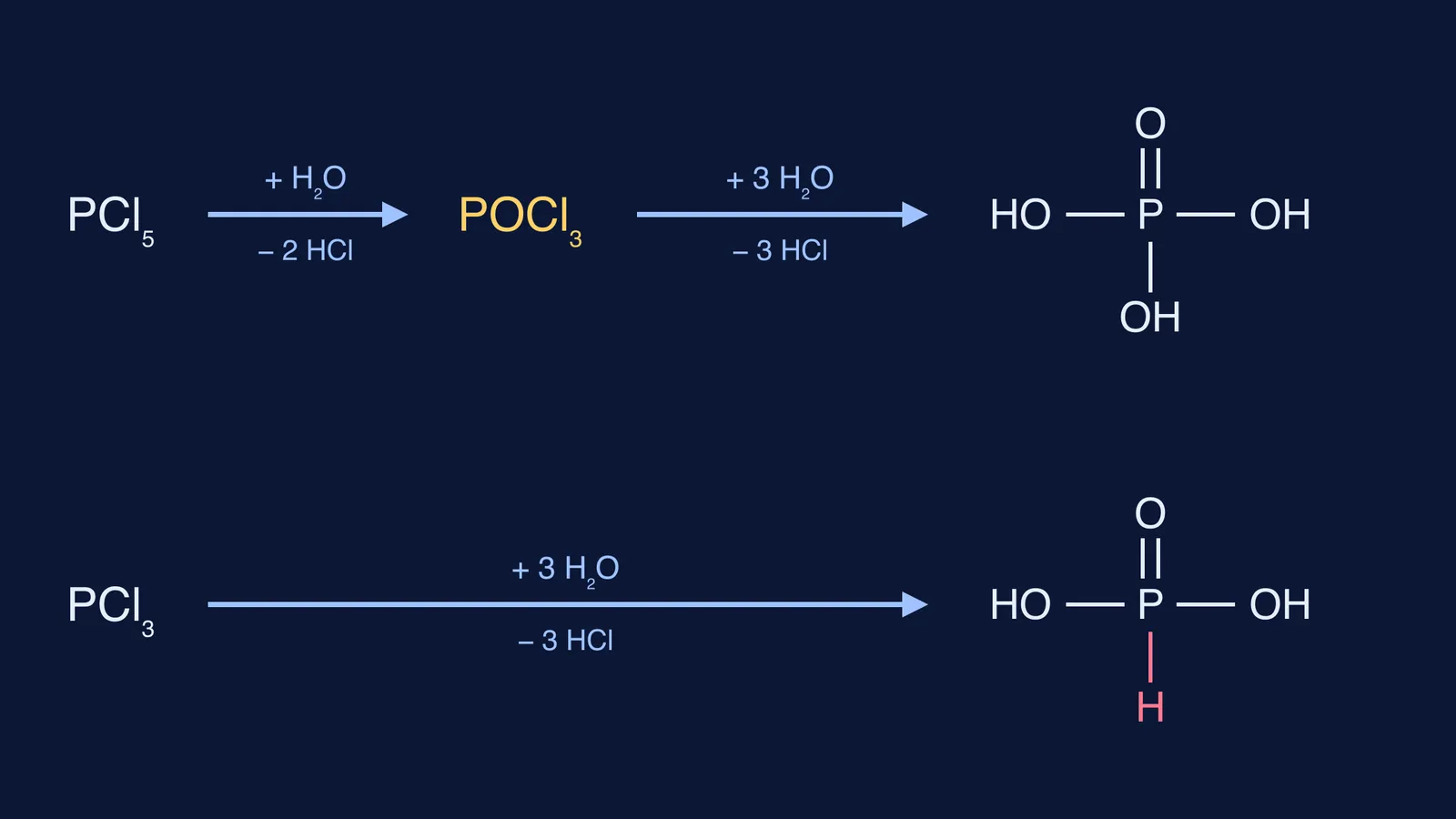
Step 1, partial hydrolysis: PCl5 + H2O → POCl3 + 2HCl. One water molecule replaces two chlorines with one double-bonded oxygen. The product is phosphoryl chloride, also called phosphorus oxychloride.
Step 2, POCl3 keeps reacting: POCl3 + 3H2O → H3PO4 + 3HCl, as shown on the phosphoryl chloride page. Each of the three remaining chlorines is replaced by an OH group.
Add the two steps and POCl3 cancels out: PCl5 + 4H2O → H3PO4 + 5HCl. This is complete hydrolysis, which the PCl5 page says happens in hot water.
So "partial" means you stop at POCl3, and "complete" means you go all the way to orthophosphoric acid. Count the water: one molecule for partial hydrolysis, four in total for complete.
These are not gentle reactions. PubChem, the chemical database of the US National Institutes of Health, describes the reaction of PCl5 with water or steam as a "violent exothermic reaction".
Why does PCl3 give H3PO3 instead of H3PO4?
Phosphorus trichloride has only three chlorines, and water replaces each one: PCl3 + 3H2O → H3PO3 + 3HCl. The product is phosphorous acid (Wikipedia, phosphorus trichloride). PubChem's entry for PCl3 says its reactions with water are also violent.
The products differ because the oxidation states differ. Phosphorus is +5 in PCl5, POCl3 and H3PO4, and +3 in PCl3 and H3PO3. Hydrolysis is not a redox reaction, so phosphorus ends in the same oxidation state it started in. You can check H3PO3 yourself: 3(+1) + x + 3(−2) = 0, so x = +3.
The structure matters here. Phosphorous acid is better written as HPO(OH)2, with one hydrogen bonded directly to phosphorus. According to the phosphorous acid page, it is diprotic, not triprotic as its formula suggests. Only the two O–H hydrogens are acidic. H3PO4 has three O–H groups, so it is tribasic.
How do exams test PCl5 and PCl3 hydrolysis?
Questions often go beyond the bare equation and hide it inside a mole or acid–base calculation. Here is an example of that kind, worked through.
Question: How many moles of NaOH are needed to neutralise all the products when 1 mol of PCl5 is completely hydrolysed? Repeat for 1 mol of PCl3.
Write the complete hydrolysis: PCl5 + 4H2O → H3PO4 + 5HCl.
Count the acidic hydrogens. H3PO4 gives 3 and the 5 HCl give 5, so you need 8 mol of NaOH.
Now write the PCl3 reaction: PCl3 + 3H2O → H3PO3 + 3HCl.
H3PO3 gives only 2, because the P–H hydrogen is not acidic. The 3 HCl give 3, so you need 5 mol of NaOH, not 6.
A tempting wrong answer for PCl3 is 6, which comes from treating H3PO3 like H3PO4. The second trap is in the wording. "Partial hydrolysis" or "with one mole of water" points to POCl3, not H3PO4.
If you keep losing marks on counting steps like these, the Fermi Problem Library has worked problems with a step-by-step solver that explains the reasoning rather than printing an answer. That way you can see exactly where your count went wrong.
What should you check before your chemistry paper?
Partial hydrolysis of PCl5 gives POCl3 + 2HCl and uses one water.
Complete hydrolysis of PCl5 gives H3PO4 + 5HCl and uses four waters in total.
POCl3 is the intermediate, and it hydrolyses to H3PO4 + 3HCl.
PCl3 gives H3PO3 + 3HCl and uses three waters.
H3PO4 is tribasic. H3PO3 is dibasic because one hydrogen sits on phosphorus.
The oxidation state of phosphorus does not change in any of these reactions.
If oxidation states or the basicity of oxoacids still feel shaky, the Fermi Concept Library covers every concept in chemistry, each with its own lesson. Fill that gap first, then come back and rewrite the four equations from memory.