On this page
Open a bottle of silicon tetrachloride in humid air and it fumes. Carbon tetrachloride, the same shape with the element just above silicon in group 14, can be shaken with water and come out unchanged. The difference comes down to one question you can ask of any covalent halide: can a water molecule get its lone pair onto the central atom?
Why does SiCl4 hydrolyse but CCl4 does not?
Hydrolysis of a covalent halide starts when a lone pair on water's oxygen attacks the central atom. Chemguide's page on the group 4 chlorides gives two reasons carbon refuses. Carbon is small and the four chlorines are bulky, so the oxygen cannot easily get at it. And carbon has no convenient empty orbital to accept the lone pair, because there are no 2d orbitals.
Silicon is larger, so there is more room around it, and Chemguide adds that it has empty 3d orbitals to accept a lone pair from water. The same page explains that the oxygen can bond to silicon before a silicon-chlorine bond has to break, which makes the whole process energetically easier. The overall reaction is SiCl4 + 2H2O → SiO2 + 4HCl. The silicon tetrachloride entry on Wikipedia describes the vapour fuming as it reacts with moisture to give an aerosol of silica and hydrochloric acid.
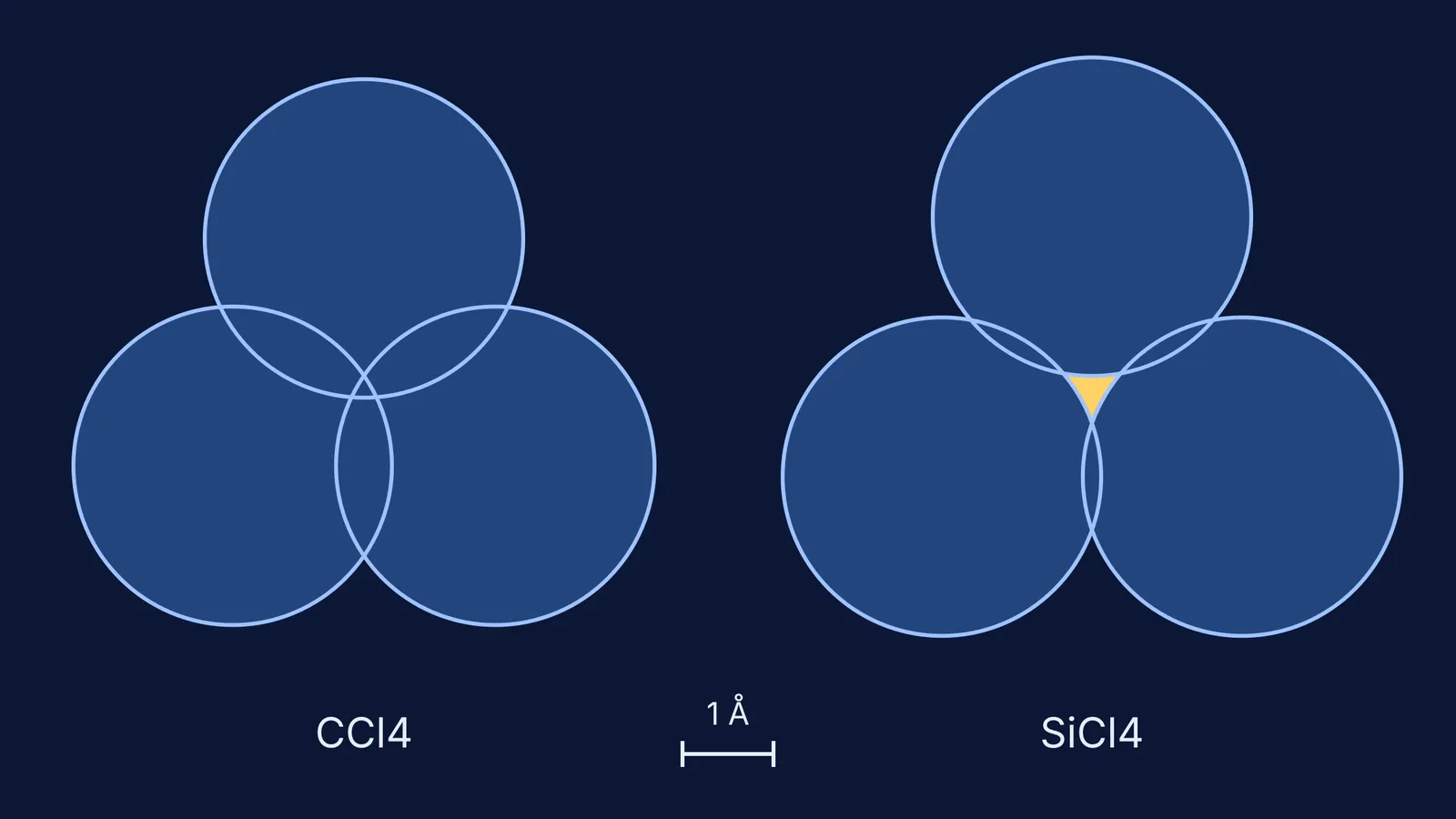
The size difference is measurable. The C-Cl bond in CCl4 is 1.767 Å long (NIST CCCBDB). The Si-Cl bond in SiCl4 is 2.02 Å (Wikipedia). Chlorine's van der Waals radius is 1.75 Å in Bondi's values (Wikipedia). Viewed along a water molecule's line of approach, the three nearest chlorines sit 0.943 times the bond length off-axis: 1.67 Å for carbon, inside the chlorine radius, so they close over it; 1.90 Å for silicon, leaving a small opening, as the diagram shows.
Is it really silicon's empty 3d orbitals?
The usual school answer is that silicon accepts water's lone pair into vacant 3d orbitals. Write that in your exam if your syllabus expects it, but know that it is a simplification. LibreTexts' inorganic chemistry text/03%3A_Simple_Bonding_Theory/3.01%3A_Lewis_Electron-Dot_Diagrams/3.1.02%3A_Breaking_the_octet_rule_with_higher_electron_counts_(hypervalent_atoms)) notes that d orbitals are not involved in bonding in molecules like SF6 any more than in SF4 and SF2.
The idea that survives either way: a period 3 atom such as silicon or phosphorus is big enough to hold a fifth group around it for a moment, and a small period 2 atom with a full octet, like carbon in CCl4, is not.
How do you predict the products of a halide hydrolysis?
Ask three questions, in order.
Can water's oxygen bond to the central atom? It needs an empty orbital (boron in BCl3 has only six electrons around it) or room for a fifth group (silicon, phosphorus). If neither, the central atom resists attack, as in CCl4.
Which atom does water actually end up attacking? Usually the central atom, but check the products for clues, as NCl3 shows below.
Swap every Cl for OH, release one HCl for each, then tidy up. Si(OH)4 loses water to give SiO2; P(OH)3 is written H3PO3; B(OH)3 is boric acid.
What do groups 13, 14 and 15 halides give with water?
BCl3 (group 13): BCl3 + 3H2O → B(OH)3 + 3HCl. It hydrolyses readily, and it is a strong Lewis acid (Wikipedia). Our post on why boric acid is a Lewis acid follows the same empty orbital into the product.
AlCl3 (group 13): in water it gives [Al(H2O)6]3+ and Cl- ions, and the hydrated ion then releases H+, leaving a solution with a pH around 2 to 3 (Chemguide on period 3 chlorides). See why aluminium salt solutions are acidic.
CCl4 (group 14): no reaction.
SiCl4 (group 14): SiCl4 + 2H2O → SiO2 + 4HCl.
NCl3 (group 15): NCl3 + 3H2O → NH3 + 3HOCl, with hot water (Wikipedia).
PCl3 (group 15): PCl3 + 3H2O → H3PO3 + 3HCl (Chemguide).
PCl5 (group 15): with cold water, PCl5 + H2O → POCl3 + 2HCl; with boiling water, PCl5 + 4H2O → H3PO4 + 5HCl (same Chemguide page).
If the word itself trips you up, our explainer on hydration versus hydrolysis separates the two.
How should you practise this?
Cover the list above and try these before checking.
Why does SiCl4 fume in moist air but CCl4 does not?
Write the products of PCl3 with water.
Boron and carbon are both in period 2. Why does BCl3 hydrolyse when CCl4 does not?
Why are the products of NCl3 different in kind from those of PCl3?
If question 3 or 4 stalls you, the gap is usually Lewis acids and electron counting, and the Fermi Concept Library has a lesson for every concept in chemistry, each with its place in the map. For mixed practice, the Fermi Problem Library has worked problems with a step-by-step solver that explains the reasoning rather than printing an answer.