On this page
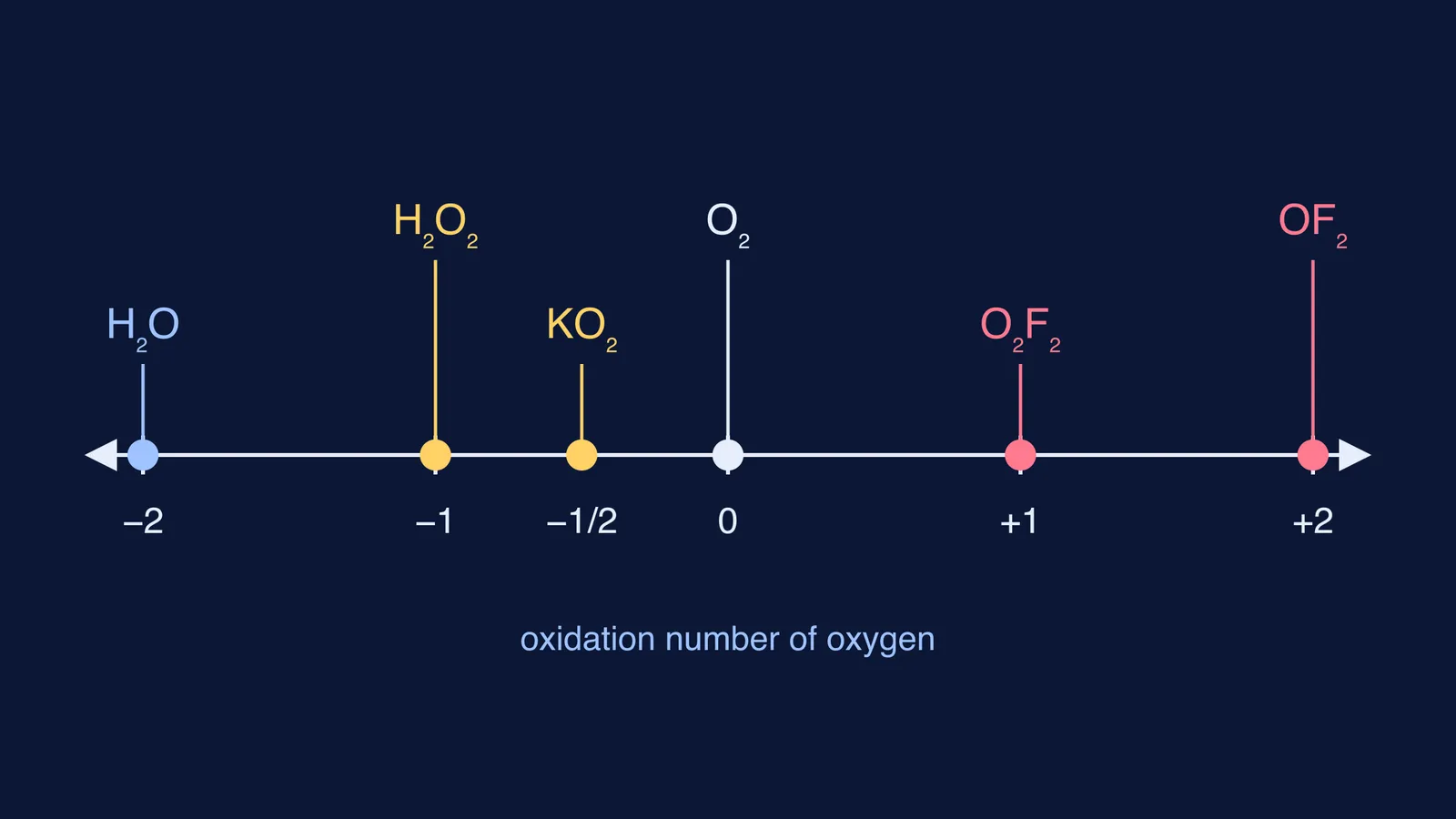
Most of the time you can write −2 for oxygen and move on. NCERT's Class 11 chapter on redox reactions says exactly that, then lists two exceptions: compounds where oxygen atoms are bonded to each other, and compounds where oxygen is bonded to fluorine (NCERT Chemistry Part II, Unit 7). Both come from one idea, so you need not memorise them separately.
What does an oxidation number actually count?
An oxidation number is bookkeeping, not a real charge. NCERT defines it as the oxidation state worked out "on the basis that electron pair in a covalent bond belongs entirely to more electronegative element" (NCERT, Unit 7). IUPAC's 2016 recommendation takes the same approach: oxidation state "is defined using ionic approximation of bonds" (Karen, McArdle and Takats, Pure and Applied Chemistry, 2016).
So for every bond, ask one question: which atom is more electronegative? PubChem's periodic table lists electronegativity values of 3.98 for fluorine, 3.44 for oxygen, 2.2 for hydrogen and 0.82 for potassium (PubChem periodic table). Against hydrogen or a metal, oxygen wins the bond. With two such bonds, as in water, oxygen collects two extra electrons on paper and is −2.
Two cases break that pattern. Either oxygen is bonded to another oxygen, where nobody wins, or it is bonded to fluorine, where oxygen loses.
Why is oxygen +2 in OF2?
Fluorine pulls electrons harder than oxygen does, so in each O–F bond the shared pair is counted as fluorine's. NCERT's rule states that fluorine has an oxidation number of −1 in all its compounds (NCERT, Unit 7).
OF2 is neutral, so its oxidation numbers add up to zero:
Each F is −1, so two F atoms give −2.
O + (−2) = 0.
O = +2.
The same method gives +1 for oxygen in O2F2. There are two O atoms and two F atoms, so 2x − 2 = 0 and x = +1. NCERT lists both values and notes that this exception appears rarely. For why fluorine is so hungry for electrons, see our post on why fluorine is the strongest oxidising agent among the halogens.
Why is oxygen −1 in H2O2 and other peroxides?
Peroxides contain an O–O single bond. In a bond between two identical atoms, neither is more electronegative, so the shared pair is split evenly and the bond adds nothing to either oxygen's count.
Look at H–O–O–H. Each oxygen has one bond to hydrogen, which it wins (one extra electron), and one bond to the other oxygen, which is a draw. One electron gained means −1.
The algebra agrees: 2(+1) + 2x = 0, so x = −1. NCERT gives H2O2 and Na2O2 as peroxides in which each oxygen is −1 (NCERT, Unit 7). Hydrogen peroxide has a history of its own: read how Thénard first made hydrogen peroxide in 1818.
Why is oxygen −1/2 in superoxides like KO2?
KO2 is potassium superoxide. NCERT's rules say alkali metals are +1 in their compounds, and that when a formula has two or more atoms of one element, the oxidation number is the average across those atoms (NCERT, Unit 7).
K = +1.
+1 + 2x = 0.
x = −1/2.
NCERT lists KO2 and RbO2 as superoxides with oxygen at −1/2. The fraction is only an average: one extra negative charge shared between two oxygen atoms, not half an electron sitting on one atom.
How do you spot the exception in an exam question?
Run these checks in order before you write −2:
Is fluorine present? If yes, fluorine is −1 and oxygen may be positive. Solve for it.
Does the other element have a fixed value? Alkali metals are +1, alkaline earth metals +2, and hydrogen is usually +1 (NCERT, Unit 7). Put that in and solve for oxygen.
Read your answer: −2 means an ordinary oxide, −1 a peroxide, −1/2 a superoxide.
If the other element can take several oxidation states, as most transition metals can, the formula alone cannot decide. Use −2 unless the question or the structure shows an O–O bond.
The common trap is a formula that looks like a peroxide but is not. MnO2 has two oxygens per metal atom, but NCERT's worked problem on Stock notation gives manganese +4 in MnO2, so its oxygen is an ordinary −2. BaO2 is different: barium, an alkaline earth metal, is fixed at +2, so 2 + 2x = 0 gives x = −1, a peroxide.
Try four on your own: Na2O2, CsO2, O2F2 and Li2O. (Answers: −1, −1/2, +1, −2.) If one goes wrong, the Fermi Problem Library has worked problems with a step-by-step solver that explains the reasoning rather than printing an answer. If the gap is electronegativity itself, the Fermi Concept Library gives each concept its own lesson and shows where it sits in the map.
To check a whole worksheet, see how to check oxidation numbers in compounds with AI.